Bookhawk PressRead two chapters
Cover of The Turn of the Screw, The Reader’s Companion Edition
The Reader’s Companion Edition

The Turn of the Screw

She’s the only witness. Now you can weigh her word.

James’s complete 1898 text, an introduction and a note before every chapter. You’ll be arguing about it by the last page.

Hardcover US$39.99 · Paperback US$25.99 · Ebook US$15.99

Get my copy · from US$15.99

Gave up on Henry James before? This is the copy that keeps you on track.

Hardcover and paperback ship within 14 days · Late? Cancel for a full refund · Damaged or not as described? Refund or replacement, no return needed

The hardcover includes the ebook; with the paperback, add it for US$4.00. Start reading while your book is printed and shipped.

Why this edition

  • Weigh her word for yourself

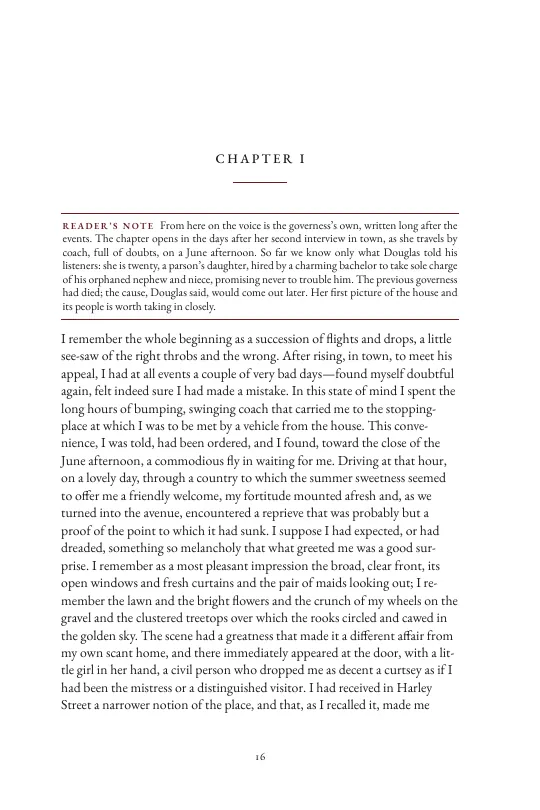
    “So far the evidence is hers alone,” one note reminds you. Before the prologue and every chapter, a note records what the governess saw, what she concluded and what others said. It never tells you what comes next, or what to believe.

  • A question left open, and a way to weigh it

    Readers have argued about it for well over a century. The introduction takes no side. It gives you three things to keep apart (what she sees, what she concludes, what others say) and one tip for his long sentences: try a paragraph aloud.

  • Henry James, finally easy to follow

    Found him hard going before? His sentences wind, pause and turn back on themselves, and that’s where the suspense lives. With a note at every chapter saying where you are and who is there, you won’t lose the thread.

  • A glossary for the words that trip you up

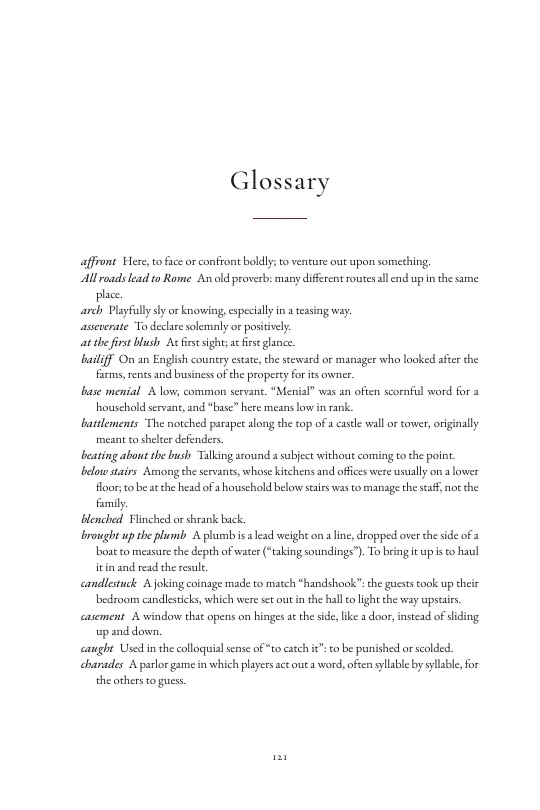
    In Chapter I a “commodious fly” waits for her: a light one-horse carriage, often hired. The glossary’s 116 terms take in words, customs and allusions, from “Laws!” (a softened “Lord!”) to the mystery of Udolpho.

  • Jeered on opening night, then a ghost story

    In January 1895 part of the audience jeered James when he came out to take a bow at his play Guy Domville. A week later he set down the outline of a ghost story the Archbishop of Canterbury had told him. The introduction tells how it grew.

  • All of it, in an evening or two

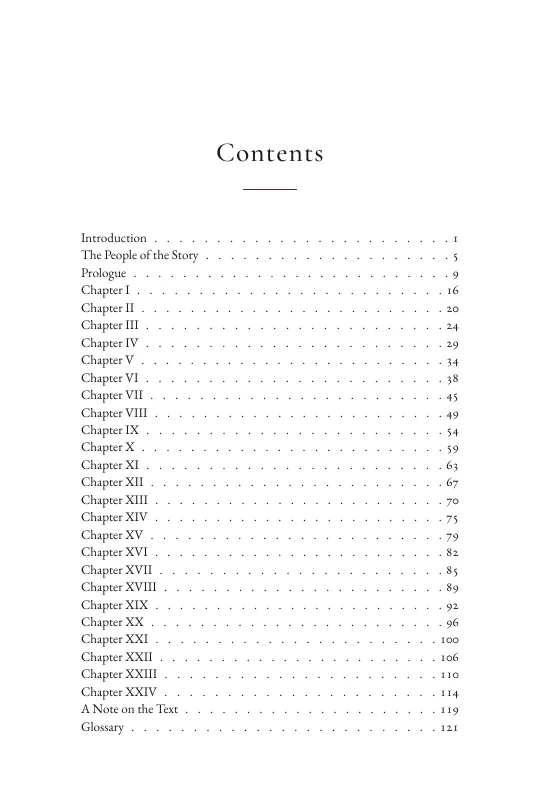
    James’s complete 1898 text: the prologue and all twenty-four chapters, plus a who’s who of 18 entries to keep the names straight, from the guests by the fire to the servants at Bly.

Get my copy · from US$15.99

The same words, with the world behind them

A plain copyThis edition
Chapter after chapter of one woman’s word, and nothing to help you keep track of it.A note before every chapter records what she saw, what she concluded and what others said.
A “commodious fly” waits for her in Chapter I, and you’re left picturing an insect.The glossary: a light one-horse carriage, often hired. One of 116 terms at the back.
James’s long sentences wind and double back, and the page begins to swim.The introduction’s tip: give them time or try a paragraph aloud; the suspense lives in the pauses.
Readers argue about this story, and a plain copy leaves you guessing what the fuss is about.The introduction explains the open question and three things to keep apart. It takes no side.
Names pile up by the fire and at the house, and you flip back to find who’s who.A who’s who of 18 entries, from the ladies of the party to the servants at Bly.

Get my copy · from US$15.99

If you’ve ever given up on Henry James, it wasn’t the ghosts. It was the sentences: long, winding, full of second thoughts, and all from one woman who is the only witness to what she tells. This edition gives you your bearings back. Before the prologue and every chapter, a short reader’s note records what the governess actually saw, what she concluded and what others actually said. It never tells you what is about to happen, and never tells you what to believe. It is the most absorbing way into this story you’ll ever hold.

It opens by the fire on Christmas Eve, where guests trade ghost stories and Douglas promises one to outdo them all: a governess’s manuscript, which he reads aloud. In it, a young woman takes charge of two orphaned children at Bly, a lonely country house, on the strict condition that she never trouble their uncle in London. Then she begins to see figures about the house and grounds that no one else admits to seeing.

What grips is the question nobody can settle, and readers have argued over it for well over a century. The introduction takes no side; it shows you how to weigh her account for yourself. A glossary at the back explains words such as “fly” and customs such as the first post, a who’s who keeps the names straight, and James’s 1898 text is printed as the book gave it. You’ll be arguing about it by the last page.

What’s inside

  • The complete story in the text first published in book form in 1898: the prologue and all twenty-four chapters
  • An introduction for today’s reader: who Henry James was, how the story came to be written, and how to read a tale that reaches us through one woman’s account
  • A short reader’s note before the prologue and every chapter, 25 in all: where we are, who is there, and what has been seen and said so far, never what is about to happen
  • A guide to the people of the story, in 18 entries
  • A glossary of 116 terms: period words, customs, places, phrases and literary allusions

Look inside

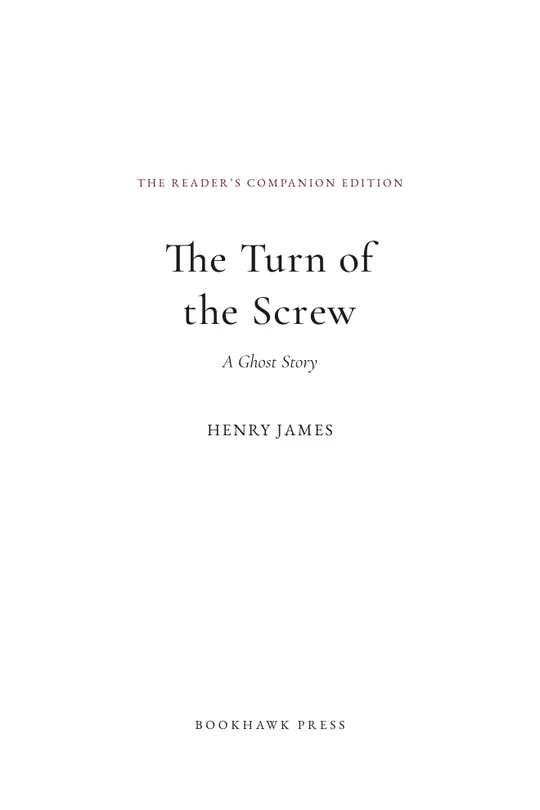
Title page
Title page
Contents
Contents
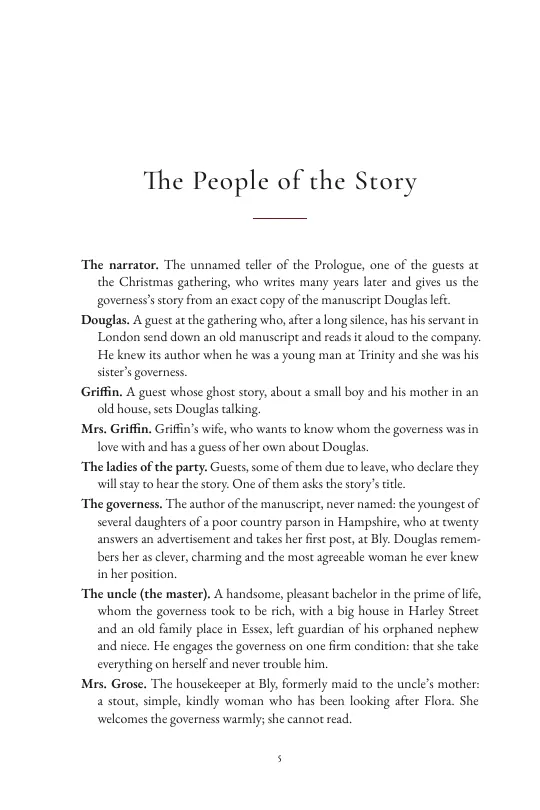
The people of the story
Chapter I, with its reader’s note
The glossary
The glossary

The people of the story

  • The governess. The author of the manuscript, never named: the youngest of several daughters of a poor country parson in Hampshire, who at twenty answers an advertisement and takes her first post, at Bly. Douglas remembers her as clever, charming and the most agreeable woman he ever knew in her position.
  • Mrs. Grose. The housekeeper at Bly, formerly maid to the uncle’s mother: a stout, simple, kindly woman who has been looking after Flora. She welcomes the governess warmly; she cannot read.
  • The uncle (the master). A handsome, pleasant bachelor in the prime of life, whom the governess took to be rich, with a big house in Harley Street and an old family place in Essex, left guardian of his orphaned nephew and niece. He engages the governess on one firm condition: that she take everything on herself and never trouble him.
  • Douglas. A guest at the gathering who, after a long silence, has his servant in London send down an old manuscript and reads it aloud to the company. He knew its author when he was a young man at Trinity and she was his sister’s governess.

Choose your format

Every format includes the reader’s notes, the introduction, the who’s who and the glossary.

The hardcover and paperback editions (illustration)
Format
Ship to

Prices in US dollars. Printed books ship for a flat US$5.99 to the US or US$10.99 to Canada. Ebooks have no shipping charge. US sales tax, if any, is shown before you pay. Internationally fulfilled orders may be subject to customs duties or other import charges.

With tracked shipping, printed books usually arrive about 3 weeks after you order in the US and about 4 weeks in Canada.

Our promise

  • Order today and your hardcover or paperback ships within 14 days, or your ebook is emailed within 5 days. Your confirmation email gives the exact date.
  • Running late? We email you before that date, and you can keep waiting or cancel for a full refund.
  • Arrives damaged or misprinted, or not as this page describes? Email us a photo up to 30 days after delivery for a full refund or a replacement. No need to send it back.
  • Secure checkout by Stripe. Your card details go to Stripe, never to us. Your statement will show BOOKHAWK PRESS.

Shipping · Refunds

See how it works: two chapters from the book

You haven’t read the chapters before these, and you won’t need to. The note above each one tells you where you are and what to watch for. Every chapter in the book opens this way.

Chapter I

I remember the whole beginning as a succession of flights and drops, a little see-saw of the right throbs and the wrong. After rising, in town, to meet his appeal, I had at all events a couple of very bad days—found myself doubtful again, felt indeed sure I had made a mistake. In this state of mind I spent the long hours of bumping, swinging coach that carried me to the stopping-place at which I was to be met by a vehicle from the house. This convenience, I was told, had been ordered, and I found, toward the close of the June afternoon, a commodious fly in waiting for me. Driving at that hour, on a lovely day, through a country to which the summer sweetness seemed to offer me a friendly welcome, my fortitude mounted afresh and, as we turned into the avenue, encountered a reprieve that was probably but a proof of the point to which it had sunk. I suppose I had expected, or had dreaded, something so melancholy that what greeted me was a good surprise. I remember as a most pleasant impression the broad, clear front, its open windows and fresh curtains and the pair of maids looking out; I remember the lawn and the bright flowers and the crunch of my wheels on the gravel and the clustered treetops over which the rooks circled and cawed in the golden sky. The scene had a greatness that made it a different affair from my own scant home, and there immediately appeared at the door, with a little girl in her hand, a civil person who dropped me as decent a curtsey as if I had been the mistress or a distinguished visitor. I had received in Harley Street a narrower notion of the place, and that, as I recalled it, made me think the proprietor still more of a gentleman, suggested that what I was to enjoy might be something beyond his promise.

I had no drop again till the next day, for I was carried triumphantly through the following hours by my introduction to the younger of my pupils. The little girl who accompanied Mrs. Grose appeared to me on the spot a creature so charming as to make it a great fortune to have to do with her. She was the most beautiful child I had ever seen, and I afterwards wondered that my employer had not told me more of her. I slept little that night—I was too much excited; and this astonished me too, I recollect, remained with me, adding to my sense of the liberality with which I was treated. The large, impressive room, one of the best in the house, the great state bed, as I almost felt it, the full, figured draperies, the long glasses in which, for the first time, I could see myself from head to foot, all struck me—like the extraordinary charm of my small charge—as so many things thrown in. It was thrown in as well, from the first moment, that I should get on with Mrs. Grose in a relation over which, on my way, in the coach, I fear I had rather brooded. The only thing indeed that in this early outlook might have made me shrink again was the clear circumstance of her being so glad to see me. I perceived within half an hour that she was so glad—stout, simple, plain, clean, wholesome woman—as to be positively on her guard against showing it too much. I wondered even then a little why she should wish not to show it, and that, with reflection, with suspicion, might of course have made me uneasy.

But it was a comfort that there could be no uneasiness in a connection with anything so beatific as the radiant image of my little girl, the vision of whose angelic beauty had probably more than anything else to do with the restlessness that, before morning, made me several times rise and wander about my room to take in the whole picture and prospect; to watch, from my open window, the faint summer dawn, to look at such portions of the rest of the house as I could catch, and to listen, while, in the fading dusk, the first birds began to twitter, for the possible recurrence of a sound or two, less natural and not without, but within, that I had fancied I heard. There had been a moment when I believed I recognised, faint and far, the cry of a child; there had been another when I found myself just consciously starting as at the passage, before my door, of a light footstep. But these fancies were not marked enough not to be thrown off, and it is only in the light, or the gloom, I should rather say, of other and subsequent matters that they now come back to me. To watch, teach, “form” little Flora would too evidently be the making of a happy and useful life. It had been agreed between us downstairs that after this first occasion I should have her as a matter of course at night, her small white bed being already arranged, to that end, in my room. What I had undertaken was the whole care of her, and she had remained, just this last time, with Mrs. Grose only as an effect of our consideration for my inevitable strangeness and her natural timidity. In spite of this timidity—which the child herself, in the oddest way in the world, had been perfectly frank and brave about, allowing it, without a sign of uncomfortable consciousness, with the deep, sweet serenity indeed of one of Raphael’s holy infants, to be discussed, to be imputed to her and to determine us—I felt quite sure she would presently like me. It was part of what I already liked Mrs. Grose herself for, the pleasure I could see her feel in my admiration and wonder as I sat at supper with four tall candles and with my pupil, in a high chair and a bib, brightly facing me, between them, over bread and milk. There were naturally things that in Flora’s presence could pass between us only as prodigious and gratified looks, obscure and roundabout allusions.

“And the little boy—does he look like her? Is he too so very remarkable?”

One wouldn’t flatter a child. “Oh, Miss, most remarkable. If you think well of this one!”—and she stood there with a plate in her hand, beaming at our companion, who looked from one of us to the other with placid heavenly eyes that contained nothing to check us.

“Yes; if I do——?”

“You will be carried away by the little gentleman!”

“Well, that, I think, is what I came for—to be carried away. I’m afraid, however,” I remember feeling the impulse to add, “I’m rather easily carried away. I was carried away in London!”

I can still see Mrs. Grose’s broad face as she took this in. “In Harley Street?”

“In Harley Street.”

“Well, Miss, you’re not the first—and you won’t be the last.”

“Oh, I’ve no pretension,” I could laugh, “to being the only one. My other pupil, at any rate, as I understand, comes back tomorrow?”

“Not tomorrow—Friday, Miss. He arrives, as you did, by the coach, under care of the guard, and is to be met by the same carriage.”

I forthwith expressed that the proper as well as the pleasant and friendly thing would be therefore that on the arrival of the public conveyance I should be in waiting for him with his little sister; an idea in which Mrs. Grose concurred so heartily that I somehow took her manner as a kind of comforting pledge—never falsified, thank heaven!—that we should on every question be quite at one. Oh, she was glad I was there!

What I felt the next day was, I suppose, nothing that could be fairly called a reaction from the cheer of my arrival; it was probably at the most only a slight oppression produced by a fuller measure of the scale, as I walked round them, gazed up at them, took them in, of my new circumstances. They had, as it were, an extent and mass for which I had not been prepared and in the presence of which I found myself, freshly, a little scared as well as a little proud. Lessons, in this agitation, certainly suffered some delay; I reflected that my first duty was, by the gentlest arts I could contrive, to win the child into the sense of knowing me. I spent the day with her out of doors; I arranged with her, to her great satisfaction, that it should be she, she only, who might show me the place. She showed it step by step and room by room and secret by secret, with droll, delightful, childish talk about it and with the result, in half an hour, of our becoming immense friends. Young as she was, I was struck, throughout our little tour, with her confidence and courage with the way, in empty chambers and dull corridors, on crooked staircases that made me pause and even on the summit of an old machicolated square tower that made me dizzy, her morning music, her disposition to tell me so many more things than she asked, rang out and led me on. I have not seen Bly since the day I left it, and I dare say that to my older and more informed eyes it would now appear sufficiently contracted. But as my little conductress, with her hair of gold and her frock of blue, danced before me round corners and pattered down passages, I had the view of a castle of romance inhabited by a rosy sprite, such a place as would somehow, for diversion of the young idea, take all colour out of storybooks and fairy-tales. Wasn’t it just a storybook over which I had fallen a-doze and a-dream? No; it was a big, ugly, antique, but convenient house, embodying a few features of a building still older, half replaced and half utilised, in which I had the fancy of our being almost as lost as a handful of passengers in a great drifting ship. Well, I was, strangely, at the helm!

Chapter III

Her thus turning her back on me was fortunately not, for my just preoccupations, a snub that could check the growth of our mutual esteem. We met, after I had brought home little Miles, more intimately than ever on the ground of my stupefaction, my general emotion: so monstrous was I then ready to pronounce it that such a child as had now been revealed to me should be under an interdict. I was a little late on the scene, and I felt, as he stood wistfully looking out for me before the door of the inn at which the coach had put him down, that I had seen him, on the instant, without and within, in the great glow of freshness, the same positive fragrance of purity, in which I had, from the first moment, seen his little sister. He was incredibly beautiful, and Mrs. Grose had put her finger on it: everything but a sort of passion of tenderness for him was swept away by his presence. What I then and there took him to my heart for was something divine that I have never found to the same degree in any child—his indescribable little air of knowing nothing in the world but love. It would have been impossible to carry a bad name with a greater sweetness of innocence, and by the time I had got back to Bly with him I remained merely bewildered—so far, that is, as I was not outraged—by the sense of the horrible letter locked up in my room, in a drawer. As soon as I could compass a private word with Mrs. Grose I declared to her that it was grotesque.

Continue reading

She promptly understood me. “You mean the cruel charge——?”

“It doesn’t live an instant. My dear woman, look at him!”

She smiled at my pretension to have discovered his charm. “I assure you, Miss, I do nothing else! What will you say, then?” she immediately added.

“In answer to the letter?” I had made up my mind. “Nothing.”

“And to his uncle?”

I was incisive. “Nothing.”

“And to the boy himself?”

I was wonderful. “Nothing.”

She gave with her apron a great wipe to her mouth. “Then I’ll stand by you. We’ll see it out.”

“We’ll see it out!” I ardently echoed, giving her my hand to make it a vow.

She held me there a moment, then whisked up her apron again with her detached hand. “Would you mind, Miss, if I used the freedom——”

“To kiss me? No!” I took the good creature in my arms and, after we had embraced like sisters, felt still more fortified and indignant.

This, at all events, was for the time: a time so full that, as I recall the way it went, it reminds me of all the art I now need to make it a little distinct. What I look back at with amazement is the situation I accepted. I had undertaken, with my companion, to see it out, and I was under a charm, apparently, that could smooth away the extent and the far and difficult connections of such an effort. I was lifted aloft on a great wave of infatuation and pity. I found it simple, in my ignorance, my confusion, and perhaps my conceit, to assume that I could deal with a boy whose education for the world was all on the point of beginning. I am unable even to remember at this day what proposal I framed for the end of his holidays and the resumption of his studies. Lessons with me, indeed, that charming summer, we all had a theory that he was to have; but I now feel that, for weeks, the lessons must have been rather my own. I learnt something—at first certainly—that had not been one of the teachings of my small, smothered life; learnt to be amused, and even amusing, and not to think for the morrow. It was the first time, in a manner, that I had known space and air and freedom, all the music of summer and all the mystery of nature. And then there was consideration—and consideration was sweet. Oh, it was a trap—not designed, but deep—to my imagination, to my delicacy, perhaps to my vanity; to whatever, in me, was most excitable. The best way to picture it all is to say that I was off my guard. They gave me so little trouble—they were of a gentleness so extraordinary. I used to speculate—but even this with a dim disconnectedness—as to how the rough future (for all futures are rough!) would handle them and might bruise them. They had the bloom of health and happiness; and yet, as if I had been in charge of a pair of little grandees, of princes of the blood, for whom everything, to be right, would have to be enclosed and protected, the only form that, in my fancy, the after-years could take for them was that of a romantic, a really royal extension of the garden and the park. It may be, of course, above all, that what suddenly broke into this gives the previous time a charm of stillness—that hush in which something gathers or crouches. The change was actually like the spring of a beast.

In the first weeks the days were long; they often, at their finest, gave me what I used to call my own hour, the hour when, for my pupils, tea-time and bed-time having come and gone, I had, before my final retirement, a small interval alone. Much as I liked my companions, this hour was the thing in the day I liked most; and I liked it best of all when, as the light faded—or rather, I should say, the day lingered and the last calls of the last birds sounded, in a flushed sky, from the old trees—I could take a turn into the grounds and enjoy, almost with a sense of property that amused and flattered me, the beauty and dignity of the place. It was a pleasure at these moments to feel myself tranquil and justified; doubtless, perhaps, also to reflect that by my discretion, my quiet good sense and general high propriety, I was giving pleasure—if he ever thought of it!—to the person to whose pressure I had responded. What I was doing was what he had earnestly hoped and directly asked of me, and that I could, after all, do it proved even a greater joy than I had expected. I dare say I fancied myself, in short, a remarkable young woman and took comfort in the faith that this would more publicly appear. Well, I needed to be remarkable to offer a front to the remarkable things that presently gave their first sign.

It was plump, one afternoon, in the middle of my very hour: the children were tucked away and I had come out for my stroll. One of the thoughts that, as I don’t in the least shrink now from noting, used to be with me in these wanderings was that it would be as charming as a charming story suddenly to meet someone. Someone would appear there at the turn of a path and would stand before me and smile and approve. I didn’t ask more than that—I only asked that he should know; and the only way to be sure he knew would be to see it, and the kind light of it, in his handsome face. That was exactly present to me—by which I mean the face was—when, on the first of these occasions, at the end of a long June day, I stopped short on emerging from one of the plantations and coming into view of the house. What arrested me on the spot—and with a shock much greater than any vision had allowed for—was the sense that my imagination had, in a flash, turned real. He did stand there!—but high up, beyond the lawn and at the very top of the tower to which, on that first morning, little Flora had conducted me. This tower was one of a pair—square, incongruous, crenelated structures—that were distinguished, for some reason, though I could see little difference, as the new and the old. They flanked opposite ends of the house and were probably architectural absurdities, redeemed in a measure indeed by not being wholly disengaged nor of a height too pretentious, dating, in their gingerbread antiquity, from a romantic revival that was already a respectable past. I admired them, had fancies about them, for we could all profit in a degree, especially when they loomed through the dusk, by the grandeur of their actual battlements; yet it was not at such an elevation that the figure I had so often invoked seemed most in place.

It produced in me, this figure, in the clear twilight, I remember, two distinct gasps of emotion, which were, sharply, the shock of my first and that of my second surprise. My second was a violent perception of the mistake of my first: the man who met my eyes was not the person I had precipitately supposed. There came to me thus a bewilderment of vision of which, after these years, there is no living view that I can hope to give. An unknown man in a lonely place is a permitted object of fear to a young woman privately bred; and the figure that faced me was—a few more seconds assured me—as little anyone else I knew as it was the image that had been in my mind. I had not seen it in Harley Street—I had not seen it anywhere. The place, moreover, in the strangest way in the world, had, on the instant, and by the very fact of its appearance, become a solitude. To me at least, making my statement here with a deliberation with which I have never made it, the whole feeling of the moment returns. It was as if, while I took in—what I did take in—all the rest of the scene had been stricken with death. I can hear again, as I write, the intense hush in which the sounds of evening dropped. The rooks stopped cawing in the golden sky and the friendly hour lost, for the minute, all its voice. But there was no other change in nature, unless indeed it were a change that I saw with a stranger sharpness. The gold was still in the sky, the clearness in the air, and the man who looked at me over the battlements was as definite as a picture in a frame. That’s how I thought, with extraordinary quickness, of each person that he might have been and that he was not. We were confronted across our distance quite long enough for me to ask myself with intensity who then he was and to feel, as an effect of my inability to say, a wonder that in a few instants more became intense.

The great question, or one of these, is, afterwards, I know, with regard to certain matters, the question of how long they have lasted. Well, this matter of mine, think what you will of it, lasted while I caught at a dozen possibilities, none of which made a difference for the better, that I could see, in there having been in the house—and for how long, above all?—a person of whom I was in ignorance. It lasted while I just bridled a little with the sense that my office demanded that there should be no such ignorance and no such person. It lasted while this visitant, at all events,—and there was a touch of the strange freedom, as I remember, in the sign of familiarity of his wearing no hat,—seemed to fix me, from his position, with just the question, just the scrutiny through the fading light, that his own presence provoked. We were too far apart to call to each other, but there was a moment at which, at shorter range, some challenge between us, breaking the hush, would have been the right result of our straight mutual stare. He was in one of the angles, the one away from the house, very erect, as it struck me, and with both hands on the ledge. So I saw him as I see the letters I form on this page; then, exactly, after a minute, as if to add to the spectacle, he slowly changed his place—passed, looking at me hard all the while, to the opposite corner of the platform. Yes, I had the sharpest sense that during this transit he never took his eyes from me, and I can see at this moment the way his hand, as he went, passed from one of the crenelations to the next. He stopped at the other corner, but less long, and even as he turned away still markedly fixed me. He turned away; that was all I knew.

Enjoyed Chapter III? Get the whole book.

That’s how every chapter in this edition works: a short note, then the chapter itself. All twenty-four of them, and the Prologue too.

Hardcover US$39.99 · Paperback US$25.99 · Ebook US$15.99

Get my copy · from US$15.99

Not ready yet? Get Chapters IV and V free by email

Chapters IV and V, each with its reader’s note. They pick up straight after Chapter III: the governess tells no one what she saw on the tower, until one wet Sunday, before evening church, she steps into the dining-room for a pair of gloves (PDF, 13 pages).

We’ll email the sample whether or not you tick the box. Sent by Bookhawk Press (Space Dog Tech LLC), 411 Walnut St, PMB 22412, Green Cove Springs, FL 32043, USA · support@bookhawkpress.com. Privacy

Questions

Isn’t Henry James hard going for a modern reader?
Less than you’d think, with this edition beside you. His sentences are long and winding, and the introduction’s advice works: give them time, or try a paragraph aloud, as Douglas reads the manuscript to his friends. Much of the suspense lives in their hesitations. And the reader’s note before every chapter tells you where you are, who is there and what has been seen and said so far, so you keep your bearings.
Which text is this, and is it complete?
It’s the complete story, in the text first published in book form in 1898 (in The Two Magics, New York): the prologue and all twenty-four chapters. James’s words are printed as that book gives them. James revised the story again for the New York Edition of 1908; this is the book text its first readers met. Covering End, the other story in the 1898 volume, is not included.
Do the reader’s notes give anything away?
They never tell you what is about to happen, and they never tell you what to believe. Each note, about a hundred words, says where we are and when, and keeps track of what has been seen and said so far: what the governess actually saw, what she concluded and what others actually said. A note may recall what earlier pages have already told you, or point to what’s worth weighing: “Whenever Mrs. Grose answers, one may ask what exactly she said, and what the governess heard.”
Does this edition tell me whether the ghosts are real?
No. James leaves the question open, and readers have argued about it for well over a century. The governess is the only witness, and the introduction shows you how to weigh her account: keep apart what she actually sees, what she concludes and what others actually say. The edition takes no side and never tells you what to believe.
Does it suit a book club or a class?
In our view it’s a natural for a book club: it’s short, and it’s built to be argued over. The notes give everyone the same record of what has been seen and said, which makes for sharper talk, and the introduction and glossary are good company for students too. The edition has no discussion questions or teaching materials.
How long is it to read?
About 42,000 words: a prologue and twenty-four short chapters, easily read in an evening or two. The whole book, with the introduction, 25 reader’s notes, the who’s who and the glossary, runs to 132 pages.
How is the ebook delivered, and what does it work on?
It comes to you by email: an EPUB that works on most e-readers and reading apps, plus a PDF in the print layout. Emailed within 5 days.
Where do you ship, and how long do printed books take?
We sell and ship to the US and Canada only. Printed books ship for a flat US$5.99 in the US and US$10.99 in Canada, and usually arrive in about 3 weeks in the US and about 4 weeks in Canada. Every copy is printed for its order, and each format’s delivery promise is shown on its card.
Can I cancel or get a refund?
You can cancel an order before your book goes to print. Because every copy is printed for its order, an undamaged printed book can’t be returned once printed; if your book arrives damaged, misprinted or not as described, you can ask for a refund up to 30 days after delivery. The full terms are at bookhawkpress.com/refunds.
Who is Bookhawk Press?
Bookhawk Press is an independent publisher in the United States, and this is our Reader’s Companion Edition. Questions are welcome at support@bookhawkpress.com.
What is the hardcover like?
A hardcover to keep or to give: 6 × 9 inches, 132 pages, cream paper. The cover is printed on rigid boards, matte finish, no dust jacket.

About Bookhawk Press

Bookhawk Press is an independent publisher of carefully edited books in print and ebook. We sell direct from our own site, and each copy is printed for your order and shipped straight to you. Questions before you order? Email support@bookhawkpress.com. We answer every message, usually in two business days.

See all our books

Order The Turn of the Screw