Bookhawk PressRead two chapters
Cover of Tao Te Ching, The Reader’s Companion Edition
The Reader’s Companion Edition

Tao Te Ching

What’s a nave? Legge’s stiff 1891 English, opened up

Legge’s full text, every chapter followed by plain words and its Chinese terms made sayable. The Tao Te Ching you’ll actually understand.

Hardcover US$34.99 · Paperback US$22.99 · Ebook US$12.99

Get my copy · from US$12.99Give the hardcover · US$34.99

Put it down before? This time every chapter comes with help. We bet you finish it.

Hardcover and paperback ship within 14 days · Late? Cancel for a full refund · Damaged or not as described? Refund or replacement, no return needed

Sending it as a gift? Enter their name and address at checkout and we ship it straight to them. Your receipt, and any ebook in your order, come to you. Printed books usually arrive about 3 weeks after you order in the US, about 4 weeks in Canada. How gifting works

With the hardcover, add it for US$5.00; with the paperback, add it for US$4.00. Start reading while your book is printed and shipped.

Why this edition

  • Every chapter, then in plain words

    Legge wrote “The thirty spokes unite in the one nave;” in 1891. After every chapter, In plain words gives our short paraphrase in everyday English, marked as ours. Legge’s text stays exactly as printed.

  • Say wúwéi with confidence

    Key terms after every chapter give the Chinese behind Legge’s English with a sounds-like pronunciation (wúwéi, woo-WAY; dào, DOW), and his old words too: a nave is a wheel’s hub. Many are collected in a glossary.

  • Know what to watch for, and where readers differ

    Before you read sets up each chapter in a few lines. After it, Context shows where Daoist and philosophical readings part ways, and Connections point you to the chapters that return to the same image.

  • Thirty days, about ten minutes a day

    Follow the thirty-day reading plan, about ten minutes a day, or read by theme: water and softness, acting without forcing, emptiness and use, ruling and war. Or simply read straight through.

  • Know the book behind the words

    An introduction of about four thousand words on the book, the living Daoist tradition, the silk manuscripts of Mawangdui (sealed 168 BCE), the bamboo slips of Guodian, and Legge and his translation. Plus a timeline.

  • All eighty-one chapters, word for word

    James Legge’s 1891 translation, complete in two parts, printed word for word as first published. The help comes around the text, never instead of it.

Get my copy · from US$12.99

The words alone, or the words with the world behind them

A plain copyThis edition
“The thirty spokes unite in the one nave;” and no clue what a nave is.Nave is the hub of a wheel, explained right after the chapter and again in the glossary.
Legge’s stiff 1891 English, and you nod along to lines you can’t explain.In plain words after every chapter: our short paraphrase, clearly marked as ours.
Wúwéi hides behind different English phrases, and it’s easy to miss.Key terms name it where it appears, with a sounds-like guide: woo-WAY.
“God” in Chapter 4, with no hint of the Chinese word behind it.A note that it renders dì, a high deity of early China, and why Legge chose God.
Eighty-one chapters and no idea where to begin.A thirty-day plan, about ten minutes a day, or a themes index to read by.

Get my copy · from US$12.99

James Legge’s 1891 English is careful and faithful, and often stiff. “The thirty spokes unite in the one nave;” is a fine line once you know a nave is the hub of a wheel. And the Chinese ideas behind his English can hide behind shifting words: wúwéi turns up as “without doing anything” in one chapter and “abstinence from action” in the next. This edition puts help right where you need it. Before every chapter comes a short orientation. After it come a plain-words paraphrase, the key terms with pronunciation, and notes on where readers differ. Stop nodding along to lines you can’t explain: this is the Tao Te Ching you’ll actually understand.

The book opens by doubting its own tools: “The Tâo that can be trodden is not the enduring and unchanging Tâo.” Then it names the Way anyway. Its eighty-one short chapters run from a few lines to less than a page: the empty vessel, the valley spirit, the straw dogs of the old rites, water settling in the low places people dislike. “The highest excellence is like (that of) water.” It is a founding text of Daoism, a living religious tradition, and a classic of Chinese philosophy.

This Reader’s Companion Edition prints Legge’s translation word for word and builds everything else around it: an introduction on the book, its tradition and the manuscripts found at Mawangdui and Guodian; a thirty-day reading plan, about ten minutes a day; a themes index; a timeline; a glossary with pronunciation; and further reading. Read it once through, then keep it and come back to it.

What’s inside

  • James Legge’s 1891 translation of the Tao Te Ching: all eighty-one chapters in two parts, word for word
  • An introduction of about four thousand words: the book, its Daoist tradition and history, the Mawangdui and Guodian manuscripts, how it has been read, and Legge’s translation
  • Before every chapter, a short orientation; after it, Context, In plain words (our paraphrase, marked as ours), Key terms with pronunciation, Connections, and a question to reflect on where the chapter invites one
  • How to Use This Companion: read straight through, follow the thirty-day reading plan (about ten minutes a day), or read by theme
  • A themes index, from The Way and Acting Without Forcing to Water, the Soft and the Low
  • A timeline, a glossary with pronunciation, and further reading

Look inside

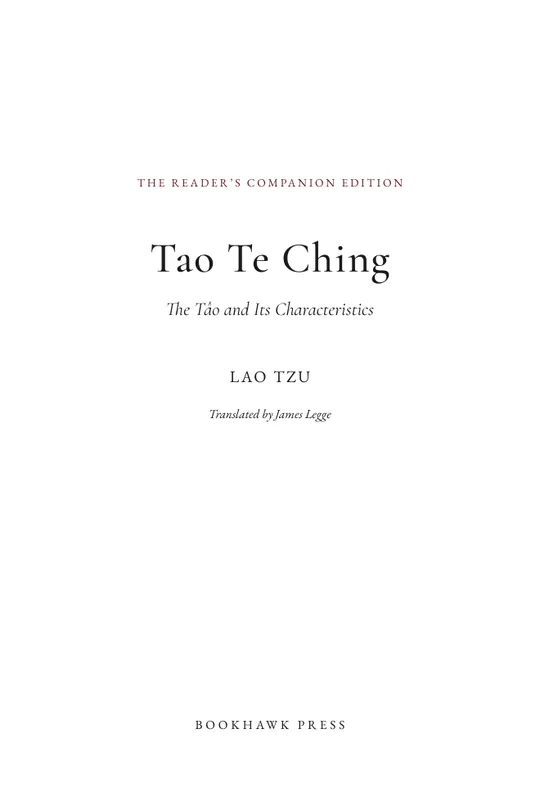
Title page
Title page
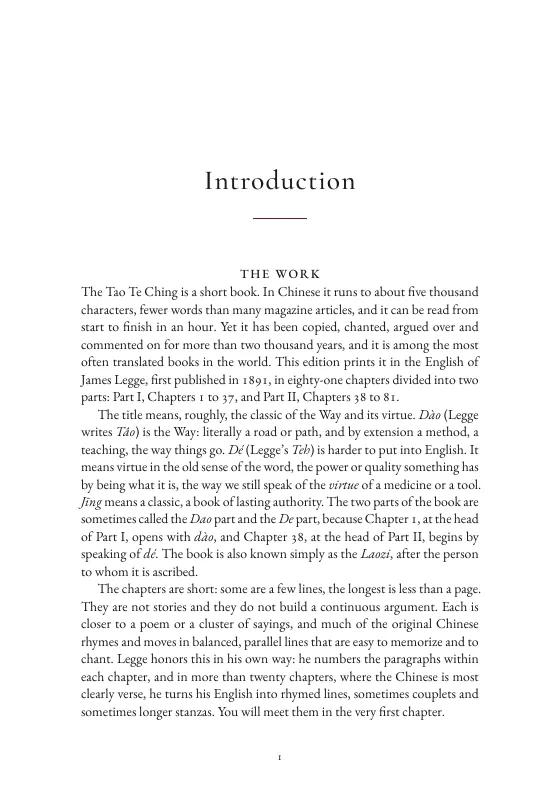
The introduction
The introduction
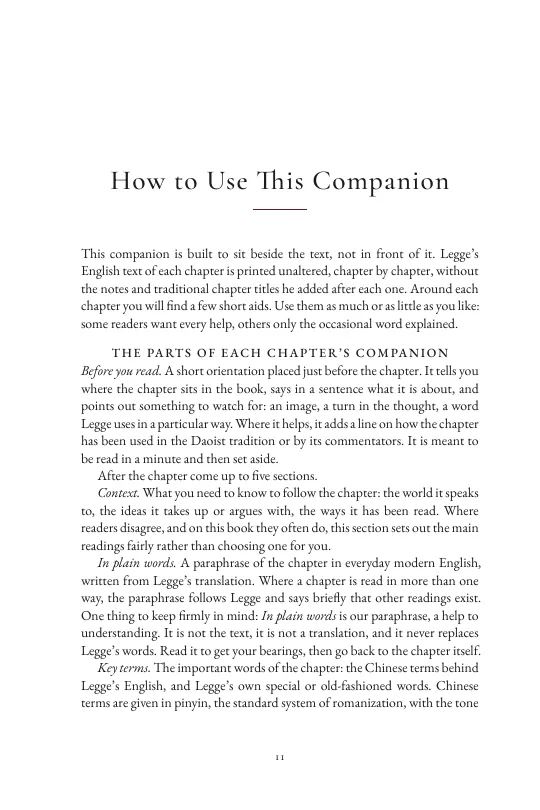
How to Use This Companion
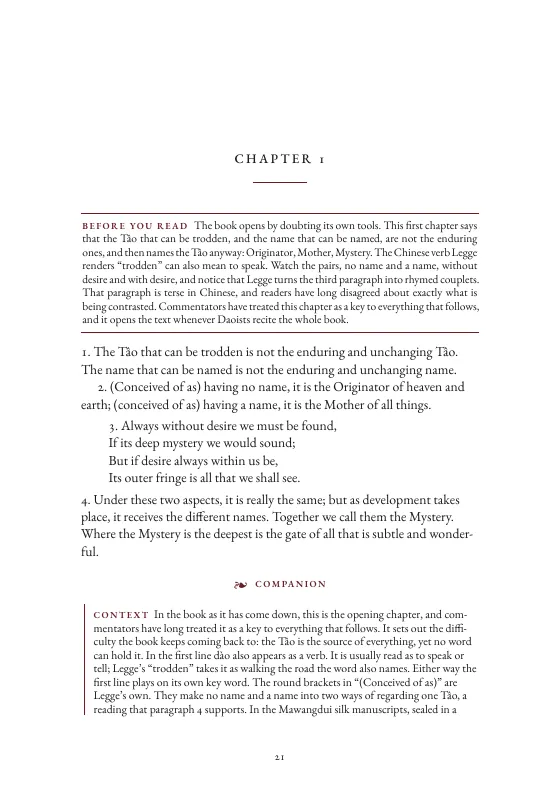
Chapter 1, with Before you read
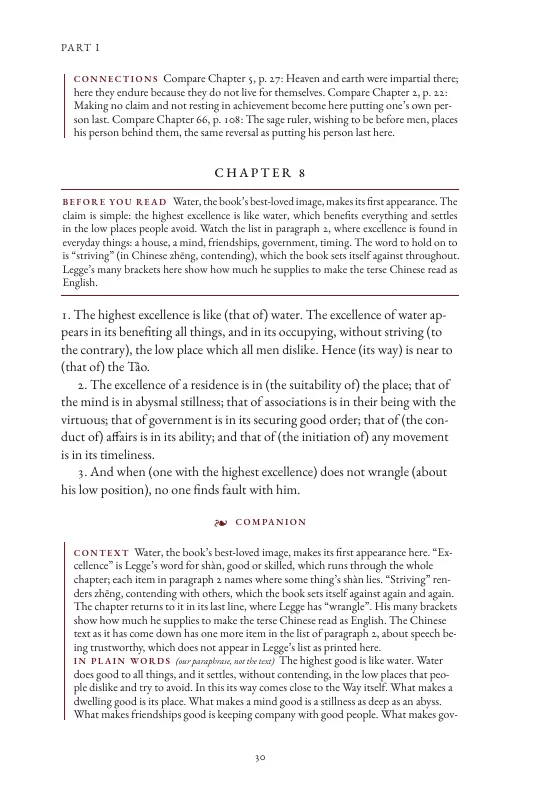
Chapter 8 and its companion
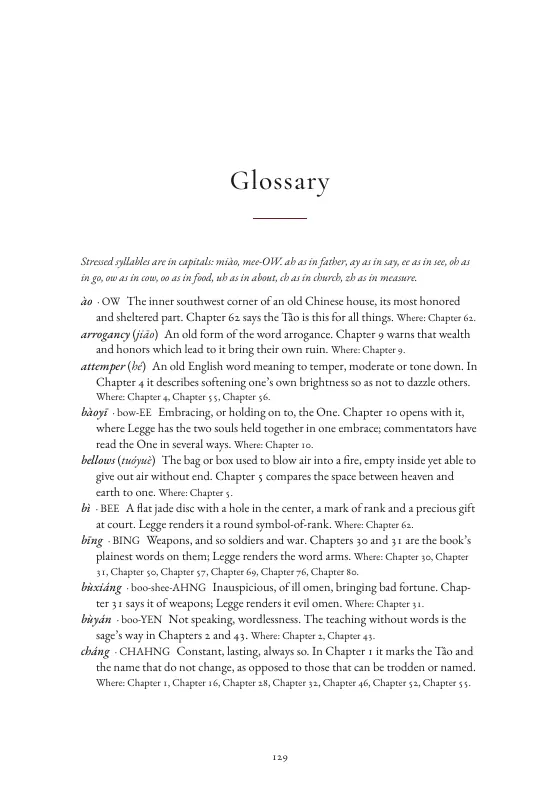
The glossary, with pronunciation

Choose your format

Every format includes the whole companion: the introduction, an orientation and companion notes for every chapter, the glossary and the themes.

Format
Ship to

Prices in US dollars. Printed books ship for a flat rate to the US or Canada, shown at checkout before you pay. Ebooks have no shipping charge. US sales tax, if any, is shown before you pay. Internationally fulfilled orders may be subject to customs duties or other import charges.

With tracked shipping, printed books usually arrive about 3 weeks after you order in the US and about 4 weeks in Canada.

Our promise

  • Order today and your hardcover or paperback ships within 14 days, or your ebook is emailed within 5 days. Your confirmation email gives the exact date.
  • Running late? We email you before that date, and you can keep waiting or cancel for a full refund.
  • Arrives damaged or misprinted, or not as this page describes? Email us a photo up to 30 days after delivery for a full refund or a replacement. No need to send it back.
  • Secure checkout by Stripe. Your card details go to Stripe, never to us. Your statement will show BOOKHAWK PRESS.

Shipping · Refunds

See how it works: two chapters from the book

Every chapter opens with a short Before you read and ends with its companion. Here are Chapter 1 and Chapter 8, whole, as Legge translated them; open the companion under each to see what comes after.

Chapter 1

1. The Tâo that can be trodden is not the enduring and unchanging Tâo. The name that can be named is not the enduring and unchanging name.

2. (Conceived of as) having no name, it is the Originator of heaven and earth; (conceived of as) having a name, it is the Mother of all things.

3. Always without desire we must be found,
If its deep mystery we would sound;
But if desire always within us be,
Its outer fringe is all that we shall see.

4. Under these two aspects, it is really the same; but as development takes place, it receives the different names. Together we call them the Mystery. Where the Mystery is the deepest is the gate of all that is subtle and wonderful.

Read the companion to Chapter 1

Context In the book as it has come down, this is the opening chapter, and commentators have long treated it as a key to everything that follows. It sets out the difficulty the book keeps coming back to: the Tâo is the source of everything, yet no word can hold it. In the first line dào also appears as a verb. It is usually read as to speak or tell; Legge’s “trodden” takes it as walking the road the word also names. Either way the first line plays on its own key word. The round brackets in “(Conceived of as)” are Legge’s own. They make no name and a name into two ways of regarding one Tâo, a reading that paragraph 4 supports. In the Mawangdui silk manuscripts, sealed in a tomb in 168 BCE and found in 1973, the Te half comes first, so there this chapter opens the second half.

In plain words (our paraphrase, not the text) The Way that can be walked is not the Way that lasts and never changes. The name that can be spoken is not the name that lasts. Thought of as having no name, the Way is where heaven and earth begin. Thought of as having a name, it is the mother who gives birth to every single thing. To reach its depths we have to stay free of wanting; as long as wanting lives in us, we will see only its outer edge, though some commentators divide these lines differently and read them as being about non-being and being rather than about desire. The nameless and the named are really one and the same. They come to have different names only as things unfold. Together they are called the Mystery, dark and deep, and at the Mystery’s deepest point is the gateway through which everything subtle and wonderful comes.

Key terms dào (DOW), “Tâo”: The Way, a road or path. In the first line it is also the verb: most readers take it as speaking, Legge as treading. míng (MING), “name”: A name, or the act of naming. The chapter says the name that can be named is not the lasting one, and then names the Tâo anyway. cháng (CHAHNG), “enduring and unchanging”: Constant, always so. Legge uses two English words for this one Chinese word, which marks the Tâo and the name that do not pass away. yù (YOO), “desire”: Wanting. In this chapter it decides how much of the Tâo we see: its depths without desire, only its fringe with it. xuán (SHWEN), “Mystery”: Dark, deep, hidden, like the night sky. Legge capitalizes it as the name for the nameless and the named taken together. miào (mee-OW), “subtle and wonderful”: Fine, subtle, wondrous. The Mystery is the gate through which such things come; the same word lies behind the deep mystery of paragraph 3.

To reflect on Think of something you care about that no word quite fits: a person, a place, a feeling. When you do give it a name, what does the name leave out?

Chapter 8

1. The highest excellence is like (that of) water. The excellence of water appears in its benefiting all things, and in its occupying, without striving (to the contrary), the low place which all men dislike. Hence (its way) is near to (that of) the Tâo.

2. The excellence of a residence is in (the suitability of) the place; that of the mind is in abysmal stillness; that of associations is in their being with the virtuous; that of government is in its securing good order; that of (the conduct of) affairs is in its ability; and that of (the initiation of) any movement is in its timeliness.

3. And when (one with the highest excellence) does not wrangle (about his low position), no one finds fault with him.

Read the companion to Chapter 8

Context Water, the book’s best-loved image, makes its first appearance here. “Excellence” is Legge’s word for shàn, good or skilled, which runs through the whole chapter; each item in paragraph 2 names where some thing’s shàn lies. “Striving” renders zhēng, contending with others, which the book sets itself against again and again. The chapter returns to it in its last line, where Legge has “wrangle”. His many brackets show how much he supplies to make the terse Chinese read as English. The Chinese text as it has come down has one more item in the list of paragraph 2, about speech being trustworthy, which does not appear in Legge’s list as printed here.

In plain words (our paraphrase, not the text) The highest good is like water. Water does good to all things, and it settles, without contending, in the low places that people dislike and try to avoid. In this its way comes close to the Way itself. What makes a dwelling good is its place. What makes a mind good is a stillness as deep as an abyss. What makes friendships good is keeping company with good people. What makes government good is order, what makes the handling of affairs good is competence, and what makes any move good is its timing. Legge takes the item about friendships to mean choosing good company, while others read it as dealing kindly with people. And because the one with this highest good does not quarrel about being placed low, no one finds fault with him.

Key terms shàn (SHAHN), “excellence”: Good, excellent, skilled. It is the word repeated through the chapter, first for water and then for each item in the list. zhēng (JUNG), “striving”: Contending, competing with others. Water does not do it, which is why it takes the low place and escapes blame. dào (DOW), “Tâo”: The Way. Water’s way of benefiting and staying low is said to come near to it.

Connections Compare Chapter 7: The sage puts himself last there and is preserved; water takes the lowest place here, and no one finds fault. Compare Chapter 6: The low valley that never dies is close kin to the low place water chooses. Compare Chapter 3: Rivalry among the people, which a ruler should not stir up, is the striving that water never does.

To reflect on Watch where water goes today when it is left to itself: a gutter, a puddle, the low corner of a sink. What does this chapter see in that, and do you see it too?

Enjoyed Chapter 8? Get the whole book.

That’s how every chapter in this edition works: a short orientation, the chapter itself, then its companion.

Hardcover US$34.99 · Paperback US$22.99 · Ebook US$12.99

Get my copy · from US$12.99

Not ready yet? Get three more chapters free by email

Chapters 9, 10 and 11, from the vessel filled to the brim to the thirty spokes of the wheel and its empty hub, each with its Before you read and its companion (PDF, 8 pages).

We’ll email the sample whether or not you tick the box. Sent by Bookhawk Press (Space Dog Tech LLC), 411 Walnut St, PMB 22412, Green Cove Springs, FL 32043, USA · support@bookhawkpress.com. Privacy

Questions

I’ve tried the Tao Te Ching before and found it hard going. Will this edition help?
Yes. That’s what it’s built for. Before every chapter, a short orientation tells you where it sits, what it’s about and what to watch for. After it come Context, In plain words (our short paraphrase), Key terms with pronunciation and Connections. Legge’s English is stiff, but here every chapter comes with help, and we think this is the time you finish it.
Does In plain words replace Legge’s text?
No. Legge’s text is printed in full, word for word. In plain words comes after each chapter, labeled as our paraphrase and not the text. It’s there to help you understand the chapter, never to stand in for Legge’s words.
Which translation is this, and is the whole book included?
It’s James Legge’s 1891 translation, first published by the Clarendon Press, Oxford, in The Sacred Books of the East. All eighty-one chapters are here in two parts (Chapters 1–37 and 38–81), word for word as first printed and checked against a copy of the 1891 printing. His spelling Tâo, his paragraph numbers, his rhymed couplets and the words he added in round brackets are kept as he printed them, and the companion explains what his brackets add.
Is this a religious book, and do I need to know anything about Daoism?
It’s both. It’s a founding text of Daoism, a living religious tradition, recited in Daoist temples today, and it’s also a classic of Chinese philosophy. You don’t need any background. The introduction sets out both ways of reading it fairly, and each chapter’s Context notes where readers differ, then leaves the choice to you.
How do I say the Chinese words?
Say them with confidence. The key terms after each chapter and the glossary give the pinyin with tone marks and a rough sounds-like pronunciation: dào is DOW, wúwéi is woo-WAY, and the title is DOW DUH JING. How to Use This Companion explains how the pronunciations are written.
How does the thirty-day reading plan work?
It spreads the book over thirty days, at about ten minutes a day, and How to Use This Companion sets it out. If you’d like a different route, read straight through, or read by theme with the themes index.
What are the hardcover and the paperback like?
Both are 6 × 9 in, 154 pages, on cream paper, and each copy is printed for its order. The hardcover’s cover is printed on rigid boards with a matte finish and no dust jacket. The paperback has a matte cover.
Which ebook formats are included, and how does the ebook arrive?
You get both. There’s an EPUB for Kindle (through Amazon’s Send to Kindle), Kobo, Apple Books and most reading apps, plus a PDF in the print layout. They come by email. Emailed within 5 days.
Where do you ship, and how long does it take?
We sell and ship to the US and Canada only. Printed books go by tracked mail. Each copy is printed for its order. Ships within 14 days. Books usually arrive in about 3 weeks in the US or about 4 weeks in Canada after you order. Your confirmation gives the date your order will ship by, and we email you when it ships.
Can I cancel, and what if something goes wrong?
Yes. You can cancel for a full refund until your order goes to print. If we might miss the ship-by date in your confirmation, we’ll email you before that date, and you can cancel for a full refund. If a printed book arrives damaged or misprinted, or isn’t what this page describes, email us a photo up to 30 days after delivery. We’ll refund you in full or send a replacement where we can, and we won’t ask for the book back. The same applies if tracking shows no movement for 10 business days. Each copy is printed for its order, so we can’t take back undamaged books. Full details: bookhawkpress.com/refunds.
Who is Bookhawk Press?
We’re an independent publisher based in the United States, and we sell our books direct from our own site. Questions go to support@bookhawkpress.com.

About Bookhawk Press

Bookhawk Press is an independent publisher of carefully edited books in print and ebook. We sell direct from our own site, and each copy is printed for your order and shipped straight to you. Questions before you order? Email support@bookhawkpress.com. We answer every message, usually in two business days.

See all our books

Order Tao Te Ching