Bookhawk PressRead two stories
Cover of The Legend of Sleepy Hollow and Other Haunted Tales, The Reader’s Companion Edition
The Reader’s Companion Edition

The Legend of Sleepy Hollow and Other Haunted Tales

In Sleepy Hollow, a ‘cow-boy’ was a Loyalist cattle raider

Every story complete, in Irving’s own words, with a note before each one, a who’s who and a glossary. Fireside mischief at its best.

Hardcover US$39.99 · Paperback US$25.99 · Ebook US$15.99

Get my copy · from US$15.99

Gave up on Irving once? This time, we think you’ll reach the last page.

Hardcover and paperback ship within 14 days · Late? Cancel for a full refund · Damaged or not as described? Refund or replacement, no return needed

The hardcover includes the ebook; with the paperback, add it for US$4.00. Start reading while your book is printed and shipped.

Why this edition

  • Know the ground before the story begins

    A note before every story: who’s telling it, where and when, what to listen for. Sleepy Hollow’s: Tarry Town around 1790, no-man’s-land in the Revolution, the Hessians, Major André stopped nearby in 1780. No twist or ending given away.

  • Words that don’t mean what you think

    In Sleepy Hollow a ‘cow-boy’ is a Loyalist cattle raider. ‘Sparking’ is courting; a ‘wallet’ is a food bag. The glossary’s 551 terms sort them out, oly koeks (fried sweet dough) and Hollands (Dutch gin) too.

  • A whole haunted evening, not one tale

    13 complete stories: Sleepy Hollow, Rip Van Winkle, The Spectre Bridegroom, the snowbound guests’ ghost stories by the Baronet’s fire, Kidd the Pirate and The Devil and Tom Walker.

  • Meet the ruined man behind the masks

    In 1818 Irving was bankrupt, and he wrote his way out. The introduction tells how, unmasks Geoffrey Crayon and Diedrich Knickerbocker, traces where the headless rider came from, and shows off his ‘terror with a wink’.

  • Never lose track of who’s who

    A who’s who of 108 entries, arranged by story: the tellers first, then each story’s people (Rip’s dog Wolf included), plus real figures like Captain Kidd and Cotton Mather. It says who they are, not what becomes of them.

  • Every story complete, in Irving’s words

    No story shortened, nothing rewritten. The notes sit before each story, never inside it, so Irving’s text runs just as he printed it. The only footnotes are Irving’s own.

Get my copy · from US$15.99

The same words, plus the world behind them

A plain copyThis edition
‘Cow-boys’ turn up in the old war stories, and you picture the Wild West.The glossary: Loyalists who stole cattle and plundered farms in Westchester’s no-man’s-land.
Tarry Town, Major André, the Hessians: names with nothing behind them.The note before the story sets out the valley around 1790 and the war it still remembers.
A ‘wallet’ goes on a journey and you picture money.It’s a food bag. ‘Sparking’ is courting. 551 terms, alphabetical, at the back.
Tellers inside tellers, and you lose track of who’s speaking.Each note says who’s telling the story and to whom; the who’s who puts the tellers first.
‘Oly koeks’ and ‘Hollands’ go by without a taste.Balls of sweet fried dough, ancestors of the doughnut, and Dutch gin. Now you’re at the table.

Get my copy · from US$15.99

Irving is a joy, but he takes for granted a world today’s readers no longer know: the old Hudson Valley, the Revolution and a table spread with oly koeks (balls of sweet fried dough). Read a plain copy and you’re left guessing. This edition puts a short reader’s note before every story, saying who is telling it, where and when it is set, and what to listen for. It adds a who’s who, arranged by story, and an alphabetical glossary at the back. We think it’s the most fun you’ll have with a ghost story.

Sleepy Hollow is a drowsy little valley near Tarry Town on the Tappan Zee, and its favorite ghost is said to be a horseman without a head. Ichabod Crane, a lanky schoolmaster from Connecticut with an enormous appetite and a firm faith in witches, teaches there. He courts Katrina Van Tassel, the only child of a rich Dutch farmer, and his rival is Brom Bones. At the foot of the Kaatskills, good-natured Rip Van Winkle will help any neighbor with anything but his own farm. To escape Dame Van Winkle’s tongue, he strolls off into the woods with his gun and his dog Wolf.

Then a storm shuts a Baronet’s guests indoors and they trade ghost stories by the fire. And outside Boston, a miser named Tom Walker takes a short cut through a swamp.

Every story is complete, in Irving’s own words. Each note sets its story up without giving away the twist or the ending, then steps aside. Save these for a dark, stormy evening and read them aloud.

What’s inside

  • 13 complete stories by Washington Irving: Rip Van Winkle, The Spectre Bridegroom and The Legend of Sleepy Hollow from The Sketch Book, and ten tales from Tales of a Traveller, among them The Adventure of the German Student and The Devil and Tom Walker
  • The Sketch Book stories in the text Irving revised in 1848, with his own footnotes, and the Tales of a Traveller stories from the editions of 1824
  • An introduction for today’s reader in eight short sections: Irving’s ruin and rise, his storytellers Geoffrey Crayon and Diedrich Knickerbocker, the old Dutch Hudson Valley, and where the stories came from
  • A short reader’s note before every story: who is telling it, where and when it is set, the history behind it, and what to listen for
  • A who’s who of the storytellers and characters in 108 entries, arranged by story
  • A glossary of 551 terms at the back: Dutch-American farm life, old-fashioned English, customs, and the places and history the stories pass through
  • A Note on the Text saying which printings each story follows

Look inside

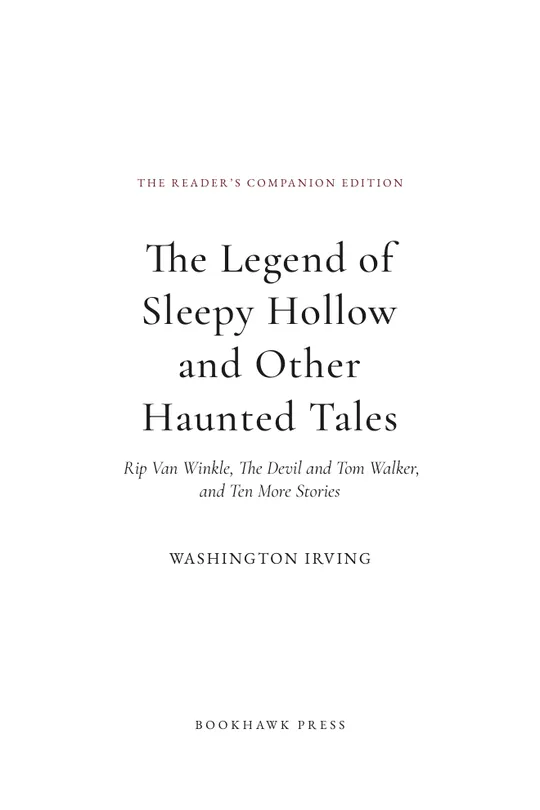
Title page
Title page
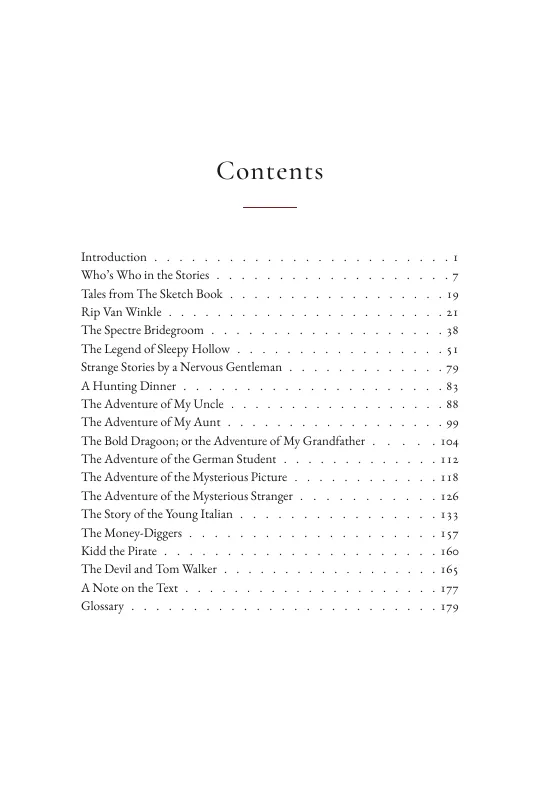
Contents
Contents
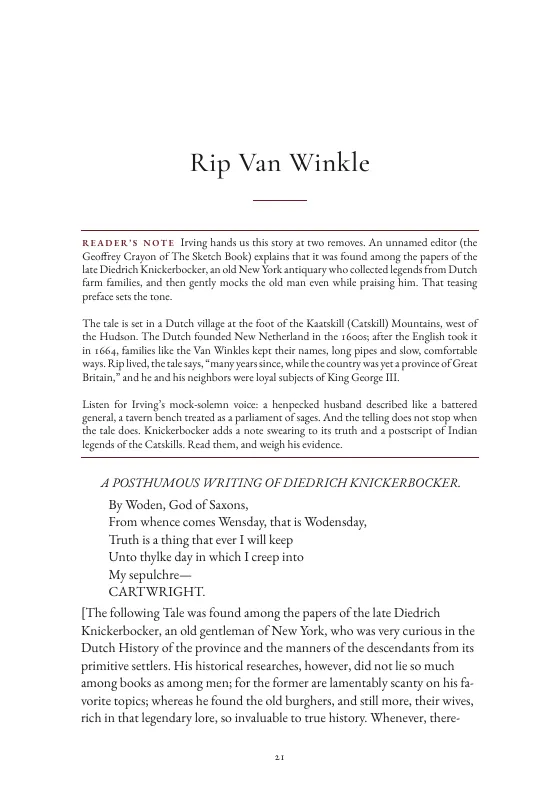
Rip Van Winkle, with its reader’s note
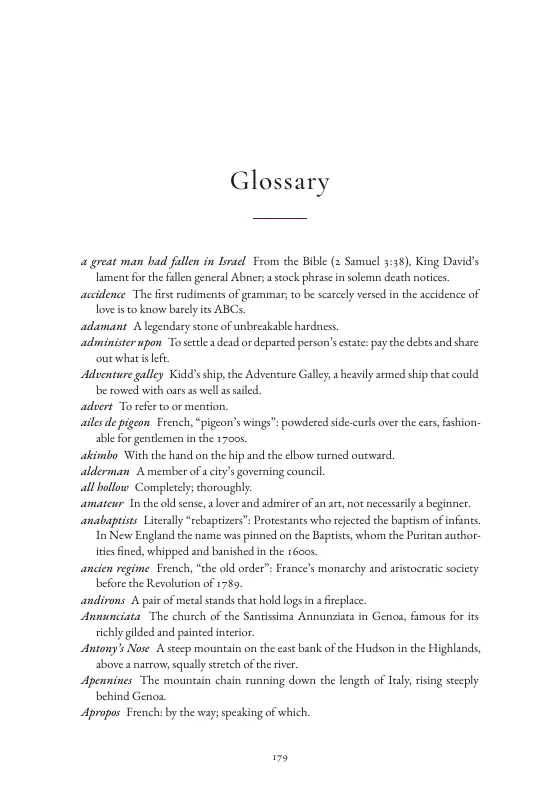
The glossary
The glossary

Who’s who

  • Diedrich Knickerbocker. A late old gentleman of New York, a fussy antiquary devoted to the Dutch history of the province, who gathered legends from old Dutch families. “Rip Van Winkle” was found among his papers, along with his note vouching for its truth and his jottings on Catskill legends.
  • Rip Van Winkle. A simple, good-natured villager at the foot of the Kaatskill mountains, adored by children and by the neighbors’ wives, willing to help anyone with anything except his own farm.
  • Dame Van Winkle. Rip’s wife, who keeps a neat house and a sharp tongue, and never stops lecturing him about his idleness and the ruin he is bringing on the family.
  • Ichabod Crane. A tall, lank schoolmaster from Connecticut who teaches in Sleepy Hollow, boards round among the farmers, leads the church singing, eats like an anaconda and believes every ghost story he hears, especially those of Cotton Mather.
  • Brom Bones. Abraham (“Brom”) Van Brunt, the burly, roistering hero of the countryside, a daring horseman and the umpire of every dispute, with more mischief than ill will in him. He has singled out Katrina for his rough courtship.
  • The Baron Von Landshort. A small, fussy, proud nobleman of the great house of Katzenellenbogen, clinging to his hilltop castle in the Odenwald, his ancestors’ feuds, and his favorite goblin stories.
  • Tom Walker. A meagre, miserly fellow who lives near Boston around 1727 in a lonely, starved-looking house. He is hard-minded and not easily daunted, and he quarrels endlessly with his wife over money.

Choose your format

Every format includes the reader’s notes, the introduction, the who’s who and the glossary.

The hardcover and paperback editions (illustration)
Format
Ship to

Prices in US dollars. Printed books ship for a flat US$5.99 to the US or US$10.99 to Canada. Ebooks have no shipping charge. US sales tax, if any, is shown before you pay. Internationally fulfilled orders may be subject to customs duties or other import charges.

With tracked shipping, printed books usually arrive about 3 weeks after you order in the US and about 4 weeks in Canada.

Our promise

  • Order today and your hardcover or paperback ships within 14 days, or your ebook is emailed within 5 days. Your confirmation email gives the exact date.
  • Running late? We email you before that date, and you can keep waiting or cancel for a full refund.
  • Arrives damaged or misprinted, or not as this page describes? Email us a photo up to 30 days after delivery for a full refund or a replacement. No need to send it back.
  • Secure checkout by Stripe. Your card details go to Stripe, never to us. Your statement will show BOOKHAWK PRESS.

Shipping · Refunds

See how it works: the first two stories in the book

Every story opens with a short reader’s note: who is telling it, where and when it is set, and what to listen for, without giving the ending away. Here are the first two, as the book prints them.

Rip Van Winkle

A POSTHUMOUS WRITING OF DIEDRICH KNICKERBOCKER.

By Woden, God of Saxons,
From whence comes Wensday, that is Wodensday,
Truth is a thing that ever I will keep
Unto thylke day in which I creep into
My sepulchre—
CARTWRIGHT.

[The following Tale was found among the papers of the late Diedrich Knickerbocker, an old gentleman of New York, who was very curious in the Dutch History of the province and the manners of the descendants from its primitive settlers. His historical researches, however, did not lie so much among books as among men; for the former are lamentably scanty on his favorite topics; whereas he found the old burghers, and still more, their wives, rich in that legendary lore, so invaluable to true history. Whenever, therefore, he happened upon a genuine Dutch family, snugly shut up in its low-roofed farm-house, under a spreading sycamore, he looked upon it as a little clasped volume of black-letter, and studied it with the zeal of a bookworm.

Continue reading

The result of all these researches was a history of the province, during the reign of the Dutch governors, which he published some years since. There have been various opinions as to the literary character of his work, and, to tell the truth, it is not a whit better than it should be. Its chief merit is its scrupulous accuracy, which indeed was a little questioned on its first appearance, but has since been completely established; and it is now admitted into all historical collections, as a book of unquestionable authority.

The old gentleman died shortly after the publication of his work; and now that he is dead and gone, it cannot do much harm to his memory to say that his time might have been much better employed in weightier labors. He, however, was apt to ride his hobby his own way; and though it did now and then kick up the dust a little in the eyes of his neighbors, and grieve the spirit of some friends, for whom he felt the truest deference and affection, yet his errors and follies are remembered “more in sorrow than in anger,” and it begins to be suspected, that he never intended to injure or offend. But however his memory may be appreciated by critics, it is still held dear among many folks, whose good opinion is well worth having; particularly by certain biscuit-bakers, who have gone so far as to imprint his likeness on their new-year cakes, and have thus given him a chance for immortality, almost equal to the being stamped on a Waterloo medal, or a Queen Anne’s farthing.]

Whoever has made a voyage up the Hudson must remember the Kaatskill mountains. They are a dismembered branch of the great Appalachian family, and are seen away to the west of the river, swelling up to a noble height, and lording it over the surrounding country. Every change of season, every change of weather, indeed, every hour of the day produces some change in the magical hues and shapes of these mountains; and they are regarded by all the good wives, far and near, as perfect barometers. When the weather is fair and settled, they are clothed in blue and purple, and print their bold outlines on the clear evening sky; but sometimes, when the rest of the landscape is cloudless, they will gather a hood of gray vapors about their summits, which, in the last rays of the setting sun, will glow and light up like a crown of glory.

At the foot of these fairy mountains, the voyager may have descried the light smoke curling up from a village, whose shingle roofs gleam among the trees, just where the blue tints of the upland melt away into the fresh green of the nearer landscape. It is a little village of great antiquity, having been founded by some of the Dutch colonists, in the early times of the province, just about the beginning of the government of the good Peter Stuyvesant (may he rest in peace!), and there were some of the houses of the original settlers standing within a few years, built of small yellow bricks, brought from Holland, having latticed windows and gable fronts, surmounted with weathercocks.

In that same village, and in one of these very houses (which, to tell the precise truth, was sadly time-worn and weather-beaten), there lived, many years since, while the country was yet a province of Great Britain, a simple, good-natured fellow, of the name of Rip Van Winkle. He was a descendant of the Van Winkles who figured so gallantly in the chivalrous days of Peter Stuyvesant, and accompanied him to the siege of Fort Christina. He inherited, however, but little of the martial character of his ancestors. I have observed that he was a simple, good-natured man; he was, moreover, a kind neighbor, and an obedient henpecked husband. Indeed, to the latter circumstance might be owing that meekness of spirit which gained him such universal popularity; for those men are most apt to be obsequious and conciliating abroad, who are under the discipline of shrews at home. Their tempers, doubtless, are rendered pliant and malleable in the fiery furnace of domestic tribulation, and a curtain-lecture is worth all the sermons in the world for teaching the virtues of patience and long-suffering. A termagant wife may, therefore, in some respects, be considered a tolerable blessing, and if so, Rip Van Winkle was thrice blessed.

Certain it is, that he was a great favorite among all the good wives of the village, who, as usual with the amiable sex, took his part in all family squabbles, and never failed, whenever they talked those matters over in their evening gossipings, to lay all the blame on Dame Van Winkle. The children of the village, too, would shout with joy whenever he approached. He assisted at their sports, made their playthings, taught them to fly kites and shoot marbles, and told them long stories of ghosts, witches, and Indians. Whenever he went dodging about the village, he was surrounded by a troop of them hanging on his skirts, clambering on his back, and playing a thousand tricks on him with impunity; and not a dog would bark at him throughout the neighborhood.

The great error in Rip’s composition was an insuperable aversion to all kinds of profitable labor. It could not be from the want of assiduity or perseverance; for he would sit on a wet rock, with a rod as long and heavy as a Tartar’s lance, and fish all day without a murmur, even though he should not be encouraged by a single nibble. He would carry a fowling-piece on his shoulder, for hours together, trudging through woods and swamps, and up hill and down dale, to shoot a few squirrels or wild pigeons. He would never refuse to assist a neighbor even in the roughest toil, and was a foremost man at all country frolics for husking Indian corn, or building stone fences; the women of the village, too, used to employ him to run their errands, and to do such little odd jobs as their less obliging husbands would not do for them. In a word, Rip was ready to attend to any body’s business but his own; but as to doing family duty, and keeping his farm in order, he found it impossible.

In fact, he declared it was of no use to work on his farm; it was the most pestilent little piece of ground in the whole country; every thing about it went wrong, and would go wrong, in spite of him. His fences were continually falling to pieces; his cow would either go astray, or get among the cabbages; weeds were sure to grow quicker in his fields than any where else; the rain always made a point of setting in just as he had some out-door work to do; so that though his patrimonial estate had dwindled away under his management, acre by acre, until there was little more left than a mere patch of Indian corn and potatoes, yet it was the worst-conditioned farm in the neighborhood.

His children, too, were as ragged and wild as if they belonged to nobody. His son Rip, an urchin begotten in his own likeness, promised to inherit the habits, with the old clothes, of his father. He was generally seen trooping like a colt at his mother’s heels, equipped in a pair of his father’s cast-off galligaskins, which he had much ado to hold up with one hand, as a fine lady does her train in bad weather.

Rip Van Winkle, however, was one of those happy mortals, of foolish, well-oiled dispositions, who take the world easy, eat white bread or brown, whichever can be got with least thought or trouble, and would rather starve on a penny than work for a pound. If left to himself, he would have whistled life away, in perfect contentment; but his wife kept continually dinning in his ears about his idleness, his carelessness, and the ruin he was bringing on his family. Morning, noon, and night, her tongue was incessantly going, and every thing he said or did was sure to produce a torrent of household eloquence. Rip had but one way of replying to all lectures of the kind, and that, by frequent use, had grown into a habit. He shrugged his shoulders, shook his head, cast up his eyes, but said nothing. This, however, always provoked a fresh volley from his wife, so that he was fain to draw off his forces, and take to the outside of the house—the only side which, in truth, belongs to a henpecked husband.

Rip’s sole domestic adherent was his dog Wolf, who was as much henpecked as his master; for Dame Van Winkle regarded them as companions in idleness, and even looked upon Wolf with an evil eye, as the cause of his master’s going so often astray. True it is, in all points of spirit befitting an honorable dog, he was as courageous an animal as ever scoured the woods—but what courage can withstand the ever-during and all-besetting terrors of a woman’s tongue? The moment Wolf entered the house his crest fell, his tail drooped to the ground or curled between his legs, he sneaked about with a gallows air, casting many a sidelong glance at Dame Van Winkle, and at the least flourish of a broomstick or ladle, he would fly to the door with yelping precipitation.

Times grew worse and worse with Rip Van Winkle as years of matrimony rolled on; a tart temper never mellows with age, and a sharp tongue is the only edged tool that grows keener with constant use. For a long while he used to console himself, when driven from home, by frequenting a kind of perpetual club of the sages, philosophers, and other idle personages of the village, which held its sessions on a bench before a small inn, designated by a rubicund portrait of his Majesty George the Third. Here they used to sit in the shade through a long, lazy summer’s day, talking listlessly over village gossip, or telling endless, sleepy stories about nothing. But it would have been worth any statesman’s money to have heard the profound discussions that sometimes took place, when by chance an old newspaper fell into their hands from some passing traveler. How solemnly they would listen to the contents, as drawled out by Derrick Van Bummel, the school-master, a dapper learned little man, who was not to be daunted by the most gigantic word in the dictionary; and how sagely they would deliberate upon public events some months after they had taken place.

The opinions of this junto were completely controlled by Nicholas Vedder, a patriarch of the village, and landlord of the inn, at the door of which he took his seat from morning till night, just moving sufficiently to avoid the sun, and keep in the shade of a large tree; so that the neighbors could tell the hour by his movements as accurately as by a sun-dial. It is true, he was rarely heard to speak, but smoked his pipe incessantly. His adherents, however (for every great man has his adherents), perfectly understood him, and knew how to gather his opinions. When any thing that was read or related displeased him, he was observed to smoke his pipe vehemently, and to send forth short, frequent, and angry puffs; but when pleased, he would inhale the smoke slowly and tranquilly, and emit it in light and placid clouds, and sometimes, taking the pipe from his mouth, and letting the fragrant vapor curl about his nose, would gravely nod his head in token of perfect approbation.

From even this stronghold the unlucky Rip was at length routed by his termagant wife, who would suddenly break in upon the tranquillity of the assemblage, and call the members all to naught; nor was that august personage, Nicholas Vedder himself, sacred from the daring tongue of this terrible virago, who charged him outright with encouraging her husband in habits of idleness.

Poor Rip was at last reduced almost to despair; and his only alternative, to escape from the labor of the farm and clamor of his wife, was to take gun in hand, and stroll away into the woods. Here he would sometimes seat himself at the foot of a tree, and share the contents of his wallet with Wolf, with whom he sympathized as a fellow-sufferer in persecution. “Poor Wolf,” he would say, “thy mistress leads thee a dog’s life of it; but never mind, my lad, whilst I live thou shalt never want a friend to stand by thee!” Wolf would wag his tail, look wistfully in his master’s face, and if dogs can feel pity, I verily believe he reciprocated the sentiment with all his heart.

In a long ramble of the kind, on a fine autumnal day, Rip had unconsciously scrambled to one of the highest parts of the Kaatskill mountains. He was after his favorite sport of squirrel-shooting, and the still solitudes had echoed and re-echoed with the reports of his gun. Panting and fatigued, he threw himself, late in the afternoon, on a green knoll, covered with mountain herbage, that crowned the brow of a precipice. From an opening between the trees, he could overlook all the lower country for many a mile of rich woodland. He saw at a distance the lordly Hudson, far, far below him, moving on its silent but majestic course, with the reflection of a purple cloud, or the sail of a lagging bark, here and there sleeping on its glassy bosom and at last losing itself in the blue highlands.

On the other side he looked down into a deep mountain glen, wild, lonely, and shagged, the bottom filled with fragments from the impending cliffs, and scarcely lighted by the reflected rays of the setting sun. For some time Rip lay musing on this scene; evening was gradually advancing; the mountains began to throw their long blue shadows over the valleys; he saw that it would be dark long before he could reach the village; and he heaved a heavy sigh when he thought of encountering the terrors of Dame Van Winkle.

As he was about to descend, he heard a voice from a distance hallooing: “Rip Van Winkle! Rip Van Winkle!” He looked round, but could see nothing but a crow winging its solitary flight across the mountain. He thought his fancy must have deceived him, and turned again to descend, when he heard the same cry ring through the still evening air, “Rip Van Winkle! Rip Van Winkle!”—at the same time Wolf bristled up his back, and giving a low growl, skulked to his master’s side, looking fearfully down into the glen. Rip now felt a vague apprehension stealing over him; he looked anxiously in the same direction, and perceived a strange figure slowly toiling up the rocks, and bending under the weight of something he carried on his back. He was surprised to see any human being in this lonely and unfrequented place, but supposing it to be some one of the neighborhood in need of his assistance, he hastened down to yield it.

On nearer approach, he was still more surprised at the singularity of the stranger’s appearance. He was a short, square-built old fellow, with thick bushy hair, and a grizzled beard. His dress was of the antique Dutch fashion—a cloth jerkin strapped round the waist—several pair of breeches, the outer one of ample volume, decorated with rows of buttons down the sides, and bunches at the knees. He bore on his shoulder a stout keg, that seemed full of liquor, and made signs for Rip to approach and assist him with the load. Though rather shy and distrustful of this new acquaintance, Rip complied with his usual alacrity; and mutually relieving each other, they clambered up a narrow gully, apparently the dry bed of a mountain torrent. As they ascended, Rip every now and then heard long rolling peals, like distant thunder, that seemed to issue out of a deep ravine, or rather cleft between lofty rocks, toward which their rugged path conducted. He paused for an instant, but supposing it to be the muttering of one of those transient thunder-showers which often take place in mountain heights, he proceeded. Passing through the ravine, they came to a hollow, like a small amphitheatre, surrounded by perpendicular precipices, over the brinks of which impending trees shot their branches, so that you only caught glimpses of the azure sky, and the bright evening cloud. During the whole time Rip and his companion had labored on in silence; for though the former marvelled greatly what could be the object of carrying a keg of liquor up this wild mountain, yet there was something strange and incomprehensible about the unknown, that inspired awe, and checked familiarity.

On entering the amphitheatre, new objects of wonder presented themselves. On a level spot in the centre was a company of odd-looking personages playing at ninepins. They were dressed in a quaint outlandish fashion; some wore short doublets, others jerkins, with long knives in their belts, and most of them had enormous breeches, of similar style with that of the guide’s. Their visages, too, were peculiar; one had a large head, broad face, and small piggish eyes; the face of another seemed to consist entirely of nose, and was surmounted by a white sugar-loaf hat, set off with a little red cock’s tail. They all had beards, of various shapes and colors. There was one who seemed to be the commander. He was a stout old gentleman, with a weather-beaten countenance; he wore a laced doublet, broad belt and hanger, high-crowned hat and feather, red stockings, and high-heeled shoes, with roses in them. The whole group reminded Rip of the figures in an old Flemish painting, in the parlor of Dominie Van Shaick, the village parson, and which had been brought over from Holland at the time of the settlement.

What seemed particularly odd to Rip was, that though these folks were evidently amusing themselves, yet they maintained the gravest faces, the most mysterious silence, and were, withal, the most melancholy party of pleasure he had ever witnessed. Nothing interrupted the stillness of the scene but the noise of the balls, which, whenever they were rolled, echoed along the mountains like rumbling peals of thunder.

As Rip and his companion approached them, they suddenly desisted from their play, and stared at him with such fixed statue-like gaze, and such strange uncouth, lack-lustre countenances, that his heart turned within him, and his knees smote together. His companion now emptied the contents of the keg into large flagons, and made signs to him to wait upon the company. He obeyed with fear and trembling; they quaffed the liquor in profound silence, and then returned to their game.

By degrees, Rip’s awe and apprehension subsided. He even ventured, when no eye was fixed upon him, to taste the beverage which he found had much of the flavor of excellent Hollands. He was naturally a thirsty soul, and was soon tempted to repeat the draught. One taste provoked another; and he reiterated his visits to the flagon so often, that at length his senses were overpowered, his eyes swam in his head, his head gradually declined, and he fell into a deep sleep.

On waking, he found himself on the green knoll whence he had first seen the old man of the glen. He rubbed his eyes—it was a bright sunny morning. The birds were hopping and twittering among the bushes, and the eagle was wheeling aloft, and breasting the pure mountain breeze. “Surely,” thought Rip, “I have not slept here all night.” He recalled the occurrences before he fell asleep. The strange man with a keg of liquor—the mountain ravine—the wild retreat among the rocks—the wo-begone party at ninepins—the flagon—“Oh! that flagon! that wicked flagon!” thought Rip—“what excuse shall I make to Dame Van Winkle?”

He looked round for his gun, but in place of the clean well-oiled fowling-piece, he found an old firelock lying by him, the barrel encrusted with rust, the lock falling off, and the stock worm-eaten. He now suspected that the grave roysters of the mountain had put a trick upon him, and, having dosed him with liquor, had robbed him of his gun. Wolf, too, had disappeared, but he might have strayed away after a squirrel or partridge. He whistled after him and shouted his name, but all in vain; the echoes repeated his whistle and shout, but no dog was to be seen.

He determined to revisit the scene of the last evening’s gambol, and if he met with any of the party, to demand his dog and gun. As he rose to walk, he found himself stiff in the joints, and wanting in his usual activity. “These mountain beds do not agree with me,” thought Rip, “and if this frolic should lay me up with a fit of the rheumatism, I shall have a blessed time with Dame Van Winkle.” With some difficulty he got down into the glen: he found the gully up which he and his companion had ascended the preceding evening; but to his astonishment a mountain stream was now foaming down it, leaping from rock to rock, and filling the glen with babbling murmurs. He, however, made shift to scramble up its sides, working his toilsome way through thickets of birch, sassafras, and witch-hazel; and sometimes tripped up or entangled by the wild grape vines that twisted their coils or tendrils from tree to tree, and spread a kind of network in his path.

At length he reached to where the ravine had opened through the cliffs to the amphitheatre; but no traces of such opening remained. The rocks presented a high impenetrable wall, over which the torrent came tumbling in a sheet of feathery foam, and fell into a broad deep basin, black from the shadows of the surrounding forest. Here, then, poor Rip was brought to a stand. He again called and whistled after his dog; he was only answered by the cawing of a flock of idle crows, sporting high in air about a dry tree that overhung a sunny precipice; and who, secure in their elevation, seemed to look down and scoff at the poor man’s perplexities. What was to be done? The morning was passing away, and Rip felt famished for want of his breakfast. He grieved to give up his dog and gun; he dreaded to meet his wife; but it would not do to starve among the mountains. He shook his head, shouldered the rusty firelock, and, with a heart full of trouble and anxiety, turned his steps homeward.

As he approached the village, he met a number of people, but none whom he knew, which somewhat surprised him, for he had thought himself acquainted with every one in the country round. Their dress, too, was of a different fashion from that to which he was accustomed. They all stared at him with equal marks of surprise, and whenever they cast their eyes upon him, invariably stroked their chins. The constant recurrence of this gesture induced Rip, involuntarily, to do the same, when, to his astonishment, he found his beard had grown a foot long!

He had now entered the skirts of the village. A troop of strange children ran at his heels, hooting after him, and pointing at his gray beard. The dogs, too, not one of which he recognized for an old acquaintance, barked at him as he passed. The very village was altered: it was larger and more populous. There were rows of houses which he had never seen before, and those which had been his familiar haunts had disappeared. Strange names were over the doors—strange faces at the windows—every thing was strange. His mind now misgave him; he began to doubt whether both he and the world around him were not bewitched. Surely this was his native village, which he had left but the day before. There stood the Kaatskill mountains—there ran the silver Hudson at a distance—there was every hill and dale precisely as it had always been—Rip was sorely perplexed—“That flagon last night,” thought he, “has addled my poor head sadly!”

It was with some difficulty that he found the way to his own house, which he approached with silent awe, expecting every moment to hear the shrill voice of Dame Van Winkle. He found the house gone to decay—the roof fallen in, the windows shattered, and the doors off the hinges. A half-starved dog, that looked like Wolf, was skulking about it. Rip called him by name, but the cur snarled, showed his teeth, and passed on. This was an unkind cut indeed—“My very dog,” sighed poor Rip, “has forgotten me!”

He entered the house, which, to tell the truth, Dame Van Winkle had always kept in neat order. It was empty, forlorn, and apparently abandoned. This desolateness overcame all his connubial fears—he called loudly for his wife and children—the lonely chambers rang for a moment with his voice, and then all again was silence.

He now hurried forth, and hastened to his old resort, the village inn—but it too was gone. A large rickety wooden building stood in its place, with great gaping windows, some of them broken, and mended with old hats and petticoats, and over the door was painted, “The Union Hotel, by Jonathan Doolittle.” Instead of the great tree that used to shelter the quiet little Dutch inn of yore, there now was reared a tall naked pole, with something on the top that looked like a red nightcap, and from it was fluttering a flag, on which was a singular assemblage of stars and stripes—all this was strange and incomprehensible. He recognized on the sign, however, the ruby face of King George, under which he had smoked so many a peaceful pipe, but even this was singularly metamorphosed. The red coat was changed for one of blue and buff, a sword was held in the hand instead of a sceptre, the head was decorated with a cocked hat, and underneath was painted in large characters, “GENERAL WASHINGTON.”

There was, as usual, a crowd of folk about the door, but none that Rip recollected. The very character of the people seemed changed. There was a busy, bustling, disputatious tone about it, instead of the accustomed phlegm and drowsy tranquillity. He looked in vain for the sage Nicholas Vedder, with his broad face, double chin, and fair long pipe, uttering clouds of tobacco-smoke, instead of idle speeches; or Van Bummel, the schoolmaster, doling forth the contents of an ancient newspaper. In place of these, a lean, bilious-looking fellow, with his pockets full of handbills, was haranguing, vehemently about rights of citizens—elections—members of Congress—liberty—Bunker’s hill—heroes of seventy-six—and other words, which were a perfect Babylonish jargon to the bewildered Van Winkle.

The appearance of Rip, with his long, grizzled beard, his rusty fowling-piece, his uncouth dress, and an army of women and children at his heels, soon attracted the attention of the tavern politicians. They crowded round him, eyeing him from head to foot, with great curiosity. The orator bustled up to him, and, drawing him partly aside, inquired, “on which side he voted?” Rip stared in vacant stupidity. Another short but busy little fellow pulled him by the arm, and rising on tiptoe, inquired in his ear, “whether he was Federal or Democrat.” Rip was equally at a loss to comprehend the question; when a knowing, self-important old gentleman, in a sharp cocked hat, made his way through the crowd, putting them to the right and left with his elbows as he passed, and planting himself before Van Winkle, with one arm akimbo, the other resting on his cane, his keen eyes and sharp hat penetrating, as it were, into his very soul, demanded in an austere tone, “What brought him to the election with a gun on his shoulder, and a mob at his heels; and whether he meant to breed a riot in the village?”

“Alas! gentlemen,” cried Rip, somewhat dismayed, “I am a poor, quiet man, a native of the place, and a loyal subject of the King, God bless him!”

Here a general shout burst from the by-standers—“A tory! a tory! a spy! a refugee! hustle him! away with him!” It was with great difficulty that the self-important man in the cocked hat restored order; and having assumed a tenfold austerity of brow, demanded again of the unknown culprit, what he came there for, and whom he was seeking. The poor man humbly assured him that he meant no harm, but merely came there in search of some of his neighbors, who used to keep about the tavern.

“Well—who are they?—name them.”

Rip bethought himself a moment, and inquired, “Where’s Nicholas Vedder?”

There was a silence for a little while, when an old man replied, in a thin, piping voice, “Nicholas Vedder? why, he is dead and gone these eighteen years! There was a wooden tombstone in the churchyard that used to tell all about him, but that’s rotten and gone too.”

“Where’s Brom Dutcher?”

“Oh, he went off to the army in the beginning of the war; some say he was killed at the storming of Stony-Point—others say he was drowned in a squall at the foot of Antony’s Nose. I don’t know—he never came back again.”

“Where’s Van Bummel, the schoolmaster?”

“He went off to the wars, too; was a great militia general, and is now in Congress.”

Rip’s heart died away, at hearing of these sad changes in his home and friends, and finding himself thus alone in the world. Every answer puzzled him too, by treating of such enormous lapses of time, and of matters which he could not understand: war—Congress-Stony-Point;—he had no courage to ask after any more friends, but cried out in despair, “Does nobody here know Rip Van Winkle?”

“Oh, Rip Van Winkle!” exclaimed two or three. “Oh, to be sure! that’s Rip Van Winkle yonder, leaning against the tree.”

Rip looked, and beheld a precise counterpart of himself as he went up the mountain; apparently as lazy, and certainly as ragged. The poor fellow was now completely confounded. He doubted his own identity, and whether he was himself or another man. In the midst of his bewilderment, the man in the cocked hat demanded who he was, and what was his name?

“God knows!” exclaimed he at his wit’s end; “I’m not myself—I’m somebody else—that’s me yonder—no—that’s somebody else got into my shoes—I was myself last night, but I fell asleep on the mountain, and they’ve changed my gun, and every thing’s changed, and I’m changed, and I can’t tell what’s my name, or who I am!”

The by-standers began now to look at each other, nod, wink significantly, and tap their fingers against their foreheads. There was a whisper, also, about securing the gun, and keeping the old fellow from doing mischief; at the very suggestion of which, the self-important man in the cocked hat retired with some precipitation. At this critical moment a fresh, comely woman pressed through the throng to get a peep at the gray-bearded man. She had a chubby child in her arms, which, frightened at his looks, began to cry. “Hush, Rip,” cried she, “hush, you little fool; the old man won’t hurt you.” The name of the child, the air of the mother, the tone of her voice, all awakened a train of recollections in his mind.

“What is your name, my good woman?” asked he.

“Judith Gardenier.”

“And your father’s name?”

“Ah, poor man, Rip Van Winkle was his name, but it’s twenty years since he went away from home with his gun, and never has been heard of since,—his dog came home without him; but whether he shot himself, or was carried away by the Indians, nobody can tell. I was then but a little girl.”

Rip had but one question more to ask; but he put it with a faltering voice:

“Where’s your mother?”

Oh, she too had died but a short time since; she broke a blood-vessel in a fit of passion at a New-England pedler.

There was a drop of comfort, at least, in this intelligence. The honest man could contain himself no longer. He caught his daughter and her child in his arms. “I am your father!” cried he—“Young Rip Van Winkle once—old Rip Van Winkle now!—Does nobody know poor Rip Van Winkle!”

All stood amazed, until an old woman, tottering out from among the crowd, put her hand to her brow, and peering under it in his face for a moment exclaimed, “sure enough! it is Rip Van Winkle—it is himself. Welcome home again, old neighbor. Why, where have you been these twenty long years?”

Rip’s story was soon told, for the whole twenty years had been to him but as one night. The neighbors stared when they heard it; some were seen to wink at each other, and put their tongues in their cheeks; and the self-important man in the cocked hat, who, when the alarm was over, had returned to the field, screwed down the corners of his mouth, and shook his head—upon which there was a general shaking of the head throughout the assemblage.

It was determined, however, to take the opinion of old Peter Vanderdonk, who was seen slowly advancing up the road. He was a descendant of the historian of that name, who wrote one of the earliest accounts of the province. Peter was the most ancient inhabitant of the village, and well versed in all the wonderful events and traditions of the neighborhood. He recollected Rip at once, and corroborated his story in the most satisfactory manner. He assured the company that it was a fact, handed down from his ancestor, the historian, that the Kaatskill mountains had always been haunted by strange beings. That it was affirmed that the great Hendrick Hudson, the first discoverer of the river and country, kept a kind of vigil there every twenty years, with his crew of the Half-moon; being permitted in this way to revisit the scenes of his enterprise, and keep a guardian eye upon the river and the great city called by his name. That his father had once seen them in their old Dutch dresses playing at ninepins in a hollow of the mountain; and that he himself had heard, one summer afternoon, the sound of their balls, like distant peals of thunder.

To make a long story short, the company broke up, and returned to the more important concerns of the election. Rip’s daughter took him home to live with her; she had a snug, well-furnished house, and a stout cheery farmer for a husband, whom Rip recollected for one of the urchins that used to climb upon his back. As to Rip’s son and heir, who was the ditto of himself, seen leaning against the tree, he was employed to work on the farm; but evinced an hereditary disposition to attend to any thing else but his business.

Rip now resumed his old walks and habits; he soon found many of his former cronies, though all rather the worse for the wear and tear of time; and preferred making friends among the rising generation, with whom he soon grew into great favor.

Having nothing to do at home, and being arrived at that happy age when a man can be idle with impunity, he took his place once more on the bench, at the inn door, and was reverenced as one of the patriarchs of the village, and a chronicle of the old times “before the war.” It was some time before he could get into the regular track of gossip, or could be made to comprehend the strange events that had taken place during his torpor. How that there had been a revolutionary war—that the country had thrown off the yoke of old England—and that, instead of being a subject of his Majesty George the Third, he was now a free citizen of the United States. Rip, in fact, was no politician; the changes of states and empires made but little impression on him; but there was one species of despotism under which he had long groaned, and that was—petticoat government. Happily, that was at an end; he had got his neck out of the yoke of matrimony, and could go in and out whenever he pleased, without dreading the tyranny of Dame Van Winkle. Whenever her name was mentioned, however, he shook his head, shrugged his shoulders, and cast up his eyes; which might pass either for an expression of resignation to his fate, or joy at his deliverance.

He used to tell his story to every stranger that arrived at Mr. Doolittle’s hotel. He was observed, at first, to vary on some points every time he told it, which was, doubtless, owing to his having so recently awaked. It at last settled down precisely to the tale I have related, and not a man, woman, or child in the neighborhood, but knew it by heart. Some always pretended to doubt the reality of it, and insisted that Rip had been out of his head, and that this was one point on which he always remained flighty. The old Dutch inhabitants, however, almost universally gave it full credit. Even to this day, they never hear a thunder-storm of a summer afternoon about the Kaatskill, but they say Hendrick Hudson and his crew are at their game of ninepins; and it is a common wish of all henpecked husbands in the neighborhood, when life hangs heavy on their hands, that they might have a quieting draught out of Rip Van Winkle’s flagon.

NOTE.

The foregoing tale, one would suspect, had been suggested to Mr. Knickerbocker by a little German superstition about the Emperor Frederick der Rothbart and the Kypphäuser mountain; the subjoined note, however, which he had appended to the tale, shows that it is an absolute fact, narrated with his usual fidelity.

“The story of Rip Van Winkle may seem incredible to many, but nevertheless I give it my full belief, for I know the vicinity of our old Dutch settlements to have been very subject to marvelous events and appearances. Indeed, I have heard many stranger stories than this, in the villages along the Hudson; all of which were too well authenticated to admit of a doubt. I have even talked with Rip Van Winkle myself, who, when last I saw him, was a very venerable old man, and so perfectly rational and consistent on every other point, that I think no conscientious person could refuse to take this into the bargain; nay, I have seen a certificate on the subject taken before a country justice, and signed with a cross, in the justice’s own handwriting. The story, therefore, is beyond the possibility of doubt.

“D. K.”

POSTSCRIPT.

The following are traveling notes from a memorandum-book of Mr. Knickerbocker:

The Kaatsberg or Catskill mountains have always been a region full of fable. The Indians considered them the abode of spirits, who influenced the weather, spreading sunshine or clouds over the landscape, and sending good or bad hunting seasons. They were ruled by an old squaw spirit, said to be their mother. She dwelt on the highest peak of the Catskills, and had charge of the doors of day and night to open and shut them at the proper hour. She hung up the new moons in the skies, and cut up the old ones into stars. In times of drought, if properly propitiated, she would spin light summer clouds out of cobwebs and morning dew, and send them off from the crest of the mountain, flake after flake, like flakes of carded cotton, to float in the air; until, dissolved by the heat of the sun, they would fall in gentle showers, causing the grass to spring, the fruits to ripen, and the corn to grow an inch an hour. If displeased, however, she would brew up clouds black as ink, sitting in the midst of them like a bottle-bellied spider in the midst of its web; and when these clouds broke, wo betide the valleys!

In old times, say the Indian traditions, there was a kind of Manitou or Spirit, who kept about the wildest recesses of the Catskill mountains, and took a mischievous pleasure in wreaking all kinds of evils and vexations upon the red men. Sometimes he would assume the form of a bear, a panther, or a deer, lead the bewildered hunter a weary chase through tangled forests and among ragged rocks, and then spring off with a loud ho! ho! leaving him aghast on the brink of a beetling precipice or raging torrent.

The favorite abode of this Manitou is still shown. It is a great rock or cliff on the loneliest part of the mountains, and, from the flowering vines which clamber about it, and the wild flowers which abound in its neighborhood, is known by the name of the Garden Rock. Near the foot of it is a small lake, the haunt of the solitary bittern, with water-snakes basking in the sun on the leaves of the pond-lilies which lie on the surface. This place was held in great awe by the Indians, insomuch that the boldest hunter would not pursue his game within its precincts. Once upon a time, however, a hunter who had lost his way penetrated to the Garden Rock, where he beheld a number of gourds placed in the crotches of trees. One of these he seized and made off with it, but in the hurry of his retreat he let it fall among the rocks, when a great stream gushed forth, which washed him away and swept him down precipices, where he was dashed to pieces, and the stream made its way to the Hudson, and continues to flow to the present day, being the identical stream known by the name of the Kaaterskill.

The Spectre Bridegroom

A TRAVELER’S TALE.1

He that supper for is dight,
He lyes full cold, I trow, this night!
Yestreen to chamber I him led,
This night Gray-steel has made his bed!
SIR EGER, SIR GRAHAME, and SIR GRAY-STEEL.

On the summit of one of the heights of the Odenwald, a wild and romantic tract of Upper Germany that lies not far from the confluence of the Main and the Rhine, there stood many, many years since the castle of the Baron Von Landshort. It is now quite fallen to decay, and almost buried among beech trees and dark firs; above which, however, its old watch-tower may still be seen struggling, like the former possessor I have mentioned, to carry a high head and look down upon the neighboring country.

Continue reading

The baron was a dry branch of the great family of Katzenellenbogen,2 and inherited the relics of the property and all the pride, of his ancestors. Though the warlike disposition of his predecessors had much impaired the family possessions, yet the baron still endeavored to keep up some show of former state. The times were peaceable, and the German nobles in general had abandoned their inconvenient old castles, perched like eagles’ nests among the mountains, and had built more convenient residences in the valleys; still, the baron remained proudly drawn up in his little fortress, cherishing with hereditary inveteracy all the old family feuds, so that he was on ill terms with some of his nearest neighbors, on account of disputes that had happened between their great-great-grandfathers.

The baron had but one child, a daughter, but Nature, when she grants but one child, always compensates by making it a prodigy; and so it was with the daughter of the baron. All the nurses, gossips, and country cousins assured her father that she had not her equal for beauty in all Germany; and who should know better than they? She had, moreover, been brought up with great care under the superintendence of two maiden aunts, who had spent some years of their early life at one of the little German courts, and were skilled in all the branches of knowledge necessary to the education of a fine lady. Under their instructions she became a miracle of accomplishments. By the time she was eighteen she could embroider to admiration, and had worked whole histories of the saints in tapestry with such strength of expression in their countenances that they looked like so many souls in purgatory. She could read without great difficulty, and had spelled her way through several church legends and almost all the chivalric wonders of the Heldenbuch. She had even made considerable proficiency in writing; could sign her own name without missing a letter, and so legibly that her aunts could read it without spectacles. She excelled in making little elegant good-for-nothing, lady-like nicknacks of all kinds, was versed in the most abstruse dancing of the day, played a number of airs on the harp and guitar, and knew all the tender ballads of the Minnielieders by heart.

Her aunts, too, having been great flirts and coquettes in their younger days, were admirably calculated to be vigilant guardians and strict censors of the conduct of their niece; for there is no duenna so rigidly prudent and inexorably decorous as a superannuated coquette. She was rarely suffered out of their sight; never went beyond the domains of the castle unless well attended, or rather well watched; had continual lectures read to her about strict decorum and implicit obedience; and, as to the men—pah!—she was taught to hold them at such a distance and in such absolute distrust that, unless properly authorized, she would not have cast a glance upon the handsomest cavalier in the world—no, not if he were even dying at her feet.

The good effects of this system were wonderfully apparent. The young lady was a pattern of docility and correctness. While others were wasting their sweetness in the glare of the world, and liable to be plucked and thrown aside by every hand, she was coyly blooming into fresh and lovely womanhood under the protection of those immaculate spinsters, like a rosebud blushing forth among guardian thorns. Her aunts looked upon her with pride and exultation, and vaunted that, though all the other young ladies in the world might go astray, yet thank Heaven, nothing of the kind could happen to the heiress of Katzenellenbogen.

But, however scantily the Baron Von Landshort might be provided with children, his household was by no means a small one; for Providence had enriched him with abundance of poor relations. They, one and all, possessed the affectionate disposition common to humble relatives—were wonderfully attached to the baron, and took every possible occasion to come in swarms and enliven the castle. All family festivals were commemorated by these good people at the baron’s expense; and when they were filled with good cheer they would declare that there was nothing on earth so delightful as these family meetings, these jubilees of the heart.

The baron, though a small man, had a large soul, and it swelled with satisfaction at the consciousness of being the greatest man in the little world about him. He loved to tell long stories about the stark old warriors whose portraits looked grimly down from the walls around, and he found no listeners equal to those who fed at his expense. He was much given to the marvelous and a firm believer in all those supernatural tales with which every mountain and valley in Germany abounds. The faith of his guests exceeded even his own: they listened to every tale of wonder with open eyes and mouth, and never failed to be astonished, even though repeated for the hundredth time. Thus lived the Baron Von Landshort, the oracle of his table, the absolute monarch of his little territory, and happy, above all things, in the persuasion that he was the wisest man of the age.

At the time of which my story treats there was a great family gathering at the castle on an affair of the utmost importance: it was to receive the destined bridegroom of the baron’s daughter. A negotiation had been carried on between the father and an old nobleman of Bavaria to unite the dignity of their houses by the marriage of their children. The preliminaries had been conducted with proper punctilio. The young people were betrothed without seeing each other, and the time was appointed for the marriage ceremony. The young Count Von Altenburg had been recalled from the army for the purpose, and was actually on his way to the baron’s to receive his bride. Missives had even been received from him from Wurtzburg, where he was accidentally detained, mentioning the day and hour when he might be expected to arrive.

The castle was in a tumult of preparation to give him a suitable welcome. The fair bride had been decked out with uncommon care. The two aunts had superintended her toilet, and quarrelled the whole morning about every article of her dress. The young lady had taken advantage of their contest to follow the bent of her own taste; and fortunately it was a good one. She looked as lovely as youthful bridegroom could desire, and the flutter of expectation heightened the lustre of her charms.

The suffusions that mantled her face and neck, the gentle heaving of the bosom, the eye now and then lost in reverie, all betrayed the soft tumult that was going on in her little heart. The aunts were continually hovering around her, for maiden aunts are apt to take great interest in affairs of this nature. They were giving her a world of staid counsel how to deport herself, what to say, and in what manner to receive the expected lover.

The baron was no less busied in preparations. He had, in truth, nothing exactly to do; but he was naturally a fuming, bustling little man, and could not remain passive when all the world was in a hurry. He worried from top to bottom of the castle with an air of infinite anxiety; he continually called the servants from their work to exhort them to be diligent; and buzzed about every hall and chamber, as idly restless and importunate as a blue-bottle fly on a warm summer’s day.

In the mean time the fatted calf had been killed; the forests had rung with the clamor of the huntsmen; the kitchen was crowded with good cheer; the cellars had yielded up whole oceans of Rhein-wein and Ferre-wein; and even the great Heidelburg tun had been laid under contribution. Every thing was ready to receive the distinguished guest with Saus und Braus in the true spirit of German hospitality; but the guest delayed to make his appearance. Hour rolled after hour. The sun, that had poured his downward rays upon the rich forest of the Odenwald, now just gleamed along the summits of the mountains. The baron mounted the highest tower and strained his eyes in hopes of catching a distant sight of the count and his attendants. Once he thought he beheld them; the sound of horns came floating from the valley, prolonged by the mountain-echoes. A number of horsemen were seen far below slowly advancing along the road; but when they had nearly reached the foot of the mountain they suddenly struck off in a different direction. The last ray of sunshine departed, the bats began to flit by in the twilight, the road grew dimmer and dimmer to the view, and nothing appeared stirring in it but now and then a peasant lagging homeward from his labor.

While the old castle of Landshort was in this state of perplexity a very interesting scene was transacting in a different part of the Odenwald.

The young Count Von Altenburg was tranquilly pursuing his route in that sober jog-trot way in which a man travels toward matrimony when his friends have taken all the trouble and uncertainty of courtship off his hands and a bride is waiting for him as certainly as a dinner at the end of his journey. He had encountered at Wurtzburg a youthful companion-in-arms with whom he had seen some service on the frontiers—Herman Von Starkenfaust, one of the stoutest hands and worthiest hearts of German chivalry—who was now returning from the army. His father’s castle was not far distant from the old fortress of Landshort, although an hereditary feud rendered the families hostile and strangers to each other.

In the warm-hearted moment of recognition the young friends related all their past adventures and fortunes, and the count gave the whole history of his intended nuptials with a young lady whom he had never seen, but of whose charms he had received the most enrapturing descriptions.

As the route of the friends lay in the same direction, they agreed to perform the rest of their journey together, and that they might do it the more leisurely, set off from Wurtzburg at an early hour, the count having given directions for his retinue to follow and overtake him.

They beguiled their wayfaring with recollections of their military scenes and adventures; but the count was apt to be a little tedious now and then about the reputed charms of his bride and the felicity that awaited him.

In this way they had entered among the mountains of the Odenwald, and were traversing one of its most lonely and thickly wooded passes. It is well known that the forests of Germany have always been as much infested by robbers as its castles by spectres; and at this time the former were particularly numerous, from the hordes of disbanded soldiers wandering about the country. It will not appear extraordinary, therefore, that the cavaliers were attacked by a gang of these stragglers, in the midst of the forest. They defended themselves with bravery, but were nearly overpowered when the count’s retinue arrived to their assistance. At sight of them the robbers fled, but not until the count had received a mortal wound. He was slowly and carefully conveyed back to the city of Wurtzburg, and a friar summoned from a neighboring convent who was famous for his skill in administering to both soul and body; but half of his skill was superfluous; the moments of the unfortunate count were numbered.

With his dying breath he entreated his friend to repair instantly to the castle of Landshort and explain the fatal cause of his not keeping his appointment with his bride. Though not the most ardent of lovers, he was one of the most punctilious of men, and appeared earnestly solicitous that his mission should be speedily and courteously executed. “Unless this is done,” said he, “I shall not sleep quietly in my grave.” He repeated these last words with peculiar solemnity. A request at a moment so impressive admitted no hesitation. Starkenfaust endeavored to soothe him to calmness, promised faithfully to execute his wish, and gave him his hand in solemn pledge. The dying man pressed it in acknowledgment, but soon lapsed into delirium—raved about his bride, his engagements, his plighted word—ordered his horse, that he might ride to the castle of Landshort, and expired in the fancied act of vaulting into the saddle.

Starkenfaust bestowed a sigh and a soldier’s tear on the untimely fate of his comrade and then pondered on the awkward mission he had undertaken. His heart was heavy and his head perplexed; for he was to present himself an unbidden guest among hostile people, and to damp their festivity with tidings fatal to their hopes. Still, there were certain whisperings of curiosity in his bosom to see this far-famed beauty of Katzenellenbogen, so cautiously shut up from the world; for he was a passionate admirer of the sex, and there was a dash of eccentricity and enterprise in his character that made him fond of all singular adventure.

Previous to his departure he made all due arrangements with the holy fraternity of the convent for the funeral solemnities of his friend, who was to be buried in the cathedral of Wurtzburg near some of his illustrious relatives, and the mourning retinue of the count took charge of his remains.

It is now high time that we should return to the ancient family of Katzenellenbogen, who were impatient for their guest, and still more for their dinner, and to the worthy little baron, whom we left airing himself on the watch-tower.

Night closed in, but still no guest arrived. The baron descended from the tower in despair. The banquet, which had been delayed from hour to hour, could no longer be postponed. The meats were already overdone, the cook in an agony, and the whole household had the look of a garrison, that had been reduced by famine. The baron was obliged reluctantly to give orders for the feast without the presence of the guest. All were seated at table, and just on the point of commencing, when the sound of a horn from without the gate gave notice of the approach of a stranger. Another long blast filled the old courts of the castle with its echoes, and was answered by the warder from the walls. The baron hastened to receive his future son-in-law.

The drawbridge had been let down, and the stranger was before the gate. He was a tall gallant cavalier, mounted on a black steed. His countenance was pale, but he had a beaming, romantic eye and an air of stately melancholy. The baron was a little mortified that he should have come in this simple, solitary style. His dignity for a moment was ruffled, and he felt disposed to consider it a want of proper respect for the important occasion and the important family with which he was to be connected. He pacified himself, however, with the conclusion that it must have been youthful impatience which had induced him thus to spur on sooner than his attendants.

“I am sorry,” said the stranger, “to break in upon you thus unseasonably——”

Here the baron interrupted him with a world of compliments and greetings, for, to tell the truth, he prided himself upon his courtesy and eloquence. The stranger attempted once or twice to stem the torrent of words, but in vain, so he bowed his head and suffered it to flow on. By the time the baron had come to a pause they had reached the inner court of the castle, and the stranger was again about to speak, when he was once more interrupted by the appearance of the female part of the family, leading forth the shrinking and blushing bride. He gazed on her for a moment as one entranced; it seemed as if his whole soul beamed forth in the gaze and rested upon that lovely form. One of the maiden aunts whispered something in her ear; she made an effort to speak; her moist blue eye was timidly raised, gave a shy glance of inquiry on the stranger, and was cast again to the ground. The words died away, but there was a sweet smile playing about her lips, and a soft dimpling of the cheek that showed her glance had not been unsatisfactory. It was impossible for a girl of the fond age of eighteen, highly predisposed for love and matrimony, not to be pleased with so gallant a cavalier.

The late hour at which the guest had arrived left no time for parley. The baron was peremptory, and deferred all particular conversation until the morning, and led the way to the untasted banquet.

It was served up in the great hall of the castle. Around the walls hung the hard-favored portraits of the heroes of the house of Katzenellenbogen, and the trophies which they had gained in the field, and in the chase. Hacked corselets, splintered jousting-spears, and tattered banners were mingled with the spoils of sylvan warfare: the jaws of the wolf and the tusks of the boar grinned horribly among crossbows and battle-axes, and a huge pair of antlers branched immediately over the head of the youthful bridegroom.

The cavalier took but little notice of the company or the entertainment. He scarcely tasted the banquet, but seemed absorbed in admiration of his bride. He conversed in a low tone that could not be overheard, for the language of love is never loud; but where is the female ear so dull that it cannot catch the softest whisper of the lover? There was a mingled tenderness and gravity in his manner that appeared to have a powerful effect upon the young lady. Her color came and went as she listened with deep attention. Now and then she made some blushing reply, and when his eye was turned away she would steal a sidelong glance at his romantic countenance, and heave a gentle sigh of tender happiness. It was evident that the young couple were completely enamored. The aunts, who were deeply versed in the mysteries of the heart, declared that they had fallen in love with each other at first sight.

The feast went on merrily, or at least noisily, for the guests were all blessed with those keen appetites that attend upon light purses and mountain air. The baron told his best and longest stories, and never had he told them so well or with such great effect. If there was any thing marvelous, his auditors were lost in astonishment; and if any thing facetious, they were sure to laugh exactly in the right place. The baron, it is true, like most great men, was too dignified to utter any joke but a dull one; it was always enforced, however, by a bumper of excellent Hockheimer, and even a dull joke at one’s own table, served up with jolly old wine, is irresistible. Many good things were said by poorer and keener wits that would not bear repeating, except on similar occasions; many sly speeches whispered in ladies’ ears that almost convulsed them with suppressed laughter; and a song or two roared out by a poor but merry and broad-faced cousin of the baron that absolutely made the maiden aunts hold up their fans.

Amidst all this revelry the stranger guest maintained a most singular and unseasonable gravity. His countenance assumed a deeper cast of dejection as the evening advanced, and, strange as it may appear, even the baron’s jokes seemed only to render him the more melancholy. At times he was lost in thought, and at times there was a perturbed and restless wandering of the eye that bespoke a mind but ill at ease. His conversations with the bride became more and more earnest and mysterious. Lowering clouds began to steal over the fair serenity of her brow, and tremors to run through her tender frame.

All this could not escape the notice of the company. Their gayety was chilled by the unaccountable gloom of the bridegroom; their spirits were infected; whispers and glances were interchanged, accompanied by shrugs and dubious shakes of the head. The song and the laugh grew less and less frequent: there were dreary pauses in the conversation, which were at length succeeded by wild tales and supernatural legends. One dismal story produced another still more dismal, and the baron nearly frightened some of the ladies into hysterics with the history of the goblin horseman that carried away the fair Leonora—a dreadful story which has since been put into excellent verse, and is read and believed by all the world.

The bridegroom listened to this tale with profound attention. He kept his eyes steadily fixed on the baron, and, as the story drew to a close, began gradually to rise from his seat, growing taller and taller, until in the baron’s entranced eye he seemed almost to tower into a giant. The moment the tale was finished he heaved a deep sigh and took a solemn farewell of the company. They were all amazement. The baron was perfectly thunderstruck.

“What! going to leave the castle at midnight? Why, every thing was prepared for his reception; a chamber was ready for him if he wished to retire.”

The stranger shook his head mournfully and mysteriously: “I must lay my head in a different chamber to-night.”

There was something in this reply and the tone in which it was uttered that made the baron’s heart misgive him; but he rallied his forces and repeated his hospitable entreaties.

The stranger shook his head silently, but positively, at every offer, and, waving his farewell to the company, stalked slowly out of the hall. The maiden aunts were absolutely petrified; the bride hung her head and a tear stole to her eye.

The baron followed the stranger to the great court of the castle, where the black charger stood pawing the earth and snorting with impatience. When they had reached the portal, whose deep archway was dimly lighted by a cresset, the stranger paused, and addressed the baron in a hollow tone of voice, which the vaulted roof rendered still more sepulchral.

“Now that we are alone,” said he, “I will impart to you the reason of my going. I have a solemn, an indispensable engagement——”

“Why,” said the baron, “cannot you send some one in your place?”

“It admits of no substitute—I must attend it in person; I must away to Wurtzburg cathedral——”

“Ay,” said the baron, plucking up spirit, “but not until to-morrow—to-morrow you shall take your bride there.”

“No! no!” replied the stranger, with tenfold solemnity, “my engagement is with no bride—the worms! the worms expect me! I am a dead man—I have been slain by robbers—my body lies at Wurtzburg—at midnight I am to be buried—the grave is waiting for me—I must keep my appointment!”

He sprang on his black charger, dashed over the drawbridge, and the clattering of his horse’s hoofs was lost in the whistling of the night blast.

The baron returned to the hall in the utmost consternation, and related what had passed. Two ladies fainted outright, others sickened at the idea of having banqueted with a spectre. It was the opinion of some that this might be the wild huntsman, famous in German legend. Some talked of mountain-sprites, of wood-demons, and of other supernatural beings with which the good people of Germany have been so grievously harassed since time immemorial. One of the poor relations ventured to suggest that it might be some sportive evasion of the young cavalier, and that the very gloominess of the caprice seemed to accord with so melancholy a personage. This, however, drew on him, the indignation of the whole company, and especially of the baron, who looked upon him as little better than an infidel; so that he was fain to abjure his heresy as speedily as possible and come into the faith of the true believers.

But, whatever may have been the doubts entertained, they were completely put to an end by the arrival next day of regular missives confirming the intelligence of the young count’s murder and his interment in Wurtzburg cathedral.

The dismay at the castle may well be imagined. The baron shut himself up in his chamber. The guests, who had come to rejoice with him, could not think of abandoning him in his distress. They wandered about the courts or collected in groups in the hall, shaking their heads and shrugging their shoulders at the troubles of so good a man, and sat longer than ever at table, and ate and drank more stoutly than ever, by way of keeping up their spirits. But the situation of the widowed bride was the most pitiable. To have lost a husband before she had even embraced him—and such a husband! If the very spectre could be so gracious and noble, what must have been the living man? She filled the house with lamentations.

On the night of the second day of her widowhood she had retired to her chamber, accompanied by one of her aunts, who insisted on sleeping with her. The aunt, who was one of the best tellers of ghost-stories in all Germany, had just been recounting one of her longest, and had fallen asleep in the very midst of it. The chamber was remote and overlooked a small garden. The niece lay pensively gazing at the beams of the rising moon as they trembled on the leaves of an aspen tree before the lattice. The castle clock had just tolled midnight when a soft strain of music stole up from the garden. She rose hastily from her bed and stepped lightly to the window. A tall figure stood among the shadows of the trees. As it raised its head a beam of moonlight fell upon the countenance. Heaven and earth! she beheld the Spectre Bridegroom! A loud shriek at that moment burst upon her ear, and her aunt, who had been awakened by the music and had followed her silently to the window, fell into her arms. When she looked again the spectre had disappeared.

Of the two females, the aunt now required the most soothing, for she was perfectly beside herself with terror. As to the young lady, there was something even in the spectre of her lover that seemed endearing. There was still the semblance of manly beauty, and, though the shadow of a man is but little calculated to satisfy the affections of a lovesick girl, yet where the substance is not to be had even that is consoling. The aunt declared she would never sleep in that chamber again; the niece, for once, was refractory, and declared as strongly that she would sleep in no other in the castle: the consequence was, that she had to sleep in it alone; but she drew a promise from her aunt not to relate the story of the spectre, lest she should be denied the only melancholy pleasure left her on earth—that of inhabiting the chamber over which the guardian shade of her lover kept its nightly vigils.

How long the good old lady would have observed this promise is uncertain, for she dearly loved to talk of the marvelous, and there is a triumph in being the first to tell a frightful story; it is, however, still quoted in the neighborhood as a memorable instance of female secrecy that she kept it to herself for a whole week, when she was suddenly absolved from all further restraint by intelligence brought to the breakfast-table one morning that the young lady was not to be found. Her room was empty—the bed had not been slept in—the window was open and the bird had flown!

The astonishment and concern with which the intelligence was received can only be imagined by those who have witnessed the agitation which the mishaps of a great man cause among his friends. Even the poor relations paused for a moment from the indefatigable labors of the trencher, when the aunt, who had at first been struck speechless, wrung her hands and shrieked out, “The goblin! the goblin! she’s carried away by the goblin!”

In a few words she related the fearful scene of the garden, and concluded that the spectre must have carried off his bride. Two of the domestics corroborated the opinion, for they had heard the clattering of a horse’s hoofs down the mountain about midnight, and had no doubt that it was the spectre on his black charger bearing her away to the tomb. All present were struck with the direful probability for events of the kind are extremely common in Germany, as many well-authenticated histories bear witness.

What a lamentable situation was that of the poor baron! What a heartrending dilemma for a fond father and a member of the great family of Katzenellenbogen! His only daughter had either been rapt away to the grave, or he was to have some wood-demon for a son-in-law, and perchance a troop of goblin grandchildren. As usual, he was completely bewildered, and all the castle in an uproar. The men were ordered to take horse and scour every road and path and glen of the Odenwald. The baron himself had just drawn on his jack-boots, girded on his sword, and was about to mount his steed to sally forth on the doubtful quest, when he was brought to a pause by a new apparition. A lady was seen approaching the castle mounted on a palfrey, attended by a cavalier on horseback. She galloped up to the gate, sprang from her horse, and, falling at the baron’s feet, embraced his knees. It was his lost daughter, and her companion—the Spectre Bridegroom! The baron was astounded. He looked at his daughter, then at the spectre, and almost doubted the evidence of his senses. The latter, too, was wonderfully improved in his appearance since his visit to the world of spirits. His dress was splendid, and set off a noble figure of manly symmetry. He was no longer pale and melancholy. His fine countenance was flushed with the glow of youth, and joy rioted in his large dark eye.

The mystery was soon cleared up. The cavalier (for, in truth, as you must have known all the while, he was no goblin) announced himself as Sir Herman Von Starkenfaust. He related his adventure with the young count. He told how he had hastened to the castle to deliver the unwelcome tidings, but that the eloquence of the baron had interrupted him in every attempt to tell his tale. How the sight of the bride had completely captivated him and that to pass a few hours near her he had tacitly suffered the mistake to continue. How he had been sorely perplexed in what way to make a decent retreat, until the baron’s goblin stories had suggested his eccentric exit. How, fearing the feudal hostility of the family, he had repeated his visits by stealth—had haunted the garden beneath the young lady’s window—had wooed—had won—had borne away in triumph—and, in a word, had wedded the fair.

Under any other circumstances the baron would have been inflexible, for he was tenacious of paternal authority and devoutly obstinate in all family feuds; but he loved his daughter; he had lamented her as lost; he rejoiced to find her still alive; and, though her husband was of a hostile house, yet, thank Heaven! he was not a goblin. There was something, it must be acknowledged, that did not exactly accord with his notions of strict veracity in the joke the knight had passed upon him of his being a dead man; but several old friends present, who had served in the wars, assured him that every stratagem was excusable in love, and that the cavalier was entitled to especial privilege, having lately served as a trooper.

Matters, therefore, were happily arranged. The baron pardoned the young couple on the spot. The revels at the castle were resumed. The poor relations overwhelmed this new member of the family with loving-kindness; he was so gallant, so generous—and so rich. The aunts, it is true, were somewhat scandalized that their system of strict seclusion and passive obedience should be so badly exemplified, but attributed it all to their negligence in not having the windows grated. One of them was particularly mortified at having her marvelous story marred, and that the only spectre she had ever seen should turn out a counterfeit; but the niece seemed perfectly happy at having found him substantial flesh and blood. And so the story ends.

  1. The erudite reader, well versed in good-for-nothing lore, will perceive that the above Tale must have been suggested to the old Swiss by a little French anecdote, a circumstance said to have taken place at Paris.
  2. I.e., CAT’S ELBOW—the name of a family of those parts very powerful in former times. The appellation, we are told, was given in compliment to a peerless dame of the family, celebrated for her fine arm.

Enjoyed The Spectre Bridegroom? Get the whole book.

That’s how every story in this edition works: a short note, then the story itself. All 13 of them.

Hardcover US$39.99 · Paperback US$25.99 · Ebook US$15.99

Get my copy · from US$15.99

Not ready yet? Get two more stories free by email

A PDF of the last two stories in the book, each with its reader’s note: Kidd the Pirate, Diedrich Knickerbocker’s account of the pirate gold said to lie buried around old New York, and The Devil and Tom Walker, the tale of a Boston miser who takes a shortcut through a swamp one evening and meets a stranger there (PDF, 21 pages).

We’ll email the sample whether or not you tick the box. Sent by Bookhawk Press (Space Dog Tech LLC), 411 Walnut St, PMB 22412, Green Cove Springs, FL 32043, USA · support@bookhawkpress.com. Privacy

Questions

Is Irving hard going for a modern reader?
Much less so with this edition. Irving’s sentences are leisurely but friendly. What trips readers up is the world he takes for granted. The reader’s note before every story tells you who is talking, where and when you are, and what to listen for. The glossary of 551 terms at the back covers words that have shifted, like ‘sparking’ (courting) and ‘refugee’ (here a Loyalist who fled to the British side, used as an insult).
Which stories are in the book, and where do they come from?
There are 13 stories, each complete. Rip Van Winkle, The Spectre Bridegroom and The Legend of Sleepy Hollow come from The Sketch Book (1819–20). From Tales of a Traveller (1824) come all eight ‘Strange Stories by a Nervous Gentleman’, told by a Baronet’s snowbound guests round the fire, plus Kidd the Pirate and The Devil and Tom Walker from ‘The Money-Diggers’.
Which text is this? Is anything abridged?
No story is abridged. Every story is complete, in Irving’s own words, not modernized. The Sketch Book stories follow the text Irving revised in 1848, with his own footnotes. The others follow the editions of 1824. Spellings differ a little between the two groups, ‘traveler’ in one and ‘traveller’ in the other, and each is printed as its source gives it.
Do the reader’s notes give away the endings?
No. Each note (about 200 words) is printed under the story’s title, before the story begins, never inside it. It says who is telling the story and to whom, where and when it is set, the history behind it, and what to listen for. It sets the story up and does not give away its twist or its ending.
How scary are the stories?
Most are spooky and funny rather than frightening. Irving builds the chill with care, then lets a joke in by the side door. A few of the tales are darker, so expect a good shiver or two.
How is the ebook delivered, and does it work on a Kindle?
Yes, it works on a Kindle. You get an EPUB, which works on Kindle (through Send to Kindle), Kobo, Apple Books and most reading apps. You also get a PDF in the print layout. Emailed within 5 days.
Where do you ship, and how long does it take?
We sell and ship to the US and Canada only. Printed books ship for a flat US$5.99 in the US and US$10.99 in Canada. Ships within 14 days. Books usually arrive in about 3 weeks in the US and about 4 weeks in Canada.
Can I cancel, or get a refund?
Yes, in these cases. You can cancel for a full refund until your order goes to print. If we might miss the date in your order confirmation, we email you before it and you can cancel for a full refund. If a printed book arrives damaged or misprinted, or isn’t what this page describes, email a photo up to 30 days after delivery and we refund or replace it, with no return needed. The same applies if tracking shows no movement for 10 business days. Undamaged books can’t be taken back. Full details: bookhawkpress.com/refunds.
Who is Bookhawk Press?
We’re an independent publisher based in the United States, and we sell direct from our own site. Questions are welcome at support@bookhawkpress.com.
What is the hardcover like?
A hardcover to keep or to give: 6 × 9 inches, 204 pages, cream paper. The cover is printed on rigid boards, matte finish, no dust jacket.

About Bookhawk Press

Bookhawk Press is an independent publisher of carefully edited books in print and ebook. We sell direct from our own site, and each copy is printed for your order and shipped straight to you. Questions before you order? Email support@bookhawkpress.com. We answer every message, usually in two business days.

See all our books

Order The Legend of Sleepy Hollow and Other Haunted Tales