
Bookhawk PressRead two pieces
Cover of The Raven and Tales of Terror, The Reader’s Companion Edition
The Reader’s Companion Edition

The Raven and Tales of Terror

Nemo me impune lacessit. Now you’ll hear the threat.

16 tales in full, The Raven and Poe’s own account of writing it, a note before every piece and a glossary of his rarer words. Lights low.

Hardcover US$39.99 · Paperback US$25.99 · Ebook US$15.99

Get my copy · from US$15.99

Stalled on Poe before? This time a guide waits at every door. You’ll keep reading.

Hardcover and paperback ship within 14 days · Late? Cancel for a full refund · Damaged or not as described? Refund or replacement, no return needed

The hardcover includes the ebook; with the paperback, add it for US$4.00. Start reading while your book is printed and shipped.

Why this edition

  • Read The Raven, then watch Poe take it apart

    The Philosophy of Composition (1846) follows the poem. Poe claims he built it ‘with the precision and rigid consequence of a mathematical problem,’ starting from the effect and the refrain. You’ll never read the poem the same way.

  • Montresor’s Latin motto, in plain English

    Nemo me impune lacessit? ‘No one provokes me with impunity.’ The note before each piece translates its foreign-language epigraph and many of its foreign phrases, and a glossary of 506 terms covers the rest.

  • A guide at the door of every tale

    A short reader’s note before every piece, all 28: where and when it first appeared, and what to watch for, like the ebony clock that halts the dancers every hour. It never reveals how a story ends.

  • Learn how Poe builds a chill

    The introduction hands you the key: the ‘single effect,’ a tale built to be read at one sitting with every word bent toward one feeling; narrators who insist they are sane; and why these tales still frighten.

  • Secrets a plain copy keeps

    The Ulalume note prints a stanza of the 1847 first printing that the 1850 text left out. The introduction tells of Ligeia’s epigraph, never found in Glanvill, and Griswold, the rival who blackened Poe’s name yet published this text.

  • Know who’s who, down to the Raven

    A who’s who of 49 entries, from Prince Prospero, Montresor and Fortunato to C. Auguste Dupin, Lenore and the Raven itself. Some entries are groups or unnamed figures. Lost track of a name? Look it up.

Get my copy · from US$15.99

The same words. Here, the world behind them.

A plain copyThis edition
Montresor’s motto, Nemo me impune lacessit, sits there in Latin.The note before the tale gives it to you: ‘No one provokes me with impunity.’
A ‘pipe’ of Amontillado and a ‘roquelaire’ leave you guessing.A pipe is a large cask; a roquelaire, a knee-length cloak. Right there in the note.
Usher’s French epigraph goes unread.Translated: ‘His heart is a hanging lute; as soon as it is touched, it resounds.’
Ligeia’s epigraph, credited to Joseph Glanvill, taken on trust.The introduction tells you it has never been found in Glanvill’s works.
Ulalume as the 1850 text prints it, and no more.The note adds the tenth stanza of the first printing (1847), which the 1850 text omits.

Get my copy · from US$15.99

Poe wanted to be read at a single sitting, and a plain copy makes that hard: a Latin motto here, a French epigraph there, a “roquelaire” or an “avator” right in the middle of the dread. This edition clears the way. A short reader’s note before every piece tells you where it first appeared and what to watch for, translates any epigraph and many of its foreign phrases, and never reveals how a story ends. A glossary at the back covers the rest of the rarer words, names and allusions. This is the most gripping night of reading you’ll have this year.

It opens with a prince who believes he can shut the world out: a walled abbey, a thousand guests at a masked ball, and an ebony clock whose chime stops the dancers every hour. Then Montresor, all courtesy, tells of the thousand injuries of Fortunato. Then a “dull, dark, and soundless day,” and a rider coming alone to the House of Usher. Narrators insist they are sane. At midnight, something taps at a chamber door, and after The Raven comes Poe’s essay The Philosophy of Composition, in which he claims he built the poem like a mathematical problem. Readers still argue how far to believe him.

Here is the text of the first collected edition, edited by Griswold in 1850, with an introduction, a who’s who and a guide at every door. Read one late, with the house quiet. Then turn the lamp up a little, and begin the next.

What’s inside

  • 16 of Poe’s tales, among them The Masque of the Red Death, The Cask of Amontillado, The Fall of the House of Usher, The Tell-Tale Heart, The Pit and the Pendulum and The Murders in the Rue Morgue
  • The Raven, followed by Poe’s own essay on how he wrote it, The Philosophy of Composition
  • Annabel Lee, The Bells, Ulalume, Lenore and five more poems, with Poe’s preface to his poems of 1845
  • Poe’s text as printed in the first collected edition of his works (1850), each piece in full
  • An introduction for today’s reader: Poe’s life, his years in the magazines, and his idea of the single effect
  • A short reader’s note before every piece, all 28 of them: where it first appeared, what to watch for, and a translation of any epigraph
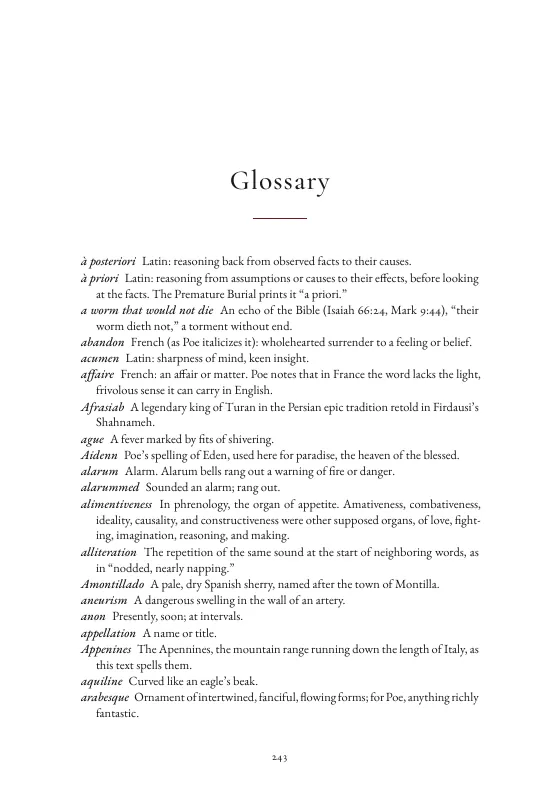
  • A who’s who in 49 entries, and a glossary of 506 terms: Poe’s rarer words, foreign phrases, names and allusions

Look inside

Title page
Title page
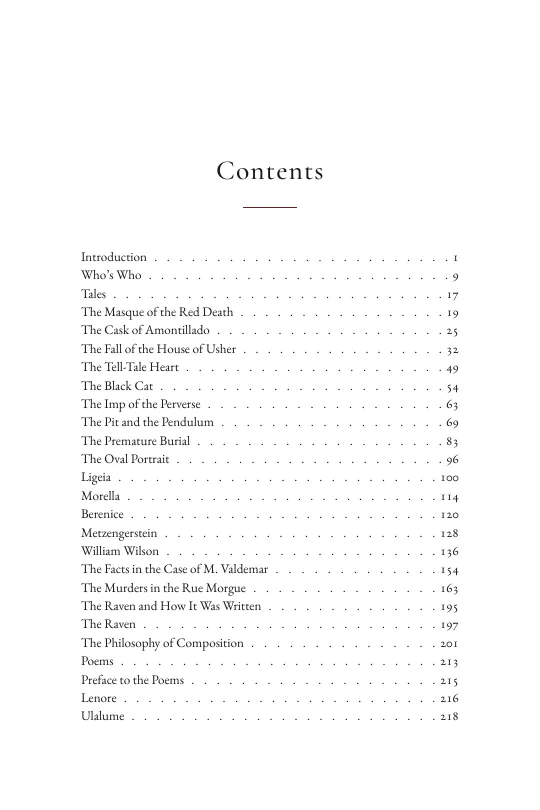
Contents
Contents
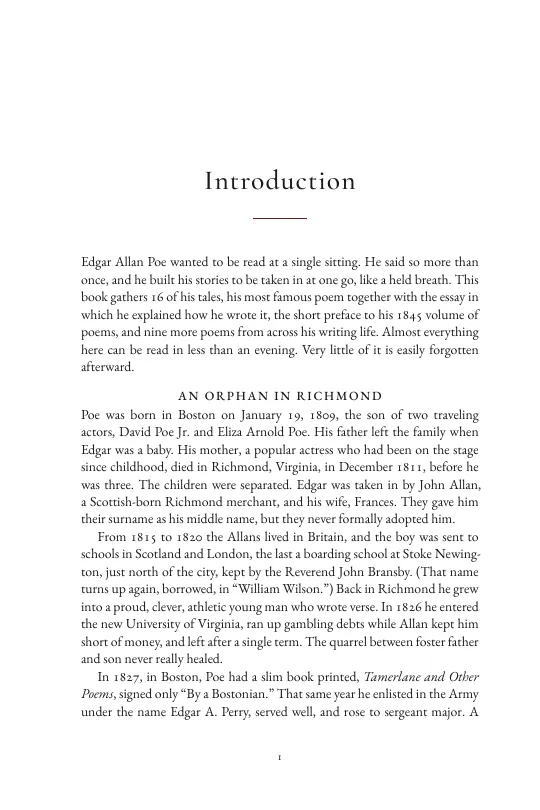
The introduction
The introduction
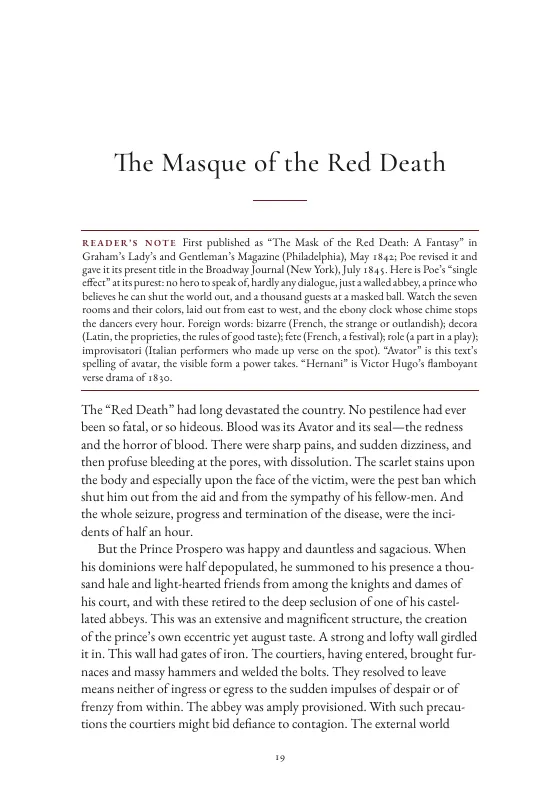
The Masque of the Red Death, with its reader’s note
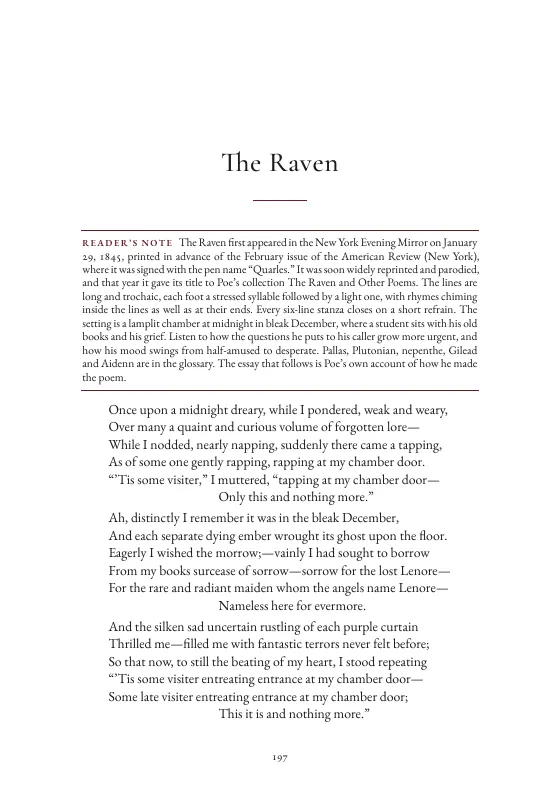
The Raven, with its reader’s note
The glossary
The glossary

Who’s who

  • Prince Prospero. Ruler of a country ravaged by the plague called the Red Death. Bold, eccentric, and devoted to pleasure and the bizarre, he shuts himself and a thousand courtiers inside one of his walled abbeys and gives a masked ball.
  • Montresor. The narrator of “The Cask of Amontillado,” heir of an old and once numerous family with its own coat of arms and vaults, who tells us he has borne Fortunato’s “thousand injuries” and has vowed revenge.
  • Fortunato. A rich, respected, and rather feared Italian gentleman who prides himself on his knowledge of wine. We meet him at carnival time, dressed in a jester’s motley and more than a little drunk.
  • Roderick Usher. The narrator’s boyhood friend and the master of the House of Usher, one of the last two of an ancient family: pale, nervous, painfully sensitive to light and sound, a painter, guitarist, and poet who has not left his house in years.
  • C. Auguste Dupin. A young Parisian of illustrious family, reduced to poverty and living frugally on what remains of his inheritance. A great reader who loves the night, he shares a crumbling house with the narrator and shows a startling analytic power.
  • The Raven. A stately bird “of the saintly days of yore” that steps in at the narrator’s window on a windy December midnight, with many a flirt and flutter, and perches on the bust of Pallas above his chamber door.

Choose your format

Every format includes the reader’s notes, the introduction, the who’s who and the glossary.

The hardcover and paperback editions (illustration)
Format
Ship to

Prices in US dollars. Printed books ship for a flat US$5.99 to the US or US$10.99 to Canada. Ebooks have no shipping charge. US sales tax, if any, is shown before you pay. Internationally fulfilled orders may be subject to customs duties or other import charges.

With tracked shipping, printed books usually arrive about 3 weeks after you order in the US and about 4 weeks in Canada.

Our promise

  • Order today and your hardcover or paperback ships within 14 days, or your ebook is emailed within 5 days. Your confirmation email gives the exact date.
  • Running late? We email you before that date, and you can keep waiting or cancel for a full refund.
  • Arrives damaged or misprinted, or not as this page describes? Email us a photo up to 30 days after delivery for a full refund or a replacement. No need to send it back.
  • Secure checkout by Stripe. Your card details go to Stripe, never to us. Your statement will show BOOKHAWK PRESS.

Shipping · Refunds

See how it works: two tales from the book

Each piece opens with a short note: where it first appeared, what to watch for, and translations of its epigraph and most of its Latin and French. Here are the first two tales in the book, with their notes.

The Masque of the Red Death

The “Red Death” had long devastated the country. No pestilence had ever been so fatal, or so hideous. Blood was its Avator and its seal—the redness and the horror of blood. There were sharp pains, and sudden dizziness, and then profuse bleeding at the pores, with dissolution. The scarlet stains upon the body and especially upon the face of the victim, were the pest ban which shut him out from the aid and from the sympathy of his fellow-men. And the whole seizure, progress and termination of the disease, were the incidents of half an hour.

Continue reading

But the Prince Prospero was happy and dauntless and sagacious. When his dominions were half depopulated, he summoned to his presence a thousand hale and light-hearted friends from among the knights and dames of his court, and with these retired to the deep seclusion of one of his castellated abbeys. This was an extensive and magnificent structure, the creation of the prince’s own eccentric yet august taste. A strong and lofty wall girdled it in. This wall had gates of iron. The courtiers, having entered, brought furnaces and massy hammers and welded the bolts. They resolved to leave means neither of ingress or egress to the sudden impulses of despair or of frenzy from within. The abbey was amply provisioned. With such precautions the courtiers might bid defiance to contagion. The external world could take care of itself. In the meantime it was folly to grieve, or to think. The prince had provided all the appliances of pleasure. There were buffoons, there were improvisatori, there were ballet-dancers, there were musicians, there was Beauty, there was wine. All these and security were within. Without was the “Red Death”.

It was toward the close of the fifth or sixth month of his seclusion, and while the pestilence raged most furiously abroad, that the Prince Prospero entertained his thousand friends at a masked ball of the most unusual magnificence.

It was a voluptuous scene, that masquerade. But first let me tell of the rooms in which it was held. There were seven—an imperial suite. In many palaces, however, such suites form a long and straight vista, while the folding doors slide back nearly to the walls on either hand, so that the view of the whole extent is scarcely impeded. Here the case was very different; as might have been expected from the duke’s love of the bizarre. The apartments were so irregularly disposed that the vision embraced but little more than one at a time. There was a sharp turn at every twenty or thirty yards, and at each turn a novel effect. To the right and left, in the middle of each wall, a tall and narrow Gothic window looked out upon a closed corridor which pursued the windings of the suite. These windows were of stained glass whose color varied in accordance with the prevailing hue of the decorations of the chamber into which it opened. That at the eastern extremity was hung, for example in blue—and vividly blue were its windows. The second chamber was purple in its ornaments and tapestries, and here the panes were purple. The third was green throughout, and so were the casements. The fourth was furnished and lighted with orange—the fifth with white—the sixth with violet. The seventh apartment was closely shrouded in black velvet tapestries that hung all over the ceiling and down the walls, falling in heavy folds upon a carpet of the same material and hue. But in this chamber only, the color of the windows failed to correspond with the decorations. The panes here were scarlet—a deep blood color. Now in no one of the seven apartments was there any lamp or candelabrum, amid the profusion of golden ornaments that lay scattered to and fro or depended from the roof. There was no light of any kind emanating from lamp or candle within the suite of chambers. But in the corridors that followed the suite, there stood, opposite to each window, a heavy tripod, bearing a brazier of fire, that projected its rays through the tinted glass and so glaringly illumined the room. And thus were produced a multitude of gaudy and fantastic appearances. But in the western or black chamber the effect of the fire-light that streamed upon the dark hangings through the blood-tinted panes, was ghastly in the extreme, and produced so wild a look upon the countenances of those who entered, that there were few of the company bold enough to set foot within its precincts at all.

It was in this apartment, also, that there stood against the western wall, a gigantic clock of ebony. Its pendulum swung to and fro with a dull, heavy, monotonous clang; and when the minute-hand made the circuit of the face, and the hour was to be stricken, there came from the brazen lungs of the clock a sound which was clear and loud and deep and exceedingly musical, but of so peculiar a note and emphasis that, at each lapse of an hour, the musicians of the orchestra were constrained to pause, momentarily, in their performance, to harken to the sound; and thus the waltzers perforce ceased their evolutions; and there was a brief disconcert of the whole gay company; and, while the chimes of the clock yet rang, it was observed that the giddiest grew pale, and the more aged and sedate passed their hands over their brows as if in confused revery or meditation. But when the echoes had fully ceased, a light laughter at once pervaded the assembly; the musicians looked at each other and smiled as if at their own nervousness and folly, and made whispering vows, each to the other, that the next chiming of the clock should produce in them no similar emotion; and then, after the lapse of sixty minutes, (which embrace three thousand and six hundred seconds of the Time that flies,) there came yet another chiming of the clock, and then were the same disconcert and tremulousness and meditation as before.

But, in spite of these things, it was a gay and magnificent revel. The tastes of the duke were peculiar. He had a fine eye for colors and effects. He disregarded the decora of mere fashion. His plans were bold and fiery, and his conceptions glowed with barbaric lustre. There are some who would have thought him mad. His followers felt that he was not. It was necessary to hear and see and touch him to be sure that he was not.

He had directed, in great part, the moveable embellishments of the seven chambers, upon occasion of this great fete; and it was his own guiding taste which had given character to the masqueraders. Be sure they were grotesque. There were much glare and glitter and piquancy and phantasm—much of what has been since seen in “Hernani.” There were arabesque figures with unsuited limbs and appointments. There were delirious fancies such as the madman fashions. There were much of the beautiful, much of the wanton, much of the bizarre, something of the terrible, and not a little of that which might have excited disgust. To and fro in the seven chambers there stalked, in fact, a multitude of dreams. And these—the dreams—writhed in, and about, taking hue from the rooms, and causing the wild music of the orchestra to seem as the echo of their steps. And, anon, there strikes the ebony clock which stands in the hall of the velvet. And then, for a moment, all is still, and all is silent save the voice of the clock. The dreams are stiff-frozen as they stand. But the echoes of the chime die away—they have endured but an instant—and a light, half-subdued laughter floats after them as they depart. And now again the music swells, and the dreams live, and writhe to and fro more merrily than ever, taking hue from the many tinted windows through which stream the rays from the tripods. But to the chamber which lies most westwardly of the seven, there are now none of the maskers who venture; for the night is waning away; and there flows a ruddier light through the blood-colored panes; and the blackness of the sable drapery appals; and to him whose foot falls upon the sable carpet, there comes from the near clock of ebony a muffled peal more solemnly emphatic than any which reaches their ears who indulge in the more remote gaieties of the other apartments.

But these other apartments were densely crowded, and in them beat feverishly the heart of life. And the revel went whirlingly on, until at length there commenced the sounding of midnight upon the clock. And then the music ceased, as I have told; and the evolutions of the waltzers were quieted; and there was an uneasy cessation of all things as before. But now there were twelve strokes to be sounded by the bell of the clock; and thus it happened, perhaps that more of thought crept, with more of time, into the meditations of the thoughtful among those who revelled. And thus too, it happened, perhaps, that before the last echoes of the last chime had utterly sunk into silence, there were many individuals in the crowd who had found leisure to become aware of the presence of a masked figure which had arrested the attention of no single individual before. And the rumor of this new presence having spread itself whisperingly around, there arose at length from the whole company a buzz, or murmur, expressive of disapprobation and surprise—then, finally, of terror, of horror, and of disgust.

In an assembly of phantasms such as I have painted, it may well be supposed that no ordinary appearance could have excited such sensation. In truth the masquerade license of the night was nearly unlimited; but the figure in question had out-Heroded Herod, and gone beyond the bounds of even the prince’s indefinite decorum. There are chords in the hearts of the most reckless which cannot be touched without emotion. Even with the utterly lost, to whom life and death are equally jests, there are matters of which no jest can be made. The whole company, indeed, seemed now deeply to feel that in the costume and bearing of the stranger neither wit nor propriety existed. The figure was tall and gaunt, and shrouded from head to foot in the habiliments of the grave. The mask which concealed the visage was made so nearly to resemble the countenance of a stiffened corpse that the closest scrutiny must have had difficulty in detecting the cheat. And yet all this might have been endured, if not approved, by the mad revellers around. But the mummer had gone so far as to assume the type of the Red Death. His vesture was dabbled in blood—and his broad brow, with all the features of the face, was besprinkled with the scarlet horror.

When the eyes of Prince Prospero fell upon this spectral image (which with a slow and solemn movement, as if more fully to sustain its role, stalked to and fro among the waltzers) he was seen to be convulsed, in the first moment with a strong shudder either of terror or distaste; but, in the next, his brow reddened with rage.

“Who dares?” he demanded hoarsely of the courtiers who stood near him—“who dares insult us with this blasphemous mockery? Seize him and unmask him—that we may know whom we have to hang at sunrise, from the battlements!”

It was in the eastern or blue chamber in which stood the Prince Prospero as he uttered these words. They rang throughout seven rooms loudly and clearly—for the prince was a bold and robust man, and the music had become hushed at the waving of his hand.

It was in the blue room where stood the prince, with a group of pale courtiers by his side. At first, as he spoke, there was a slight rushing movement of this group in the direction of the intruder, who, at the moment was also near at hand, and now, with deliberate and stately step, made closer approach to the speaker. But from a certain nameless awe with which the mad assumptions of the mummer had inspired the whole party, there were found none who put forth hand to seize him; so that, unimpeded, he passed within a yard of the prince’s person; and, while the vast assembly, as if with one impulse, shrank from the centres of the rooms to the walls, he made his way uninterruptedly, but with the same solemn and measured step which had distinguished him from the first, through the blue chamber to the purple—through the purple to the green—through the green to the orange—through this again to the white—and even thence to the violet, ere a decided movement had been made to arrest him. It was then, however, that the Prince Prospero, maddening with rage and the shame of his own momentary cowardice, rushed hurriedly through the six chambers, while none followed him on account of a deadly terror that had seized upon all. He bore aloft a drawn dagger, and had approached, in rapid impetuosity, to within three or four feet of the retreating figure, when the latter, having attained the extremity of the velvet apartment, turned suddenly and confronted his pursuer. There was a sharp cry—and the dagger dropped gleaming upon the sable carpet, upon which, instantly afterwards, fell prostrate in death the Prince Prospero. Then, summoning the wild courage of despair, a throng of the revellers at once threw themselves into the black apartment, and, seizing the mummer, whose tall figure stood erect and motionless within the shadow of the ebony clock, gasped in unutterable horror at finding the grave cerements and corpse-like mask which they handled with so violent a rudeness, untenanted by any tangible form.

And now was acknowledged the presence of the Red Death. He had come like a thief in the night. And one by one dropped the revellers in the blood-bedewed halls of their revel, and died each in the despairing posture of his fall. And the life of the ebony clock went out with that of the last of the gay. And the flames of the tripods expired. And Darkness and Decay and the Red Death held illimitable dominion over all.

The Cask of Amontillado

The thousand injuries of Fortunato I had borne as I best could; but when he ventured upon insult, I vowed revenge. You, who so well know the nature of my soul, will not suppose, however, that I gave utterance to a threat. At length I would be avenged; this was a point definitively settled—but the very definitiveness with which it was resolved, precluded the idea of risk. I must not only punish, but punish with impunity. A wrong is unredressed when retribution overtakes its redresser. It is equally unredressed when the avenger fails to make himself felt as such to him who has done the wrong.

Continue reading

It must be understood, that neither by word nor deed had I given Fortunato cause to doubt my good will. I continued, as was my wont, to smile in his face, and he did not perceive that my smile now was at the thought of his immolation.

He had a weak point—this Fortunato—although in other regards he was a man to be respected and even feared. He prided himself on his connoisseurship in wine. Few Italians have the true virtuoso spirit. For the most part their enthusiasm is adopted to suit the time and opportunity—to practise imposture upon the British and Austrian millionaires. In painting and gemmary Fortunato, like his countrymen, was a quack—but in the matter of old wines he was sincere. In this respect I did not differ from him materially: I was skilful in the Italian vintages myself, and bought largely whenever I could.

It was about dusk, one evening during the supreme madness of the carnival season, that I encountered my friend. He accosted me with excessive warmth, for he had been drinking much. The man wore motley. He had on a tight-fitting parti-striped dress, and his head was surmounted by the conical cap and bells. I was so pleased to see him, that I thought I should never have done wringing his hand.

I said to him—“My dear Fortunato, you are luckily met. How remarkably well you are looking to-day! But I have received a pipe of what passes for Amontillado, and I have my doubts.”

“How?” said he. “Amontillado? A pipe! Impossible! And in the middle of the carnival!”

“I have my doubts,” I replied; “and I was silly enough to pay the full Amontillado price without consulting you in the matter. You were not to be found, and I was fearful of losing a bargain.”

“Amontillado!”

“I have my doubts.”

“Amontillado!”

“And I must satisfy them.”

“Amontillado!”

“As you are engaged, I am on my way to Luchesi. If any one has a critical turn, it is he. He will tell me—”

“Luchesi cannot tell Amontillado from Sherry.”

“And yet some fools will have it that his taste is a match for your own.”

“Come, let us go.”

“Whither?”

“To your vaults.”

“My friend, no; I will not impose upon your good nature. I perceive you have an engagement. Luchesi—”

“I have no engagement;—come.”

“My friend, no. It is not the engagement, but the severe cold with which I perceive you are afflicted. The vaults are insufferably damp. They are encrusted with nitre.”

“Let us go, nevertheless. The cold is merely nothing. Amontillado! You have been imposed upon. And as for Luchesi, he cannot distinguish Sherry from Amontillado.”

Thus speaking, Fortunato possessed himself of my arm. Putting on a mask of black silk, and drawing a roquelaire closely about my person, I suffered him to hurry me to my palazzo.

There were no attendants at home; they had absconded to make merry in honor of the time. I had told them that I should not return until the morning, and had given them explicit orders not to stir from the house. These orders were sufficient, I well knew, to insure their immediate disappearance, one and all, as soon as my back was turned.

I took from their sconces two flambeaux, and giving one to Fortunato, bowed him through several suites of rooms to the archway that led into the vaults. I passed down a long and winding staircase, requesting him to be cautious as he followed. We came at length to the foot of the descent, and stood together on the damp ground of the catacombs of the Montresors.

The gait of my friend was unsteady, and the bells upon his cap jingled as he strode.

“The pipe,” said he.

“It is farther on,” said I; “but observe the white web-work which gleams from these cavern walls.”

He turned towards me, and looked into my eyes with two filmy orbs that distilled the rheum of intoxication.

“Nitre?” he asked, at length.

“Nitre,” I replied. “How long have you had that cough?”

“Ugh! ugh! ugh!—ugh! ugh! ugh!—ugh! ugh! ugh!—ugh! ugh! ugh!—ugh! ugh! ugh!”

My poor friend found it impossible to reply for many minutes.

“It is nothing,” he said, at last.

“Come,” I said, with decision, “we will go back; your health is precious. You are rich, respected, admired, beloved; you are happy, as once I was. You are a man to be missed. For me it is no matter. We will go back; you will be ill, and I cannot be responsible. Besides, there is Luchesi——”

“Enough,” he said; “the cough is a mere nothing; it will not kill me. I shall not die of a cough.”

“True—true,” I replied; “and, indeed, I had no intention of alarming you unnecessarily—but you should use all proper caution. A draught of this Medoc will defend us from the damps.”

Here I knocked off the neck of a bottle which I drew from a long row of its fellows that lay upon the mould.

“Drink,” I said, presenting him the wine.

He raised it to his lips with a leer. He paused and nodded to me familiarly, while his bells jingled.

“I drink,” he said, “to the buried that repose around us.”

“And I to your long life.”

He again took my arm, and we proceeded.

“These vaults,” he said, “are extensive.”

“The Montresors,” I replied, “were a great and numerous family.”

“I forget your arms.”

“A huge human foot d’or, in a field azure; the foot crushes a serpent rampant whose fangs are imbedded in the heel.”

“And the motto?”

“Nemo me impune lacessit.”

“Good!” he said.

The wine sparkled in his eyes and the bells jingled. My own fancy grew warm with the Medoc. We had passed through walls of piled bones, with casks and puncheons intermingling, into the inmost recesses of the catacombs. I paused again, and this time I made bold to seize Fortunato by an arm above the elbow.

“The nitre!” I said; “see, it increases. It hangs like moss upon the vaults. We are below the river’s bed. The drops of moisture trickle among the bones. Come, we will go back ere it is too late. Your cough—”

“It is nothing,” he said; “let us go on. But first, another draught of the Medoc.”

I broke and reached him a flaçon of De Grâve. He emptied it at a breath. His eyes flashed with a fierce light. He laughed and threw the bottle upwards with a gesticulation I did not understand.

I looked at him in surprise. He repeated the movement—a grotesque one.

“You do not comprehend?” he said.

“Not I,” I replied.

“Then you are not of the brotherhood.”

“How?”

“You are not of the masons.”

“Yes, yes,” I said, “yes, yes.”

“You? Impossible! A mason?”

“A mason,” I replied.

“A sign,” he said.

“It is this,” I answered, producing a trowel from beneath the folds of my roquelaire.

“You jest,” he exclaimed, recoiling a few paces. “But let us proceed to the Amontillado.”

“Be it so,” I said, replacing the tool beneath the cloak, and again offering him my arm. He leaned upon it heavily. We continued our route in search of the Amontillado. We passed through a range of low arches, descended, passed on, and descending again, arrived at a deep crypt, in which the foulness of the air caused our flambeaux rather to glow than flame.

At the most remote end of the crypt there appeared another less spacious. Its walls had been lined with human remains, piled to the vault overhead, in the fashion of the great catacombs of Paris. Three sides of this interior crypt were still ornamented in this manner. From the fourth side the bones had been thrown down, and lay promiscuously upon the earth, forming at one point a mound of some size. Within the wall thus exposed by the displacing of the bones, we perceived a still interior recess, in depth about four feet, in width three, in height six or seven. It seemed to have been constructed for no especial use within itself, but formed merely the interval between two of the colossal supports of the roof of the catacombs, and was backed by one of their circumscribing walls of solid granite.

It was in vain that Fortunato, uplifting his dull torch, endeavored to pry into the depth of the recess. Its termination the feeble light did not enable us to see.

“Proceed,” I said; “herein is the Amontillado. As for Luchesi——”

“He is an ignoramus,” interrupted my friend, as he stepped unsteadily forward, while I followed immediately at his heels. In an instant he had reached the extremity of the niche, and finding his progress arrested by the rock, stood stupidly bewildered. A moment more and I had fettered him to the granite. In its surface were two iron staples, distant from each other about two feet, horizontally. From one of these depended a short chain, from the other a padlock. Throwing the links about his waist, it was but the work of a few seconds to secure it. He was too much astounded to resist. Withdrawing the key I stepped back from the recess.

“Pass your hand,” I said, “over the wall; you cannot help feeling the nitre. Indeed it is very damp. Once more let me implore you to return. No? Then I must positively leave you. But I must first render you all the little attentions in my power.”

“The Amontillado!” ejaculated my friend, not yet recovered from his astonishment.

“True,” I replied; “the Amontillado.”

As I said these words I busied myself among the pile of bones of which I have before spoken. Throwing them aside, I soon uncovered a quantity of building stone and mortar. With these materials and with the aid of my trowel, I began vigorously to wall up the entrance of the niche.

I had scarcely laid the first tier of the masonry when I discovered that the intoxication of Fortunato had in a great measure worn off. The earliest indication I had of this was a low moaning cry from the depth of the recess. It was not the cry of a drunken man. There was then a long and obstinate silence. I laid the second tier, and the third, and the fourth; and then I heard the furious vibrations of the chain. The noise lasted for several minutes, during which, that I might hearken to it with the more satisfaction, I ceased my labors and sat down upon the bones. When at last the clanking subsided, I resumed the trowel, and finished without interruption the fifth, the sixth, and the seventh tier. The wall was now nearly upon a level with my breast. I again paused, and holding the flambeaux over the mason-work, threw a few feeble rays upon the figure within.

A succession of loud and shrill screams, bursting suddenly from the throat of the chained form, seemed to thrust me violently back. For a brief moment I hesitated—I trembled. Unsheathing my rapier, I began to grope with it about the recess: but the thought of an instant reassured me. I placed my hand upon the solid fabric of the catacombs, and felt satisfied. I reapproached the wall. I replied to the yells of him who clamored. I re-echoed—I aided—I surpassed them in volume and in strength. I did this, and the clamorer grew still.

It was now midnight, and my task was drawing to a close. I had completed the eighth, the ninth, and the tenth tier. I had finished a portion of the last and the eleventh; there remained but a single stone to be fitted and plastered in. I struggled with its weight; I placed it partially in its destined position. But now there came from out the niche a low laugh that erected the hairs upon my head. It was succeeded by a sad voice, which I had difficulty in recognising as that of the noble Fortunato. The voice said—

“Ha! ha! ha!—he! he!—a very good joke indeed—an excellent jest. We will have many a rich laugh about it at the palazzo—he! he! he!—over our wine—he! he! he!”

“The Amontillado!” I said.

“He! he! he!—he! he! he!—yes, the Amontillado. But is it not getting late? Will not they be awaiting us at the palazzo, the Lady Fortunato and the rest? Let us be gone.”

“Yes,” I said, “let us be gone.”

“For the love of God, Montresor!”

“Yes,” I said, “for the love of God!”

But to these words I hearkened in vain for a reply. I grew impatient. I called aloud—

“Fortunato!”

No answer. I called again—

“Fortunato!”

No answer still. I thrust a torch through the remaining aperture and let it fall within. There came forth in return only a jingling of the bells. My heart grew sick—on account of the dampness of the catacombs. I hastened to make an end of my labor. I forced the last stone into its position; I plastered it up. Against the new masonry I re-erected the old rampart of bones. For the half of a century no mortal has disturbed them. In pace requiescat!

Enjoyed The Cask of Amontillado? Get the whole book.

That’s how every piece in this edition works: a short note, then the piece itself. All 28 of them.

Hardcover US$39.99 · Paperback US$25.99 · Ebook US$15.99

Get my copy · from US$15.99

Not ready yet? Get a tale and two poems free by email

The Oval Portrait, one of Poe’s shortest and strangest tales, and two of his best-loved poems, The Bells and Annabel Lee, each with its reader’s note (PDF, 14 pages).

We’ll email the sample whether or not you tick the box. Sent by Bookhawk Press (Space Dog Tech LLC), 411 Walnut St, PMB 22412, Green Cove Springs, FL 32043, USA · support@bookhawkpress.com. Privacy

Questions

Is Poe hard going for a modern reader, with all the Latin, French and old words? How does this edition make it easy?
Much less than you’d fear. The note before every piece translates its foreign-language epigraph and many of its foreign phrases (Montresor’s Nemo me impune lacessit: ‘No one provokes me with impunity’) and tells you what to watch for. The glossary of 506 terms covers the rest: rarer words like ‘castellated’ (built like a castle, with towers and battlements), names and allusions. A who’s who of 49 entries keeps the names straight, and almost every piece can be read in less than an evening.
Which text is this, and is each piece given in full?
Yes, each piece is given in full. The text is the first collected edition of Poe’s works, The Works of the Late Edgar Allan Poe, edited by Rufus Wilmot Griswold (New York: J. S. Redfield, 1850): the tales from its vol. I, the poems and miscellanies from its vol. II. This book is a selection of 28 pieces. Where the 1850 text differs interestingly from an earlier printing, the note says so.
Which tales and poems are included?
The tales: The Masque of the Red Death, The Cask of Amontillado, The Fall of the House of Usher, The Tell-Tale Heart, The Black Cat, The Imp of the Perverse, The Pit and the Pendulum, The Premature Burial, The Oval Portrait, Ligeia, Morella, Berenice, Metzengerstein, William Wilson, The Facts in the Case of M. Valdemar and The Murders in the Rue Morgue. Then The Raven with The Philosophy of Composition. Then Poe’s 1845 preface and Lenore, Ulalume, The Bells, Annabel Lee, The City in the Sea, The Sleeper, A Dream Within a Dream, Dream-Land and Eldorado. Two pieces are free to read on this page, each with its note, and a free sample by email brings The Oval Portrait, The Bells and Annabel Lee, each with its reader’s note.
Do the notes give away the endings?
No. The notes never reveal how a story ends, as the introduction says. A note may tell you how a piece opens and what to watch for, like the seven colored rooms of Prince Prospero’s abbey. Words at the very end of a tale, where a translation in advance would give too much away, are left to the glossary.
What is The Philosophy of Composition, and why does it follow The Raven?
It’s Poe’s own account, published in April 1846, of how he wrote The Raven. He claims he built it step by step ‘with the precision and rigid consequence of a mathematical problem,’ starting from the effect he wanted and the refrain. It follows the poem so you can read The Raven fresh, then watch Poe take it apart. How far to believe him, readers still argue; the introduction calls the essay at least partly a performance, and a very entertaining one.
Why are some words spelled oddly (visiter, any thing, for ever)?
They’re the spellings of the 1850 edition, kept as they stand because they belong to Poe’s world: visiter, any thing, for ever, revery for reverie. You’ll read past them in a page. The words are printed as the source gives them, and Griswold’s texts largely follow the later versions Poe had most recently worked over. The notes and glossary do the explaining, such as ‘avator,’ this text’s spelling of avatar.
How is the ebook delivered?
By email. Emailed within 5 days. You get an EPUB for Kindle (through Amazon’s Send to Kindle), Kobo, Apple Books and most reading apps, plus a PDF in the print layout.
Where do you ship, and how long does it take?
We sell and ship to the US and Canada only. Printed books ship for a flat US$5.99 to the US and US$10.99 to Canada, and usually arrive in about 3 weeks in the US and about 4 weeks in Canada. Each copy is printed for its order and sent straight to you by tracked mail. Ships within 14 days.
Can I cancel, and what if something goes wrong?
Yes: you can cancel for a full refund until your order goes to print, and if we might miss the date in your order confirmation, we email before it and you can cancel for a full refund. If a printed book arrives damaged or misprinted, or isn’t what this page describes, email a photo up to 30 days after delivery and we’ll refund in full or replace it, with no return; the same if tracking shows no movement for 10 business days. Undamaged books can’t be taken back. Details: bookhawkpress.com/refunds.
Who is Bookhawk Press?
An independent publisher based in the United States that sells direct from its own site. This book is part of our Reader’s Companion Edition series. Questions? Write to support@bookhawkpress.com.
What is the hardcover like?
A hardcover to keep or to give: 6 × 9 inches, 268 pages, cream paper. The cover is printed on rigid boards, matte finish, no dust jacket.

About Bookhawk Press

Bookhawk Press is an independent publisher of carefully edited books in print and ebook. We sell direct from our own site, and each copy is printed for your order and shipped straight to you. Questions before you order? Email support@bookhawkpress.com. We answer every message, usually in two business days.

See all our books

Order The Raven and Tales of Terror