


Chapter II
The Seven Hermetic Principles
“The Principles of Truth are Seven; he who knows these, understandingly, possesses the Magic Key before whose touch all the Doors of the Temple fly open.”—The Kybalion.
The Seven Hermetic Principles, upon which the entire Hermetic Philosophy is based, are as follows:
I. THE PRINCIPLE OF MENTALISM.
II. THE PRINCIPLE OF CORRESPONDENCE.
III. THE PRINCIPLE OF VIBRATION.
IV. THE PRINCIPLE OF POLARITY.
V. THE PRINCIPLE OF RHYTHM.
VI. THE PRINCIPLE OF CAUSE AND EFFECT.
VII. THE PRINCIPLE OF GENDER.
These Seven Principles will be discussed and explained as we proceed with these lessons. A short explanation of each, however, may as well be given at this point.
I. THE PRINCIPLE OF MENTALISM.
“THE ALL is MIND; The Universe is Mental.”—The Kybalion.
This Principle embodies the truth that “All is Mind.” It explains that THE ALL (which is the Substantial Reality underlying all the outward manifestations and appearances which we know under the terms of “The Material Universe”; the “Phenomena of Life”; “Matter”; “Energy”; and, in short, all that is apparent to our material senses) is SPIRIT, which in itself is UNKNOWABLE and UNDEFINABLE, but which may be considered and thought of as AN UNIVERSAL, INFINITE, LIVING MIND. It also explains that all the phenomenal world or universe is simply a Mental Creation of THE ALL, subject to the Laws of Created Things, and that the universe, as a whole, and in its parts or units, has its existence in the Mind of THE ALL, in which Mind we “live and move and have our being.” This Principle, by establishing the Mental Nature of the Universe, easily explains all of the varied mental and psychic phenomena that occupy such a large portion of the public attention, and which, without such explanation, are non-understandable and defy scientific treatment. An understanding of this great Hermetic Principle of Mentalism enables the individual to readily grasp the laws of the Mental Universe, and to apply the same to his well-being and advancement. The Hermetic Student is enabled to apply intelligently the great Mental Laws, instead of using them in a haphazard manner. With the Master-Key in his possession, the student may unlock the many doors of the mental and psychic temple of knowledge, and enter the same freely and intelligently. This Principle explains the true nature of “Energy,” “Power,” and “Matter,” and why and how all these are subordinate to the Mastery of Mind. One of the old Hermetic Masters wrote, long ages ago: “He who grasps the truth of the Mental Nature of the Universe is well advanced on The Path to Mastery.” And these words are as true to-day as at the time they were first written. Without this Master-Key, Mastery is impossible, and the student knocks in vain at the many doors of The Temple.
II. THE PRINCIPLE OF CORRESPONDENCE.
“As above, so below; as below, so above.”—The Kybalion.
This Principle embodies the truth that there is always a Correspondence between the laws and phenomena of the various planes of Being and Life. The old Hermetic axiom ran in these words: “As above, so below; as below, so above.” And the grasping of this Principle gives one the means of solving many a dark paradox, and hidden secret of Nature. There are planes beyond our knowing, but when we apply the Principle of Correspondence to them we are able to understand much that would otherwise be unknowable to us. This Principle is of universal application and manifestation, on the various planes of the material, mental, and spiritual universe—it is an Universal Law. The ancient Hermetists considered this Principle as one of the most important mental instruments by which man was able to pry aside the obstacles which hid from view the Unknown. Its use even tore aside the Veil of Isis to the extent that a glimpse of the face of the goddess might be caught. Just as a knowledge of the Principles of Geometry enables man to measure distant suns and their movements, while seated in his observatory, so a knowledge of the Principle of Correspondence enables Man to reason intelligently from the Known to the Unknown. Studying the monad, he understands the archangel.
III. THE PRINCIPLE OF VIBRATION.
“Nothing rests; everything moves; everything vibrates.”—The Kybalion.
This Principle embodies the truth that “everything is in motion”; “everything vibrates”; “nothing is at rest”; facts which Modern Science endorses, and which each new scientific discovery tends to verify. And yet this Hermetic Principle was enunciated thousands of years ago, by the Masters of Ancient Egypt. This Principle explains that the differences between different manifestations of Matter, Energy, Mind, and even Spirit, result largely from varying rates of Vibration. From THE ALL, which is Pure Spirit, down to the grossest form of Matter, all is in vibration—the higher the vibration, the higher the position in the scale. The vibration of Spirit is at such an infinite rate of intensity and rapidity that it is practically at rest—just as a rapidly moving wheel seems to be motionless. And at the other end of the scale, there are gross forms of matter whose vibrations are so low as to seem at rest. Between these poles, there are millions upon millions of varying degrees of vibration. From corpuscle and electron, atom and molecule, to worlds and universes, everything is in vibratory motion. This is also true on the planes of energy and force (which are but varying degrees of vibration); and also on the mental planes (whose states depend upon vibrations); and even on to the spiritual planes. An understanding of this Principle, with the appropriate formulas, enables Hermetic students to control their own mental vibrations as well as those of others. The Masters also apply this Principle to the conquering of Natural phenomena, in various ways. “He who understands the Principle of Vibration, has grasped the sceptre of power,” says one of the old writers.
IV. THE PRINCIPLE OF POLARITY.
“Everything is Dual; everything has poles; everything has its pair of opposites; like and unlike are the same; opposites are identical in nature, but different in degree; extremes meet; all truths are but half-truths; all paradoxes may be reconciled.”—The Kybalion.
This Principle embodies the truth that “everything is dual”; “everything has two poles”; “everything has its pair of opposites,” all of which were old Hermetic axioms. It explains the old paradoxes, that have perplexed so many, which have been stated as follows: “Thesis and antithesis are identical in nature, but different in degree”; “opposites are the same, differing only in degree”; “the pairs of opposites may be reconciled”; “extremes meet”; “everything is and isn’t, at the same time”; “all truths are but half-truths”; “every truth is half-false”; “there are two sides to everything,” etc., etc., etc. It explains that in everything there are two poles, or opposite aspects, and that “opposites” are really only the two extremes of the same thing, with many varying degrees between them. To illustrate: Heat and Cold, although “opposites,” are really the same thing, the differences consisting merely of degrees of the same thing. Look at your thermometer and see if you can discover where “heat” terminates and “cold” begins! There is no such thing as “absolute heat” or “absolute cold”—the two terms “heat” and “cold” simply indicate varying degrees of the same thing, and that “same thing” which manifests as “heat” and “cold” is merely a form, variety, and rate of Vibration. So “heat” and “cold” are simply the “two poles” of that which we call “Heat”—and the phenomena attendant thereupon are manifestations of the Principle of Polarity. The same Principle manifests in the case of “Light and Darkness,” which are the same thing, the difference consisting of varying degrees between the two poles of the phenomena. Where does “darkness” leave off, and “light” begin? What is the difference between “Large and Small”? Between “Hard and Soft”? Between “Black and White”? Between “Sharp and Dull”? Between “Noise and Quiet”? Between “High and Low”? Between “Positive and Negative”? The Principle of Polarity explains these paradoxes, and no other Principle can supersede it. The same Principle operates on the Mental Plane. Let us take a radical and extreme example—that of “Love and Hate,” two mental states apparently totally different. And yet there are degrees of Hate and degrees of Love, and a middle point in which we use the terms “Like or Dislike,” which shade into each other so gradually that sometimes we are at a loss to know whether we “like” or “dislike” or “neither.” And all are simply degrees of the same thing, as you will see if you will but think a moment. And, more than this (and considered of more importance by the Hermetists), it is possible to change the vibrations of Hate to the vibrations of Love, in one’s own mind, and in the minds of others. Many of you, who read these lines, have had personal experiences of the involuntary rapid transition from Love to Hate, and the reverse, in your own case and that of others. And you will therefore realize the possibility of this being accomplished by the use of the Will, by means of the Hermetic formulas. “Good and Evil” are but the poles of the same thing, and the Hermetist understands the art of transmuting Evil into Good, by means of an application of the Principle of Polarity. In short, the “Art of Polarization” becomes a phase of “Mental Alchemy” known and practiced by the ancient and modern Hermetic Masters. An understanding of the Principle will enable one to change his own Polarity, as well as that of others, if he will devote the time and study necessary to master the art.
V. THE PRINCIPLE OF RHYTHM.
“Everything flows, out and in; everything has its tides; all things rise and fall; the pendulum-swing manifests in everything; the measure of the swing to the right is the measure of the swing to the left; rhythm compensates.”—The Kybalion.
This Principle embodies the truth that in everything there is manifested a measured motion, to and fro; a flow and inflow; a swing backward and forward; a pendulum-like movement; a tide-like ebb and flow; a high-tide and low-tide; between the two poles which exist in accordance with the Principle of Polarity described a moment ago. There is always an action and a reaction; an advance and a retreat; a rising and a sinking. This is in the affairs of the Universe, suns, worlds, men, animals, mind, energy, and matter. This law is manifest in the creation and destruction of worlds; in the rise and fall of nations; in the life of all things; and finally in the mental states of Man (and it is with this latter that the Hermetists find the understanding of the Principle most important). The Hermetists have grasped this Principle, finding its universal application, and have also discovered certain means to overcome its effects in themselves by the use of the appropriate formulas and methods. They apply the Mental Law of Neutralization. They cannot annul the Principle, or cause it to cease its operation, but they have learned how to escape its effects upon themselves to a certain degree depending upon the Mastery of the Principle. They have learned how to USE it, instead of being USED BY it. In this and similar methods, consist the Art of the Hermetists. The Master of Hermetics polarizes himself at the point at which he desires to rest, and then neutralizes the Rhythmic swing of the pendulum which would tend to carry him to the other pole. All individuals who have attained any degree of Self-Mastery do this to a certain degree, more or less unconsciously, but the Master does this consciously, and by the use of his Will, and attains a degree of Poise and Mental Firmness almost impossible of belief on the part of the masses who are swung backward and forward like a pendulum. This Principle and that of Polarity have been closely studied by the Hermetists, and the methods of counteracting, neutralizing, and USING them form an important part of the Hermetic Mental Alchemy.
VI. THE PRINCIPLE OF CAUSE AND EFFECT.
“Every Cause has its Effect; every Effect has its Cause; everything happens according to Law; Chance is but a name for Law not recognized; there are many planes of causation, but nothing escapes the Law.”—The Kybalion.
This Principle embodies the fact that there is a Cause for every Effect; an Effect from every Cause. It explains that: “Everything Happens according to Law”; that nothing ever “merely happens”; that there is no such thing as Chance; that while there are various planes of Cause and Effect, the higher dominating the lower planes, still nothing ever entirely escapes the Law. The Hermetists understand the art and methods of rising above the ordinary plane of Cause and Effect, to a certain degree, and by mentally rising to a higher plane they become Causers instead of Effects. The masses of people are carried along, obedient to environment; the wills and desires of others stronger than themselves; heredity; suggestion; and other outward causes moving them about like pawns on the Chessboard of Life. But the Masters, rising to the plane above, dominate their moods, characters, qualities, and powers, as well as the environment surrounding them, and become Movers instead of pawns. They help to PLAY THE GAME OF LIFE, instead of being played and moved about by other wills and environment. They USE the Principle instead of being its tools. The Masters obey the Causation of the higher planes, but they help to RULE on their own plane. In this statement there is condensed a wealth of Hermetic knowledge—let him read who can.
VII. THE PRINCIPLE OF GENDER.
“Gender is in everything; everything has its Masculine and Feminine Principles; Gender manifests on all planes.”—The Kybalion.
VII. THE PRINCIPLE OF GENDER. This Principle embodies the truth that there is GENDER manifested in everything—the Masculine and Feminine Principles ever at work. This is true not only of the Physical Plane, but of the Mental and even the Spiritual Planes. On the Physical Plane, the Principle manifests as SEX, on the higher planes it takes higher forms, but the Principle is ever the same. No creation, physical, mental or spiritual, is possible without this Principle. An understanding of its laws will throw light on many a subject that has perplexed the minds of men. The Principle of Gender works ever in the direction of generation, regeneration, and creation. Everything, and every person, contains the two Elements or Principles, or this great Principle, within it, him or her. Every Male thing has the Female Element also; every Female contains also the Male Principle. If you would understand the philosophy of Mental and Spiritual Creation, Generation, and Re-generation, you must understand and study this Hermetic Principle. It contains the solution of many mysteries of Life. We caution you that this Principle has no reference to the many base, pernicious and degrading lustful theories, teachings and practices, which are taught under fanciful titles, and which are a prostitution of the great natural principle of Gender. Such base revivals of the ancient infamous forms of Phallicism tend to ruin mind, body and soul, and the Hermetic Philosophy has ever sounded the warning note against these degraded teachings which tend toward lust, licentiousness, and perversion of Nature’s principles. If you seek such teachings, you must go elsewhere for them—Hermeticism contains nothing for you along these lines. To the pure, all things are pure; to the base, all things are base.
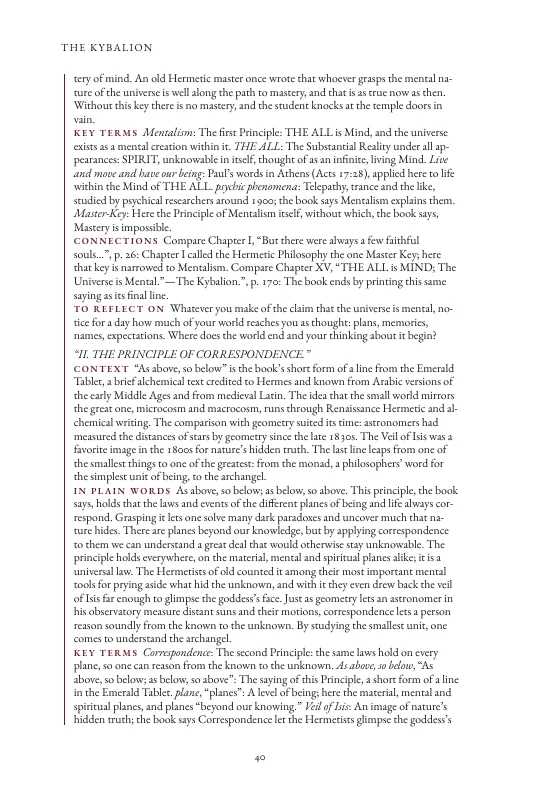
Read the companion to Chapter II
“The Principles of Truth are Seven…”
Context The second chapter lays out the plan of the whole book. Its opening saying promises that whoever knows seven Principles, “understandingly,” holds a key to every door of the Temple. Seven was a favored number in the occult writing of the day: Theosophy, for one, taught a sevenfold nature of man and seven planes of being, and older lore counted seven planets and seven days. The number also gives the book its shape, since the chapters after this one take up the Principles in turn. The word “understandingly” ties this saying to the first line of Chapter I, where wisdom speaks only to the ears of Understanding.
In plain words (our paraphrase, not the text) There are seven principles of truth, the saying goes, and whoever knows them with real understanding holds a magic key that opens every door of the temple. The whole Hermetic philosophy, the authors say, rests on these seven, and they now list them.
Key terms Master-Key, “Magic Key”: Here the key is knowledge of all seven Principles; later in the chapter Mentalism alone is called the Master-Key. The Temple: The book’s image for the whole house of hidden knowledge, whose doors open to the one who understands.
Connections Compare Chapter I, “The lips of wisdom are closed…”: Both sayings make understanding the condition: the lips of wisdom open, and the Temple doors fly open, only to it.
“I. THE PRINCIPLE OF MENTALISM.” to “These Seven Principles…”
Context The book now names its seven Principles in the order it will follow: Mentalism, Correspondence, Vibration, Polarity, Rhythm, Cause and Effect, and Gender. The list is the book’s own framework; no list like it appears in the Hermetic writings of late antiquity. The book doesn’t explain its order. One way to read it sees a movement from the nature of THE ALL as Mind, through the laws that link the planes and govern change, to the forces the book finds at work in every act of creation. Each name is printed in capitals, as the book prints all its terms of art.
In plain words The seven principles are: first, Mentalism; second, Correspondence; third, Vibration; fourth, Polarity; fifth, Rhythm; sixth, Cause and Effect; seventh, Gender. The later lessons will discuss and explain each one at length, but the authors think it useful to give a short account of all seven now.
Connections Compare Chapter I, “In this little book, of which this is…”: Chapter I promised the maxims of THE KYBALION with explanations; here the plan for giving them appears.
“I. THE PRINCIPLE OF MENTALISM.”
Context Mentalism comes first because, in the book’s scheme, everything else follows from it. Its claim, that the reality behind all appearances is an infinite living Mind and the universe a mental creation within it, stands in a long line of philosophical idealism and was central to the New Thought movement, which held mind to be the ruling reality. The phrase “live and move and have our being” is Paul’s, from his speech in Athens (Acts 17:28). The “mental and psychic phenomena” the book mentions were then being studied by psychical researchers, such as those of the Society for Psychical Research, founded in London in 1882. The book claims its principle explains them. It gives no source for the words of the “old Hermetic Master” it quotes.
In plain words THE ALL is mind; the universe is mental. This principle, the book says, holds that all is mind. THE ALL, the real substance beneath everything our senses meet as the material universe, life, matter and energy, is spirit. In itself it cannot be known or defined, but it can be thought of as a universal, infinite, living mind. The whole visible universe is a mental creation of THE ALL, subject to the laws that govern created things, and it exists, as a whole and in all its parts, within that mind, in which we live, move and exist. Because it shows the universe to be mental, the authors say, this principle readily explains the mental and psychic happenings that so interest the public and that otherwise baffle science. Understanding it lets a person grasp the laws of the mental universe and apply them to his own welfare and progress, knowingly instead of haphazardly. With this master key the student can open the many doors of the temple of mental and psychic knowledge. The principle also explains what energy, power and matter really are, and why all of them are subject to the mastery of mind. An old Hermetic master once wrote that whoever grasps the mental nature of the universe is well along the path to mastery, and that is as true now as then. Without this key there is no mastery, and the student knocks at the temple doors in vain.
Key terms Mentalism: The first Principle: THE ALL is Mind, and the universe exists as a mental creation within it. THE ALL: The Substantial Reality under all appearances: SPIRIT, unknowable in itself, thought of as an infinite, living Mind. Live and move and have our being: Paul’s words in Athens (Acts 17:28), applied here to life within the Mind of THE ALL. psychic phenomena: Telepathy, trance and the like, studied by psychical researchers around 1900; the book says Mentalism explains them. Master-Key: Here the Principle of Mentalism itself, without which, the book says, Mastery is impossible.
Connections Compare Chapter I, “But there were always a few faithful souls…”: Chapter I called the Hermetic Philosophy the one Master Key; here that key is narrowed to Mentalism.
To reflect on Whatever you make of the claim that the universe is mental, notice for a day how much of your world reaches you as thought: plans, memories, names, expectations. Where does the world end and your thinking about it begin?
“II. THE PRINCIPLE OF CORRESPONDENCE.”
Context “As above, so below” is the book’s short form of a line from the Emerald Tablet, a brief alchemical text credited to Hermes and known from Arabic versions of the early Middle Ages and from medieval Latin. The idea that the small world mirrors the great one, microcosm and macrocosm, runs through Renaissance Hermetic and alchemical writing. The comparison with geometry suited its time: astronomers had measured the distances of stars by geometry since the late 1830s. The Veil of Isis was a favorite image in the 1800s for nature’s hidden truth. The last line leaps from one of the smallest things to one of the greatest: from the monad, a philosophers’ word for the simplest unit of being, to the archangel.
In plain words As above, so below; as below, so above. This principle, the book says, holds that the laws and events of the different planes of being and life always correspond. Grasping it lets one solve many dark paradoxes and uncover much that nature hides. There are planes beyond our knowledge, but by applying correspondence to them we can understand a great deal that would otherwise stay unknowable. The principle holds everywhere, on the material, mental and spiritual planes alike; it is a universal law. The Hermetists of old counted it among their most important mental tools for prying aside what hid the unknown, and with it they even drew back the veil of Isis far enough to glimpse the goddess’s face. Just as geometry lets an astronomer in his observatory measure distant suns and their motions, correspondence lets a person reason soundly from the known to the unknown. By studying the smallest unit, one comes to understand the archangel.
Key terms Correspondence: The second Principle: the same laws hold on every plane, so one can reason from the known to the unknown. As above, so below, “As above, so below; as below, so above”: The saying of this Principle, a short form of a line in the Emerald Tablet. plane, “planes”: A level of being; here the material, mental and spiritual planes, and planes “beyond our knowing.” Veil of Isis: An image of nature’s hidden truth; the book says Correspondence let the Hermetists glimpse the goddess’s face. monad (MOH-nad): The simplest unit of being, set against the archangel to show reasoning from least to greatest.
Connections Compare Chapter I, “But among these great Masters of Ancient Egypt…”: Chapter I called Hermes the founder of astrology, an art built on correspondences between heaven and earth.
“III. THE PRINCIPLE OF VIBRATION.”
Context Here the book leans hardest on the science of its time. In the years around 1900, physics found motion almost everywhere: heat was understood as the motion of molecules, radio waves had been produced in the 1880s, X-rays and radioactivity were discovered in 1895 and 1896, and J. J. Thomson identified the “corpuscle,” now called the electron, in 1897. The book’s scale, on which matter, energy, mind and spirit differ by rate of vibration, is its own addition, not something physics measured then or measures now. Modern physics does describe matter in terms of waves and fields, but it assigns no vibration rate to mind or spirit. The “appropriate formulas” are not spelled out here.
In plain words Nothing rests; everything moves; everything vibrates. This principle, the book says, holds that everything is in motion and nothing is at rest, facts it says modern science confirms with each new discovery, though the masters of Egypt stated them thousands of years ago. It explains that matter, energy, mind and even spirit differ from one another mainly in their rates of vibration. From THE ALL, which is pure spirit, down to the coarsest matter, everything vibrates, and the higher the vibration, the higher the place on the scale. Spirit vibrates so fast and so intensely that it seems to be at rest, the way a wheel spinning very fast seems still; at the other end, some coarse matter vibrates so slowly that it too seems at rest. Between these poles lie countless degrees. Everything from the corpuscle and electron to atoms, molecules, worlds and universes is in vibration, and so are energy and force, which are only degrees of vibration, the mental planes, whose states depend on vibration, and even the spiritual planes. With the right formulas, the book says, understanding this principle lets Hermetic students control their own mental vibrations and those of others, and the masters use it in various ways to conquer natural phenomena. One of the old writers says that whoever understands vibration holds the sceptre of power.
Key terms Vibration: The third Principle: nothing rests, and things differ mainly in their rates of vibration, from spirit down to matter. corpuscle: J. J. Thomson’s 1897 word for the particle now called the electron; the book names it beside “electron.” Hermetic formulas, “appropriate formulas”: Methods the book says Hermetic students use to control mental vibrations, their own and others’; it doesn’t describe them here.
Connections Compare Chapter I, “In the early days, there was a compilation…”: Chapter I defined Hermetic alchemy as transmuting “Mental Vibrations”; here vibration becomes a principle of its own.
“IV. THE PRINCIPLE OF POLARITY.”
Context The thermometer example shows the book’s method: take a pair we treat as opposites and find one scale beneath it. Physics agreed that cold is simply less heat, but already in 1908 it held that there is an absolute zero of temperature, a lowest possible point, set out in the late 1840s by William Thomson, later Lord Kelvin; the book’s claim that there is no “absolute cold” doesn’t match that. Then comes the practical claim the book cares most about: that a trained will can shift a state such as hate toward love, in oneself and in others, and even turn evil into good. It calls this Mental Alchemy and returns to it later. Readers whose religious traditions treat good and evil as more than degrees of one thing will weigh that claim in their own way.
In plain words Everything is dual and has two poles, a pair of opposites; like and unlike are the same; opposites share one nature and differ only in degree; extremes meet; every truth is half a truth; every paradox can be reconciled. The principle, the book says, explains the old paradoxes that have puzzled so many: that thesis and antithesis differ only in degree, that everything is and isn’t at once, that there are two sides to everything. Opposites are only the two ends of one thing, with many degrees between. Heat and cold, for example, are one thing in different degrees: look at a thermometer and try to find where heat stops and cold starts. There is no absolute heat or absolute cold, only varying degrees of one thing, and that one thing is a form and rate of vibration. The same holds for light and darkness, large and small, hard and soft, black and white, noise and quiet, high and low, positive and negative. It holds on the mental plane too. Love and hate seem wholly different, yet each has degrees, and in the middle, liking and disliking shade into each other until we can’t tell which we feel. More important to the Hermetists, one can change the vibrations of hate into those of love, in one’s own mind and in others’. Many readers have seen love turn to hate, or hate to love, without meaning it; so, the authors argue, the same change can be made on purpose by the will, using Hermetic methods. Good and evil are likewise two poles of one thing, and the Hermetist, the book says, knows the art of turning evil into good. This art of polarization, in the book’s account, is a branch of the mental alchemy known and practiced by Hermetic masters old and new, and the authors hold that anyone willing to give it the time and study can learn to change his own polarity and that of others.
Key terms Polarity: The fourth Principle: opposites are the two ends of one thing, differing in degree. Thesis and antithesis: A claim and its counter-claim, which the book says are “identical in nature, but different in degree.” Mental Alchemy: The book’s name for changing a mental state from one pole toward the other by will; the “Art of Polarization” is one branch of it. Transmutation, “transmuting”: Here the changing of evil into good, or hate into love, which the book says the Hermetist can do.
Connections Compare Chapter I, “In the early days, there was a compilation…”: Chapter I said Hermetic alchemy transmutes mental states, not metals; this passage names how: by polarity.
To reflect on The book asks where “like” ends and “dislike” begins. Choose a person or task you feel mixed about and try placing your feeling on a scale instead of picking a side. Where on the scale does it sit today?
“V. THE PRINCIPLE OF RHYTHM.”
Context The saying’s “Everything flows” echoes a phrase long associated with the Greek thinker Heraclitus, of about 500 BCE, though the phrase is a later summary of his thought. Its image of a pendulum, which swings as far one way as the other, gives the book a law of compensation. Most of the passage, though, concerns moods, and here the book introduces what it calls the Mental Law of Neutralization: the Master fixes himself at the pole he chooses and neutralizes the swing that would carry him back. The book sets such Masters against “the masses,” a contrast between trained few and swinging many that runs through the book and belongs to the occult writing of its day.
In plain words Everything flows out and in, has its tides, rises and falls; the pendulum swings in everything, as far to the left as to the right; rhythm balances all. This principle, the book says, holds that everything moves to and fro between the two poles that Polarity describes: action and reaction, advance and retreat, rising and sinking. It shows in suns and worlds, people and animals, mind, energy and matter; in the making and unmaking of worlds, the rise and fall of nations, and above all, for the Hermetists, in human moods. The Hermetists cannot stop the principle, but they have found ways to escape its effects on themselves to a degree that depends on their mastery. They use what the book calls the Mental Law of Neutralization, learning to use rhythm instead of being used by it. The master sets himself at the pole where he wants to stay and cancels the swing that would carry him to the other. Everyone who has gained some self-mastery does this a little, mostly without knowing it; the master does it knowingly and by will, and reaches a steadiness the swinging crowd can hardly believe. Rhythm and Polarity, and ways to counter, neutralize and use them, form a large part of Hermetic mental alchemy.
Key terms Rhythm: The fifth Principle: everything swings like a pendulum or a tide, as far one way as the other. Mental Law of Neutralization: The book’s name for how a Master, it says, holds his chosen pole and cancels the return swing, to a degree set by his mastery. Mental Alchemy, “Hermetic Mental Alchemy”: Here the whole art of countering, neutralizing and using Rhythm and Polarity.
Connections Compare Chapter I, “And this policy of careful dissemination of the…”: Chapter I tells of teaching that decayed in India, Persia, Greece and Rome; compare that story with this principle’s rise and fall of nations.
To reflect on Think of a mood that swung back after running its course. How far did it go one way, and how far the other?
“VI. THE PRINCIPLE OF CAUSE AND EFFECT.”
Context The claim that “Chance is but a name for Law not recognized” echoes an older view, put by the philosopher David Hume in 1748, that there is no such thing as chance in the world, only our ignorance of the real causes. Physics has since moved on: quantum theory, from the 1920s, treats some events, such as the moment a radioactive atom decays, as a matter of probability, and physicists still discuss what that means. Among the forces the book says move “the masses” is “suggestion,” a word whose psychological sense grew out of the study of hypnotism in the 1800s. The chessboard image and the closing words, “let him read who can,” mark this as teaching held back for readers ready to take it further.
In plain words Every cause has its effect and every effect its cause; everything happens by law; chance is only the name for a law we haven’t recognized; there are many planes of causation, but nothing escapes the law. This principle, the book says, holds that nothing merely happens and there is no such thing as chance. There are different planes of cause and effect, with the higher governing the lower, yet nothing escapes the law entirely. The Hermetists know how to rise to some degree above the ordinary plane, and by rising mentally to a higher one they become causes instead of effects. Most people are carried along by their surroundings, by stronger wills and desires than their own, by heredity, by suggestion, and by other outside causes, moved about like pawns on the chessboard of life. The masters rise to the plane above; they govern their own moods, character, qualities and powers, and their surroundings too, and become movers instead of pawns. They help play the game of life instead of being played. They use the principle instead of being its tools. They obey the causes of the higher planes but help to rule on their own. A great deal of Hermetic knowledge is packed into this statement, the authors add, for those able to read it.
Key terms Cause and Effect: The sixth Principle: every effect has a cause, chance is unrecognized law, and causation works on higher and lower planes. plane, “planes of Cause and Effect”: Levels of causation; the book says the higher dominate the lower and the Masters rise mentally to a higher one. Master, “Masters”: Here those who rise above the ordinary plane and become “Movers instead of pawns.”
Connections Compare Chapter I, “So that according to the Teachings…”: Chapter I already called on this principle, in its aspect of attraction, to bring pupil and book together.
To reflect on The book sets “pawns” against “Movers.” Think of one decision you made this week and simply list the outside causes that helped shape it: habit, others’ wishes, surroundings, a passing suggestion.
“VII. THE PRINCIPLE OF GENDER.”
Context Gender, in the book’s sense, is wider than sex. Masculine and feminine are principles it finds on every plane and makes the condition of all creation. Pairing active and receptive powers as masculine and feminine was common in the occult and New Thought writing of 1908, and the book’s use of the words reflects its period’s ideas about men and women; it develops the principle in later chapters. The warning against Phallicism distances the book from sexual teachings that did circulate in occult circles of its time, and it closes with an echo of Titus 1:15. The 1908 text prints the heading twice, once on its own line and again at the head of the paragraph, and this edition keeps it that way.
In plain words Gender is in everything; everything has its masculine and feminine principles; gender shows itself on every plane. This principle, the book says, holds that the masculine and feminine principles are always at work, not only on the physical plane but on the mental and spiritual planes too. On the physical plane the principle appears as sex; on the higher planes it takes higher forms, but it is the same principle. No creation of any kind, physical, mental or spiritual, can happen without it, and understanding its laws sheds light on many puzzling subjects. It always works toward generation, regeneration and creation. Every thing and every person holds both elements: every male has the female element too, and every female the male. To understand mental and spiritual creation and regeneration, one must study this principle, which answers many of life’s mysteries. The authors then warn that it has nothing to do with the base, harmful and lustful theories and practices taught under fanciful names, which they call a debasement of a great natural principle. Such revivals of old phallic worship, they say, tend to ruin mind, body and soul, and Hermetic philosophy has always warned against them. Anyone looking for such teachings must go elsewhere. To the pure all things are pure; to the base, all things are base.
Key terms Gender: The seventh Principle: Masculine and Feminine Principles at work on every plane, appearing as sex on the physical plane and needed for all creation. Phallicism: Worship or symbolism of the male generative organ; the book uses the word to condemn sexual teachings it calls base. To the pure, all things are pure: An echo of Titus 1:15, closing the book’s warning about how its Principle of Gender should be read. plane, “Physical Plane”: The book names physical, mental and spiritual planes; Gender, it says, takes higher forms on the higher ones.
Connections Compare Chapter I, “Even to this day, we use the term…”: Like the pearls kept from swine in Chapter I, this closing warning turns away readers who come seeking the wrong thing.