

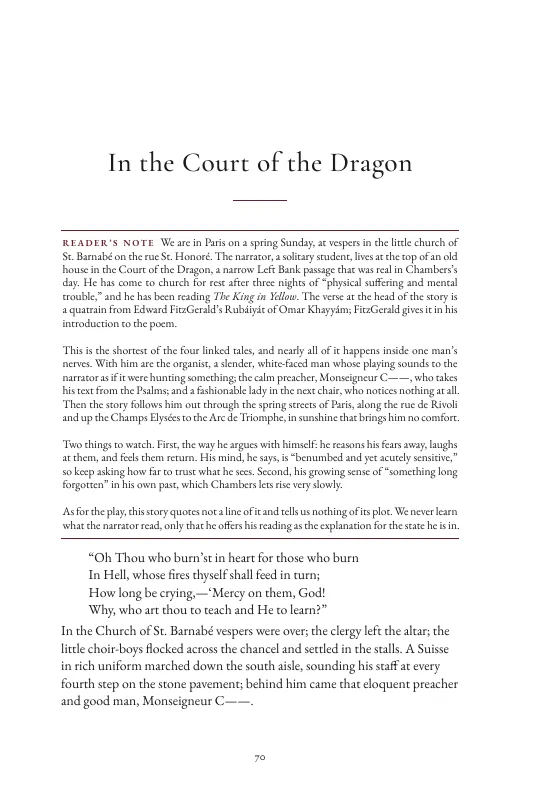

In the Court of the Dragon
“Oh Thou who burn’st in heart for those who burn
In Hell, whose fires thyself shall feed in turn;
How long be crying,—‘Mercy on them, God!
Why, who art thou to teach and He to learn?”
In the Church of St. Barnabé vespers were over; the clergy left the altar; the little choir-boys flocked across the chancel and settled in the stalls. A Suisse in rich uniform marched down the south aisle, sounding his staff at every fourth step on the stone pavement; behind him came that eloquent preacher and good man, Monseigneur C——.
Continue reading
My chair was near the chancel rail. I now turned toward the west end of the church. The other people between the altar and the pulpit turned too. There was a little scraping and rustling while the congregation seated itself again; the preacher mounted the pulpit stairs, and the organ voluntary ceased.
I had always found the organ-playing at St. Barnabé highly interesting. Learned and scientific it was, too much so for my small knowledge, but expressing a vivid if cold intelligence. Moreover, it possessed the French quality of taste; taste reigned supreme, self-controlled, dignified and reticent.
To-day, however, from the first chord I had felt a change for the worse, a sinister change. During vespers it had been chiefly the chancel organ which supported the beautiful choir, but now and again, quite wantonly as it seemed, from the west gallery where the great organ stands, a heavy hand had struck across the church, at the serene peace of those clear voices. It was something more than harsh and dissonant, and it betrayed no lack of skill. As it recurred again and again, it set me thinking of what my architect’s books say about the custom in early times to consecrate the choir as soon as it was built, and that the nave, being finished sometimes half a century later, often did not get any blessing at all: I wondered idly if that had been the case at St. Barnabé, and whether something not usually supposed to be at home in a Christian church, might have entered undetected, and taken possession of the west gallery. I had read of such things happening too, but not in works on architecture.
Then I remembered that St. Barnabé was not much more than a hundred years old, and smiled at the incongruous association of mediæval superstitions with that cheerful little piece of eighteenth century rococo.
But now vespers were over, and there should have followed a few quiet chords, fit to accompany meditation, while we waited for the sermon. Instead of that, the discord at the lower end of the church broke out with the departure of the clergy, as if now nothing could control it.
I belong to those children of an older and simpler generation, who do not love to seek for psychological subtleties in art; and I have ever refused to find in music anything more than melody and harmony, but I felt that in the labyrinth of sounds now issuing from that instrument there was something being hunted. Up and down the pedals chased him, while the manuals blared approval. Poor devil! whoever he was, there seemed small hope of escape!
My nervous annoyance changed to anger. Who was doing this? How dare he play like that in the midst of divine service? I glanced at the people near me: not one appeared to be in the least disturbed. The placid brows of the kneeling nuns, still turned toward the altar, lost none of their devout abstraction, under the pale shadow of their white headdress. The fashionable lady beside me was looking expectantly at Monseigneur C——. For all her face betrayed, the organ might have been singing an Ave Maria.
But now, at last, the preacher had made the sign of the cross, and commanded silence. I turned to him gladly. Thus far I had not found the rest I had counted on, when I entered St. Barnabé that afternoon.
I was worn out by three nights of physical suffering and mental trouble: the last had been the worst, and it was an exhausted body, and a mind benumbed and yet acutely sensitive, which I had brought to my favorite church for healing. For I had been reading “The King in Yellow.”
“The sun ariseth; they gather themselves together and lay them down in their dens.” Monseigneur C—— delivered his text in a calm voice, glancing quietly over the congregation. My eyes turned, I knew not why, toward the lower end of the church. The organist was coming from behind his pipes, and passing along the gallery on his way out, I saw him disappear by a small door that leads to some stairs which descend directly to the street. He was a slender man, and his face was as white as his coat was black. “Good riddance!” I thought, “with your wicked music! I hope your assistant will play the closing voluntary.”
With a feeling of relief, with a deep, calm feeling of relief, I turned back to the mild face in the pulpit, and settled myself to listen. Here at last, was the ease of mind I longed for.
“My children,” said the preacher, “one truth the human soul finds hardest of all to learn; that it has nothing to fear. It can never be made to see that nothing can really harm it.”
“Curious doctrine!” I thought, “for a Catholic priest. Let us see how he will reconcile that with the Fathers.”
“Nothing can really harm the soul,” he went on, in his coolest, clearest tones, “because——”
But I never heard the rest; my eye left his face, I knew not for what reason, and sought the lower end of the church. The same man was coming out from behind the organ, and was passing along the gallery the same way. But there had not been time for him to return, and if he had returned, I must have seen him. I felt a faint chill, and my heart sank; and yet, his going and coming were no affair of mine. I looked at him: I could not look away from his black figure and his white face. When he was exactly opposite to me, he turned and sent across the church, straight into my eyes, a look of hate, intense and deadly: I have never seen any other like it; would to God I might never see it again! Then he disappeared by the same door through which I had watched him depart less than sixty seconds before.
I sat and tried to collect my thoughts. My first sensation was like that of a very young child badly hurt, when it catches its breath before crying out.
To suddenly find myself the object of such hatred was exquisitely painful: and this man was an utter stranger. Why should he hate me so? Me, whom he had never seen before? For the moment all other sensation was merged in this one pang: even fear was subordinate to grief, and for that moment I never doubted; but in the next I began to reason, and a sense of the incongruous came to my aid.
As I have said, St. Barnabé is a modern church. It is small and well lighted; one sees all over it almost at a glance. The organ gallery gets a strong white light from a row of long windows in the clere-story, which have not even colored glass.
The pulpit being in the middle of the church, it followed that, when I was turned toward it, whatever moved at the west end could not fail to attract my eye. When the organist passed it was no wonder that I saw him: I had simply miscalculated the interval between his first and his second passing. He had come in that last time by the other side-door. As for the look which had so upset me, there had been no such thing, and I was a nervous fool.
I looked about. This was a likely place to harbor supernatural horrors! That clear-cut, reasonable face of Monseigneur C——, his collected manner, and easy, graceful gestures, were they not just a little discouraging to the notion of a gruesome mystery? I glanced above his head, and almost laughed. That flyaway lady, supporting one corner of the pulpit canopy, which looked like a fringed damask table-cloth in a high wind, at the first attempt of a basilisk to pose up there in the organ loft, she would point her gold trumpet at him, and puff him out of existence! I laughed to myself over this conceit, which, at the time, I thought very amusing, and sat and chaffed myself and everything else, from the old harpy outside the railing, who had made me pay ten centimes for my chair, before she would let me in (she was more like a basilisk, I told myself, than was my organist with the anæmic complexion): from that grim old dame, to, yes, alas! to Monseigneur C——, himself. For all devoutness had fled. I had never yet done such a thing in my life, but now I felt a desire to mock.
As for the sermon, I could not hear a word of it, for the jingle in my ears of
“The skirts of St. Paul has reached.”
Having preached us those six Lent lectures,
More unctuous than ever he preached:”
keeping time to the most fantastic and irreverent thoughts.
It was no use to sit there any longer: I must get out of doors and shake myself free from this hateful mood. I knew the rudeness I was committing, but still I rose and left the church.
A spring sun was shining on the rue St. Honoré, as I ran down the church steps. On one corner stood a barrow full of yellow jonquils, pale violets from the Riviera, dark Russian violets, and white Roman hyacinths in a golden cloud of mimosa. The street was full of Sunday pleasure seekers. I swung my cane and laughed with the rest. Some one overtook and passed me. He never turned, but there was the same deadly malignity in his white profile that there had been in his eyes. I watched him as long as I could see him. His lithe back expressed the same menace; every step that carried him away from me seemed to bear him on some errand connected with my destruction.
I was creeping along, my feet almost refusing to move. There began to dawn in me a sense of responsibility for something long forgotten. It began to seem as if I deserved that which he threatened: it reached a long way back—a long, long way back. It had lain dormant all these years: it was there though, and presently it would rise and confront me. But I would try to escape; and I stumbled as best I could into the rue de Rivoli, across the Place de la Concorde and on to the Quai. I looked with sick eyes upon the sun, shining through the white foam of the fountain, pouring over the backs of the dusky bronze river-gods, on the far-away Arc, a structure of amethyst mist, on the countless vistas of gray stems and bare branches faintly green. Then I saw him again coming down one of the chestnut alleys of the Cours la Reine.
I left the river side, plunged blindly across to the Champs Elysées and turned toward the Arc. The setting sun was sending its rays along the green sward of the Rond-point: in the full glow he sat on a bench, children and young mothers all about him. He was nothing but a Sunday lounger, like the others, like myself. I said the words almost aloud, and all the while I gazed on the malignant hatred of his face. But he was not looking at me. I crept past and dragged my leaden feet up the Avenue. I knew that every time I met him brought him nearer to the accomplishment of his purpose and my fate. And still I tried to save myself.
The last rays of sunset were pouring through the great Arc. I passed under it, and met him face to face. I had left him far down the Champs Elysées, and yet he came in with a stream of people who were returning from the Bois de Boulogne. He came so close that he brushed me. His slender frame felt like iron inside its loose black covering. He showed no signs of haste, nor of fatigue, nor of any human feeling. His whole being expressed but one thing: the will, and the power to work me evil.
In anguish I watched him, where he went down the broad crowded Avenue, that was all flashing with wheels and the trappings of horses, and the helmets of the Garde Republicaine.
He was soon lost to sight; then I turned and fled. Into the Bois, and far out beyond it—I know not where I went, but after a long while as it seemed to me, night had fallen, and I found myself sitting at a table before a small café. I had wandered back into the Bois. It was hours now since I had seen him. Physical fatigue, and mental suffering had left me no more power to think or feel. I was tired, so tired! I longed to hide away in my own den. I resolved to go home. But that was a long way off.
I live in the Court of the Dragon, a narrow passage that leads from the rue de Rennes to the rue du Dragon.
It is an “Impasse;” traversable only for foot passengers. Over the entrance on the rue de Rennes is a balcony, supported by an iron dragon. Within the court tall old houses rise on either side, and close the ends that give on the two streets. Huge gates, swung back during the day into the walls of the deep archways, close this court, after midnight, and one must enter then by ringing at certain small doors on the side. The sunken pavement collects unsavory pools. Steep stairways pitch down to doors that open on the court. The ground floors are occupied by shops of second-hand dealers, and by iron workers. All day long the place rings with the clink of hammers, and the clang of metal bars.
Unsavory as it is below, there is cheerfulness, and comfort, and hard, honest work above.
Five flights up are the ateliers of architects and painters, and the hiding-places of middle-aged students like myself who want to live alone. When I first came here to live I was young, and not alone.
I had to walk awhile before any conveyance appeared, but at last, when I had almost reached the Arc de Triomphe again, an empty cab came along and I took it.
From the Arc to the rue de Rennes is a drive of more than half an hour, especially when one is conveyed by a tired cab horse that has been at the mercy of Sunday fête makers.
There had been time before I passed under the Dragon’s wings, to meet my enemy over and over again, but I never saw him once, and now refuge was close at hand.
Before the wide gateway a small mob of children were playing. Our concierge and his wife walked about among them with their black poodle, keeping order; some couples were waltzing on the side-walk. I returned their greetings and hurried in.
All the inhabitants of the court had trooped out into the street. The place was quite deserted, lighted by a few lanterns hung high up, in which the gas burned dimly.
My apartment was at the top of a house, half way down the court, reached by a staircase that descended almost into the street, with only a bit of passage-way intervening. I set my foot on the threshold of the open door, the friendly, old ruinous stairs rose before me, leading up to rest and shelter. Looking back over my right shoulder, I saw him, ten paces off. He must have entered the court with me.
He was coming straight on, neither slowly, nor swiftly, but straight on to me. And now he was looking at me. For the first time since our eyes encountered across the church they met now again, and I knew that the time had come.
Retreating backward, down the court, I faced him. I meant to escape by the entrance on the rue du Dragon. His eyes told me that I never should escape.
It seemed ages while we were going, I retreating, he advancing, down the court in perfect silence; but at last I felt the shadow of the archway, and the next step brought me within it. I had meant to turn here and spring through into the street. But the shadow was not that of an archway; it was that of a vault. The great doors on the rue du Dragon were closed. I felt this by the blackness which surrounded me, and at the same instant I read it in his face. How his face gleamed in the darkness, drawing swiftly nearer! The deep vaults, the huge closed doors their cold iron clamps were all on his side. The thing which he had threatened had arrived: it gathered and bore down on me from the fathomless shadows; the point from which it would strike was his infernal eyes. Hopeless I set my back against the barred doors and defied him.
* * *
There was a scraping of chairs on the stone floor, and a rustling as the congregation rose. I could hear the Suisse’s staff in the south aisle, preceding Monseigneur C—— to the sacristy.
The kneeling nuns, roused from their devout abstraction, made their reverence and went away. The fashionable lady, my neighbor, rose also, with graceful reserve. As she departed her glance just flitted over my face in disapproval.
Half dead, or so it seemed to me, yet intensely alive to every trifle, I sat among the leisurely moving crowd, then rose too and went toward the door.
I had slept through the sermon. Had I slept through the sermon? I looked up and saw him passing along the gallery to his place. Only his side I saw; the thin bent arm in its black covering looked like one of those devilish, nameless instruments which lie in the disused torture chambers of mediæval castles.
But I had escaped him, though his eyes had said I should not. Had I escaped him? That which gave him the power over me came back out of oblivion, where I had hoped to keep it. For I knew him now. Death and the awful abode of lost souls, whither my weakness long ago had sent him—they had changed him for every other eye, but not for mine. I had recognized him almost from the first; I had never doubted what he was come to do; and now I knew that while my body sat safe in the cheerful little church, he had been hunting my soul in the Court of the Dragon.
I crept to the door; the organ broke out overhead with a blare. A dazzling light filled the church, blotting the altar from my eyes. The people faded away, the arches, the vaulted roof vanished. I raised my seared eyes to the fathomless glare, and I saw the black stars hanging in the heavens: and the wet winds from the Lake of Hali chilled my face.
And now, far away, over leagues of tossing cloud-waves, I saw the moon dripping with spray; and beyond, the towers of Carcosa rose behind the moon.
Death and the awful abode of lost souls, whither my weakness long ago had sent him, had changed him for every other eye but mine. And now I heard his voice, rising, swelling, thundering through the flaring light, and as I fell, the radiance increasing, increasing, poured over me in waves of flame. Then I sank into the depths, and I heard the King in Yellow whispering to my soul: “It is a fearful thing to fall into the hands of the living God!”