Bookhawk PressRead two letters
Cover of Frankenstein, The Reader’s Companion Edition
The Reader’s Companion Edition

Frankenstein

It began as a dare, in the year without a summer

The complete 1818 text, a note before every letter and chapter, a glossary, a who’s who. You’ll never lose track of whose voice you’re in.

Hardcover US$39.99 · Paperback US$25.99 · Ebook US$15.99

Get my copy · from US$15.99

Gave up on it once? With a guide before every chapter, this time it carries you.

Hardcover and paperback ship within 14 days · Late? Cancel for a full refund · Damaged or not as described? Refund or replacement, no return needed

The hardcover includes the ebook; with the paperback, add it for US$4.00. Start reading while your book is printed and shipped.

Why this edition

  • The story behind the story is half the thrill

    1816, ‘the year without a summer.’ Rain kept friends indoors by Lake Geneva; Byron dared each to write a ghost story; Mary Shelley, eighteen, lay awake till a picture rose in her mind. The introduction and her 1831 account tell it.

  • Never lose track of whose voice you’re in

    Three voices: Walton’s letters to his sister, Victor’s story told to Walton, the creature’s own told to Victor. A note before each letter and chapter names the voice, the place and what to notice, and none gives away what’s next.

  • Meet the science Victor grew up on

    Victor would not have called himself a scientist: the word wasn’t coined until the 1830s. The introduction opens his world: the alchemists he reads as a boy, the philosopher’s stone, the elixir of life, Franklin’s kite, Erasmus Darwin.

  • Read it as its first readers did, in 1818

    This is the text as first published in 1818. The introduction shows what changed in 1831: in 1818 Elizabeth is Victor’s cousin, his own father explains electricity to him, and the word ‘galvanism’ doesn’t occur at all.

  • A glossary of 113 terms at your side

    Geneva was then its own republic; ‘keeping’ was a painters’ word for balance in a picture. The glossary’s 113 terms cover old sciences, places from Archangel to Chamounix, and the poems and books the novel quotes or names.

  • Know exactly who’s who

    A who’s who of 23 entries, printed before Letter I, says who each person is and how they fit in. Then the complete 1818 text: the Preface, Walton’s four letters and all three volumes.

Get my copy · from US$15.99

The same words, with the world behind them

A plain copyThis edition
Letter IV: a stranger on the ice, a sledge racing north, and whose story is this, anyway?A reader’s note before each letter and chapter says whose voice you’re in and what to notice.
Walton jokes about ‘the land of mist and snow’ and the line sails past you.The glossary names it: Coleridge’s Rime of the Ancient Mariner, the sailor and the albatross.
Young Victor devours Agrippa and Paracelsus. Who were they?The glossary and introduction explain the alchemists he reads and what they promised.
Names pile up in the early chapters, with no one to tell you who’s who.A who’s who of 23 entries, before Letter I, says who each is and how they fit in.
No clue how a rainy summer and a dare became this book.The introduction tells it, and Mary Shelley’s own 1831 account is printed at the back.

Get my copy · from US$15.99

Three storytellers nested one inside another, alchemists and old sciences with strange names, and four letters before Victor’s own story begins: that’s what trips a modern reader up. This edition clears the way. A short reader’s note before every letter and chapter tells you whose voice you’re in, where you are and what to notice, without giving away what comes next. It’s the most readable Frankenstein you’ll ever hold.

It opens with a young Englishman writing home to his sister from St. Petersburgh. Robert Walton is bound for the pole, dreaming of a country of eternal light and longing for a friend. Then the ice closes in. With his ship locked fast, the crew sees a figure of gigantic stature race north on a dog-sledge. Next morning they take aboard a half-frozen stranger who is chasing it, and he agrees to tell his story.

From there it carries you to the lake and mountains around Geneva and the high Alps, until the creature speaks at last, at length and with startling eloquence.

This is the text as first published in 1818, with an introduction to the cold, wet summer of 1816 that produced it, the science Victor dreamed on and what changed in 1831, plus a glossary, a who’s who and Mary Shelley’s own account of the ghost-story dare. Read it as its first readers did: turning the pages without knowing what comes next.

What’s inside

  • The complete novel as first published in 1818: the Preface, Walton’s four letters and all three volumes
  • Mary Shelley’s own 1831 Introduction, printed at the back: how the story began in the wet summer of 1816 by Lake Geneva
  • An introduction for today’s reader in six sections, from ‘A cold summer by the lake’ to ‘Before you begin’: her life, the science of her day, the three voices, and the 1818 text against the 1831 revision
  • A short reader’s note before every letter and chapter, all 27 of them: whose voice, what happens, what to notice, without giving away what comes next
  • A who’s who of 23 entries, printed before Letter I
  • A glossary of 113 terms: old sciences and alchemists, places from Archangel to Chamounix, the poems and books the novel names, and period words

Look inside

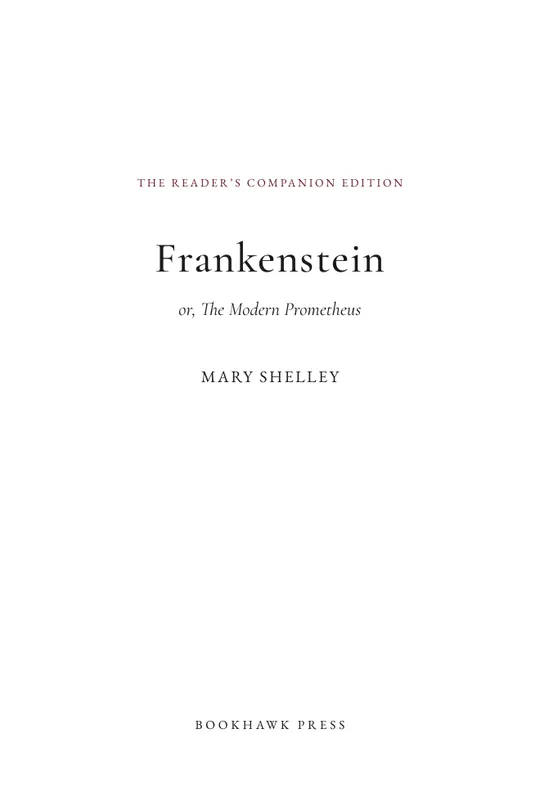
Title page
Title page
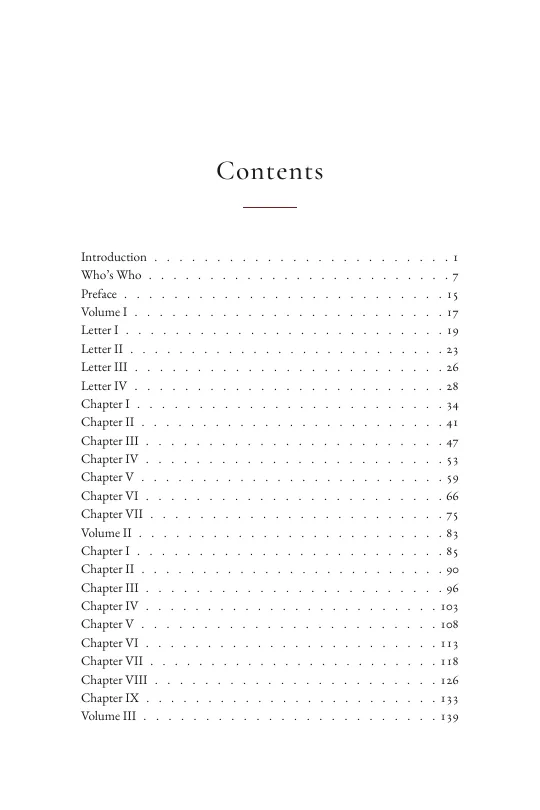
Contents
Contents
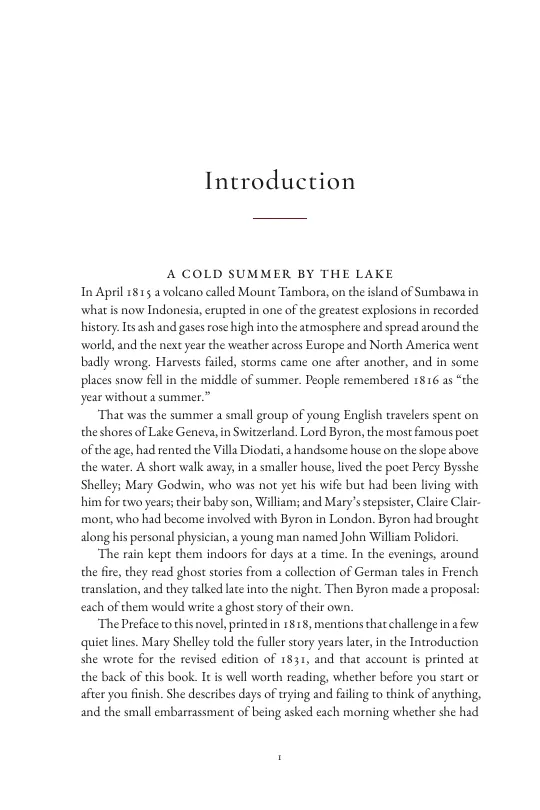
The introduction
The introduction
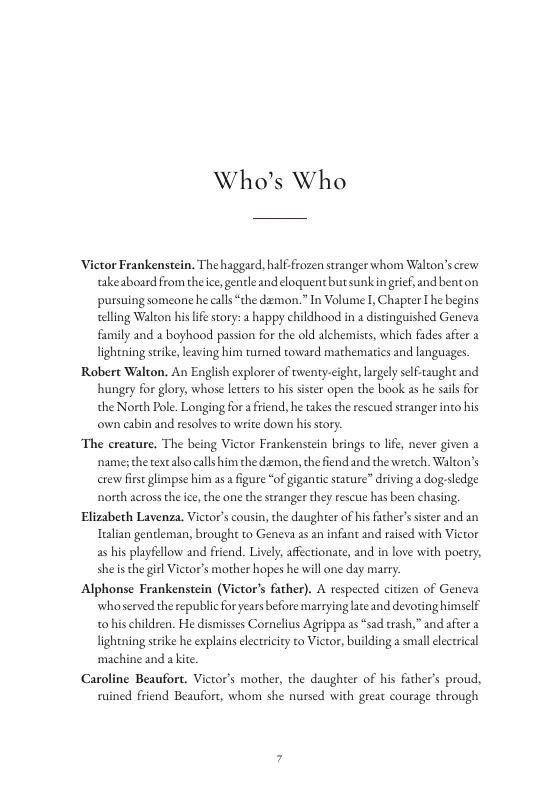
The who’s who
The who’s who
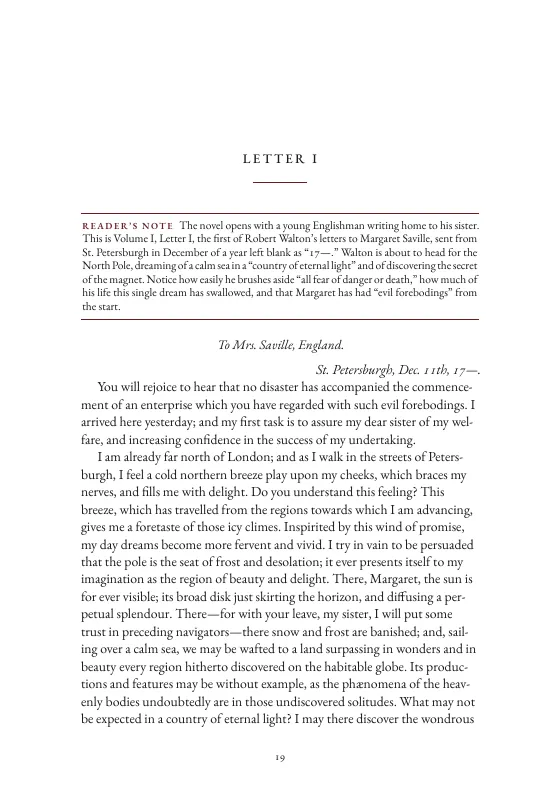
Letter I, with its reader’s note
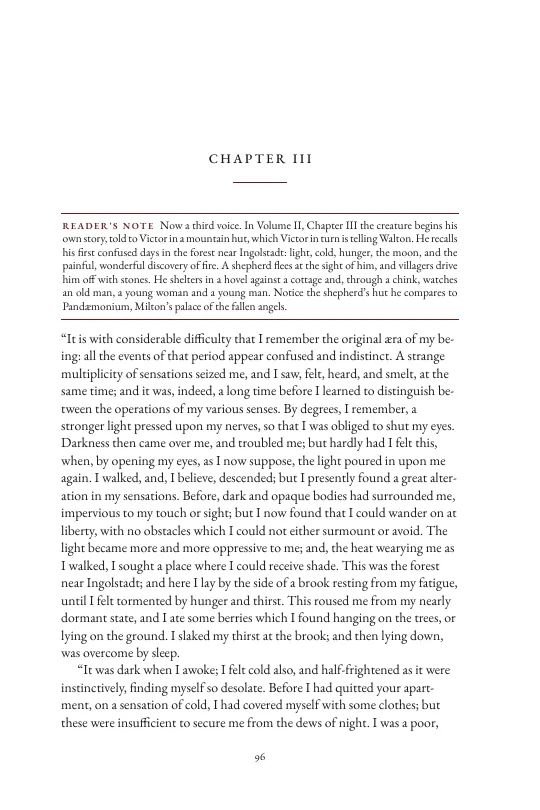
Volume II, Chapter III, with its reader’s note

Who’s who

  • Victor Frankenstein. The haggard, half-frozen stranger whom Walton’s crew take aboard from the ice, gentle and eloquent but sunk in grief, and bent on pursuing someone he calls “the dæmon.” In Volume I, Chapter I he begins telling Walton his life story: a happy childhood in a distinguished Geneva family and a boyhood passion for the old alchemists, which fades after a lightning strike, leaving him turned toward mathematics and languages.
  • The creature. The being Victor Frankenstein brings to life, never given a name; the text also calls him the dæmon, the fiend and the wretch. Walton’s crew first glimpse him as a figure “of gigantic stature” driving a dog-sledge north across the ice, the one the stranger they rescue has been chasing.
  • Robert Walton. An English explorer of twenty-eight, largely self-taught and hungry for glory, whose letters to his sister open the book as he sails for the North Pole. Longing for a friend, he takes the rescued stranger into his own cabin and resolves to write down his story.
  • Margaret Saville. Walton’s sister in England, to whom all his letters are addressed. She never appears, but she feared for his voyage from the start, and every page of the story that follows is, in the end, meant for her.
  • Elizabeth Lavenza. Victor’s cousin, the daughter of his father’s sister and an Italian gentleman, brought to Geneva as an infant and raised with Victor as his playfellow and friend. Lively, affectionate, and in love with poetry, she is the girl Victor’s mother hopes he will one day marry.
  • Henry Clerval. Victor’s closest boyhood friend, the only son of a Geneva merchant and almost one of the family. Imaginative and full of romance, as a boy he wrote a fairy tale that delighted his friends and made up plays about heroes like Robin Hood and St. George.

Choose your format

Every format includes the reader’s notes, the introduction, the who’s who and the glossary.

The hardcover and paperback editions (illustration)
Format
Ship to

Prices in US dollars. Printed books ship for a flat US$5.99 to the US or US$10.99 to Canada. Ebooks have no shipping charge. US sales tax, if any, is shown before you pay. Internationally fulfilled orders may be subject to customs duties or other import charges.

With tracked shipping, printed books usually arrive about 3 weeks after you order in the US and about 4 weeks in Canada.

Our promise

  • Order today and your hardcover or paperback ships within 14 days, or your ebook is emailed within 5 days. Your confirmation email gives the exact date.
  • Running late? We email you before that date, and you can keep waiting or cancel for a full refund.
  • Arrives damaged or misprinted, or not as this page describes? Email us a photo up to 30 days after delivery for a full refund or a replacement. No need to send it back.
  • Secure checkout by Stripe. Your card details go to Stripe, never to us. Your statement will show BOOKHAWK PRESS.

Shipping · Refunds

See how it works: two letters from the book

The novel opens with Walton’s letters to his sister. You haven’t read Letters II and III, and you won’t need to: the note above Letter IV tells you where you are. Every letter and chapter in the book opens this way.

Letter I

To Mrs. Saville, England.

You will rejoice to hear that no disaster has accompanied the commencement of an enterprise which you have regarded with such evil forebodings. I arrived here yesterday; and my first task is to assure my dear sister of my welfare, and increasing confidence in the success of my undertaking.

I am already far north of London; and as I walk in the streets of Petersburgh, I feel a cold northern breeze play upon my cheeks, which braces my nerves, and fills me with delight. Do you understand this feeling? This breeze, which has travelled from the regions towards which I am advancing, gives me a foretaste of those icy climes. Inspirited by this wind of promise, my day dreams become more fervent and vivid. I try in vain to be persuaded that the pole is the seat of frost and desolation; it ever presents itself to my imagination as the region of beauty and delight. There, Margaret, the sun is for ever visible; its broad disk just skirting the horizon, and diffusing a perpetual splendour. There—for with your leave, my sister, I will put some trust in preceding navigators—there snow and frost are banished; and, sailing over a calm sea, we may be wafted to a land surpassing in wonders and in beauty every region hitherto discovered on the habitable globe. Its productions and features may be without example, as the phænomena of the heavenly bodies undoubtedly are in those undiscovered solitudes. What may not be expected in a country of eternal light? I may there discover the wondrous power which attracts the needle; and may regulate a thousand celestial observations, that require only this voyage to render their seeming eccentricities consistent for ever. I shall satiate my ardent curiosity with the sight of a part of the world never before visited, and may tread a land never before imprinted by the foot of man. These are my enticements, and they are sufficient to conquer all fear of danger or death, and to induce me to commence this laborious voyage with the joy a child feels when he embarks in a little boat, with his holiday mates, on an expedition of discovery up his native river. But, supposing all these conjectures to be false, you cannot contest the inestimable benefit which I shall confer on all mankind to the last generation, by discovering a passage near the pole to those countries, to reach which at present so many months are requisite; or by ascertaining the secret of the magnet, which, if at all possible, can only be effected by an undertaking such as mine.

These reflections have dispelled the agitation with which I began my letter, and I feel my heart glow with an enthusiasm which elevates me to heaven; for nothing contributes so much to tranquillize the mind as a steady purpose,—a point on which the soul may fix its intellectual eye. This expedition has been the favourite dream of my early years. I have read with ardour the accounts of the various voyages which have been made in the prospect of arriving at the North Pacific Ocean through the seas which surround the pole. You may remember, that a history of all the voyages made for purposes of discovery composed the whole of our good uncle Thomas’s library. My education was neglected, yet I was passionately fond of reading. These volumes were my study day and night, and my familiarity with them increased that regret which I had felt, as a child, on learning that my father’s dying injunction had forbidden my uncle to allow me to embark in a sea-faring life.

These visions faded when I perused, for the first time, those poets whose effusions entranced my soul, and lifted it to heaven. I also became a poet, and for one year lived in a Paradise of my own creation; I imagined that I also might obtain a niche in the temple where the names of Homer and Shakespeare are consecrated. You are well acquainted with my failure, and how heavily I bore the disappointment. But just at that time I inherited the fortune of my cousin, and my thoughts were turned into the channel of their earlier bent.

Six years have passed since I resolved on my present undertaking. I can, even now, remember the hour from which I dedicated myself to this great enterprise. I commenced by inuring my body to hardship. I accompanied the whale-fishers on several expeditions to the North Sea; I voluntarily endured cold, famine, thirst, and want of sleep; I often worked harder than the common sailors during the day, and devoted my nights to the study of mathematics, the theory of medicine, and those branches of physical science from which a naval adventurer might derive the greatest practical advantage. Twice I actually hired myself as an under-mate in a Greenland whaler, and acquitted myself to admiration. I must own I felt a little proud, when my captain offered me the second dignity in the vessel, and entreated me to remain with the greatest earnestness; so valuable did he consider my services.

And now, dear Margaret, do I not deserve to accomplish some great purpose. My life might have been passed in ease and luxury; but I preferred glory to every enticement that wealth placed in my path. Oh, that some encouraging voice would answer in the affirmative! My courage and my resolution is firm; but my hopes fluctuate, and my spirits are often depressed. I am about to proceed on a long and difficult voyage; the emergencies of which will demand all my fortitude: I am required not only to raise the spirits of others, but sometimes to sustain my own, when their’s are failing.

This is the most favourable period for travelling in Russia. They fly quickly over the snow in their sledges; the motion is pleasant, and, in my opinion, far more agreeable than that of an English stage-coach. The cold is not excessive, if you are wrapt in furs, a dress which I have already adopted; for there is a great difference between walking the deck and remaining seated motionless for hours, when no exercise prevents the blood from actually freezing in your veins. I have no ambition to lose my life on the post-road between St. Petersburgh and Archangel.

I shall depart for the latter town in a fortnight or three weeks; and my intention is to hire a ship there, which can easily be done by paying the insurance for the owner, and to engage as many sailors as I think necessary among those who are accustomed to the whale-fishing. I do not intend to sail until the month of June: and when shall I return? Ah, dear sister, how can I answer this question? If I succeed, many, many months, perhaps years, will pass before you and I may meet. If I fail, you will see me again soon, or never.

Farewell, my dear, excellent, Margaret. Heaven shower down blessings on you, and save me, that I may again and again testify my gratitude for all your love and kindness.

Your affectionate brother,

R. Walton.

Letter IV

To Mrs. Saville, England.

So strange an accident has happened to us, that I cannot forbear recording it, although it is very probable that you will see me before these papers can come into your possession.

Continue reading

Last Monday (July 31st), we were nearly surrounded by ice, which closed in the ship on all sides, scarcely leaving her the sea room in which she floated. Our situation was somewhat dangerous, especially as we were compassed round by a very thick fog. We accordingly lay to, hoping that some change would take place in the atmosphere and weather.

About two o’clock the mist cleared away, and we beheld, stretched out in every direction, vast and irregular plains of ice, which seemed to have no end. Some of my comrades groaned, and my own mind began to grow watchful with anxious thoughts, when a strange sight suddenly attracted our attention, and diverted our solicitude from our own situation. We perceived a low carriage, fixed on a sledge and drawn by dogs, pass on towards the north, at the distance of half a mile: a being which had the shape of a man, but apparently of gigantic stature, sat in the sledge, and guided the dogs. We watched the rapid progress of the traveller with our telescopes, until he was lost among the distant inequalities of the ice.

This appearance excited our unqualified wonder. We were, as we believed, many hundred miles from any land; but this apparition seemed to denote that it was not, in reality, so distant as we had supposed. Shut in, however, by ice, it was impossible to follow his track, which we had observed with the greatest attention.

About two hours after this occurrence, we heard the ground sea; and before night the ice broke, and freed our ship. We, however, lay to until the morning, fearing to encounter in the dark those large loose masses which float about after the breaking up of the ice. I profited of this time to rest for a few hours.

In the morning, however, as soon as it was light, I went upon deck, and found all the sailors busy on one side of the vessel, apparently talking to some one in the sea. It was, in fact, a sledge, like that we had seen before, which had drifted towards us in the night, on a large fragment of ice. Only one dog remained alive; but there was a human being within it, whom the sailors were persuading to enter the vessel. He was not, as the other traveller seemed to be, a savage inhabitant of some undiscovered island, but an European. When I appeared on deck, the master said, “Here is our captain, and he will not allow you to perish on the open sea.”

On perceiving me, the stranger addressed me in English, although with a foreign accent. “Before I come on board your vessel,” said he, “will you have the kindness to inform me whither you are bound?”

You may conceive my astonishment on hearing such a question addressed to me from a man on the brink of destruction, and to whom I should have supposed that my vessel would have been a resource which he would not have exchanged for the most precious wealth the earth can afford. I replied, however, that we were on a voyage of discovery towards the northern pole.

Upon hearing this he appeared satisfied, and consented to come on board. Good God! Margaret, if you had seen the man who thus capitulated for his safety, your surprise would have been boundless. His limbs were nearly frozen, and his body dreadfully emaciated by fatigue and suffering. I never saw a man in so wretched a condition. We attempted to carry him into the cabin; but as soon as he had quitted the fresh air, he fainted. We accordingly brought him back to the deck, and restored him to animation by rubbing him with brandy, and forcing him to swallow a small quantity. As soon as he shewed signs of life, we wrapped him up in blankets, and placed him near the chimney of the kitchen-stove. By slow degrees he recovered, and ate a little soup, which restored him wonderfully.

Two days passed in this manner before he was able to speak; and I often feared that his sufferings had deprived him of understanding. When he had in some measure recovered, I removed him to my own cabin, and attended on him as much as my duty would permit. I never saw a more interesting creature: his eyes have generally an expression of wildness, and even madness; but there are moments when, if any one performs an act of kindness towards him, or does him any the most trifling service, his whole countenance is lighted up, as it were, with a beam of benevolence and sweetness that I never saw equalled. But he is generally melancholy and despairing; and sometimes he gnashes his teeth, as if impatient of the weight of woes that oppresses him.

When my guest was a little recovered, I had great trouble to keep off the men, who wished to ask him a thousand questions; but I would not allow him to be tormented by their idle curiosity, in a state of body and mind whose restoration evidently depended upon entire repose. Once, however, the lieutenant asked, Why he had come so far upon the ice in so strange a vehicle?

His countenance instantly assumed an aspect of the deepest gloom; and he replied, “To seek one who fled from me.”

“And did the man whom you pursued travel in the same fashion?”

“Yes.”

“Then I fancy we have seen him; for, the day before we picked you up, we saw some dogs drawing a sledge, with a man in it, across the ice.”

This aroused the stranger’s attention; and he asked a multitude of questions concerning the route which the dæmon, as he called him, had pursued. Soon after, when he was alone with me, he said, “I have, doubtless, excited your curiosity, as well as that of these good people; but you are too considerate to make inquiries.”

“Certainly; it would indeed be very impertinent and inhuman in me to trouble you with any inquisitiveness of mine.”

“And yet you rescued me from a strange and perilous situation; you have benevolently restored me to life.”

Soon after this he inquired, if I thought that the breaking up of the ice had destroyed the other sledge? I replied, that I could not answer with any degree of certainty; for the ice had not broken until near midnight, and the traveller might have arrived at a place of safety before that time; but of this I could not judge.

From this time the stranger seemed very eager to be upon deck, to watch for the sledge which had before appeared; but I have persuaded him to remain in the cabin, for he is far too weak to sustain the rawness of the atmosphere. But I have promised that some one should watch for him, and give him instant notice if any new object should appear in sight.

Such is my journal of what relates to this strange occurrence up to the present day. The stranger has gradually improved in health, but is very silent, and appears uneasy when any one except myself enters his cabin. Yet his manners are so conciliating and gentle, that the sailors are all interested in him, although they have had very little communication with him. For my own part, I begin to love him as a brother; and his constant and deep grief fills me with sympathy and compassion. He must have been a noble creature in his better days, being even now in wreck so attractive and amiable.

I said in one of my letters, my dear Margaret, that I should find no friend on the wide ocean; yet I have found a man who, before his spirit had been broken by misery, I should have been happy to have possessed as the brother of my heart.

I shall continue my journal concerning the stranger at intervals, should I have any fresh incidents to record.

* * *

My affection for my guest increases every day. He excites at once my admiration and my pity to an astonishing degree. How can I see so noble a creature destroyed by misery without feeling the most poignant grief? He is so gentle, yet so wise; his mind is so cultivated; and when he speaks, although his words are culled with the choicest art, yet they flow with rapidity and unparalleled eloquence.

He is now much recovered from his illness, and is continually on the deck, apparently watching for the sledge that preceded his own. Yet, although unhappy, he is not so utterly occupied by his own misery, but that he interests himself deeply in the employments of others. He has asked me many questions concerning my design; and I have related my little history frankly to him. He appeared pleased with the confidence, and suggested several alterations in my plan, which I shall find exceedingly useful. There is no pedantry in his manner; but all he does appears to spring solely from the interest he instinctively takes in the welfare of those who surround him. He is often overcome by gloom, and then he sits by himself, and tries to overcome all that is sullen or unsocial in his humour. These paroxysms pass from him like a cloud from before the sun, though his dejection never leaves him. I have endeavoured to win his confidence; and I trust that I have succeeded. One day I mentioned to him the desire I had always felt of finding a friend who might sympathize with me, and direct me by his counsel. I said, I did not belong to that class of men who are offended by advice. “I am self-educated, and perhaps I hardly rely sufficiently upon my own powers. I wish therefore that my companion should be wiser and more experienced than myself, to confirm and support me; nor have I believed it impossible to find a true friend.”

“I agree with you,” replied the stranger, “in believing that friendship is not only a desirable, but a possible acquisition. I once had a friend, the most noble of human creatures, and am entitled, therefore, to judge respecting friendship. You have hope, and the world before you, and have no cause for despair. But I——I have lost every thing, and cannot begin life anew.”

As he said this, his countenance became expressive of a calm settled grief, that touched me to the heart. But he was silent, and presently retired to his cabin.

Even broken in spirit as he is, no one can feel more deeply than he does the beauties of nature. The starry sky, the sea, and every sight afforded by these wonderful regions, seems still to have the power of elevating his soul from earth. Such a man has a double existence: he may suffer misery, and be overwhelmed by disappointments; yet when he has retired into himself, he will be like a celestial spirit, that has a halo around him, within whose circle no grief or folly ventures.

Will you laugh at the enthusiasm I express concerning this divine wanderer? If you do, you must have certainly lost that simplicity which was once your characteristic charm. Yet, if you will, smile at the warmth of my expressions, while I find every day new causes for repeating them.

* * *

Yesterday the stranger said to me, “You may easily perceive, Captain Walton, that I have suffered great and unparalleled misfortunes. I had determined, once, that the memory of these evils should die with me; but you have won me to alter my determination. You seek for knowledge and wisdom, as I once did; and I ardently hope that the gratification of your wishes may not be a serpent to sting you, as mine has been. I do not know that the relation of my misfortunes will be useful to you, yet, if you are inclined, listen to my tale. I believe that the strange incidents connected with it will afford a view of nature, which may enlarge your faculties and understanding. You will hear of powers and occurrences, such as you have been accustomed to believe impossible: but I do not doubt that my tale conveys in its series internal evidence of the truth of the events of which it is composed.”

You may easily conceive that I was much gratified by the offered communication; yet I could not endure that he should renew his grief by a recital of his misfortunes. I felt the greatest eagerness to hear the promised narrative, partly from curiosity, and partly from a strong desire to ameliorate his fate, if it were in my power. I expressed these feelings in my answer.

“I thank you,” he replied, “for your sympathy, but it is useless; my fate is nearly fulfilled. I wait but for one event, and then I shall repose in peace. I understand your feeling,” continued he, perceiving that I wished to interrupt him; “but you are mistaken, my friend, if thus you will allow me to name you; nothing can alter my destiny: listen to my history, and you will perceive how irrevocably it is determined.”

He then told me, that he would commence his narrative the next day when I should be at leisure. This promise drew from me the warmest thanks. I have resolved every night, when I am not engaged, to record, as nearly as possible in his own words, what he has related during the day. If I should be engaged, I will at least make notes. This manuscript will doubtless afford you the greatest pleasure: but to me, who know him, and who hear it from his own lips, with what interest and sympathy shall I read it in some future day!

Enjoyed Letter IV? Get the whole book.

That’s how every part in this edition works: a short note, then the part itself. All 27 of them.

Hardcover US$39.99 · Paperback US$25.99 · Ebook US$15.99

Get my copy · from US$15.99

Not ready yet? Get two more chapters free by email

Two chapters from the heart of the book, each with its reader’s note: Volume II, Chapters III and IV, where the creature begins to tell his own story, from his first confused days in the forest to a winter spent as the secret neighbor of a poor cottage family (PDF, 16 pages).

We’ll email the sample whether or not you tick the box. Sent by Bookhawk Press (Space Dog Tech LLC), 411 Walnut St, PMB 22412, Green Cove Springs, FL 32043, USA · support@bookhawkpress.com. Privacy

Questions

Is Frankenstein hard going for a modern reader?
Not with this edition beside you. The opening moves at the pace of letters, and the sentences are long and full of feeling in the manner of their time. The introduction’s ‘Before you begin’ shows you how to let them carry you, and a reader’s note before each of the 27 letters and chapters tells you where you are, whose voice you’re in and what to notice. The glossary and who’s who are there when a name or a term stops you.
Which text is this, and how does the 1818 text differ from the 1831 revision?
It’s the 1818 text, the novel as its first readers met it. For the 1831 edition Mary Shelley said her changes were ‘principally those of style’, ‘almost exclusively in the beginning of the first volume’, and that she ‘changed no portion of the story.’ Some are easy to see. In 1818 Elizabeth is Victor’s cousin, his father’s sister’s daughter; in 1831 she is an orphan adopted from a poor family in Italy. In 1818 Victor’s father explains electricity to him after a lightning strike and builds a small electrical machine; in 1831 a visiting natural philosopher explains ‘electricity and galvanism.’ The word ‘galvanism’ does not occur in the 1818 novel. The introduction walks you through it.
Is the whole novel included, and what else is in the book?
Yes, all of it: the Preface, Walton’s four letters and all three volumes, as first published in 1818. Around it: an introduction in six sections, a reader’s note before every letter and chapter (27 in all), a who’s who of 23 entries, a glossary of 113 terms, and Mary Shelley’s own 1831 Introduction at the back.
Do the reader’s notes give away the story?
None of them gives away what comes next. Each note is printed under its heading, before the text, and tells you where you are, whose voice you’re in, who is on stage and what to notice: a warning, a choice, an echo of Paradise Lost. It does say what happens in its own letter or chapter, so you’re never lost, but it stops there. Try it now: Letters I and IV are free to read on this page, each with its note, and we’ll email you Volume II, Chapters III and IV free.
Why do the chapter numbers start again in each volume, and why are some words spelled the old way (dæmon, phænomena)?
Because this is the real 1818 text, printed as the source gives it. The novel came out in three volumes, and each begins again at Chapter I, so this edition always names a chapter by its volume, as in ‘Volume II, Chapter III.’ Old spellings like dæmon and phænomena stay as printed, and the glossary explains them.
What are the hardcover and the paperback like?
Both are 6 × 9 in, 224 pages, on cream paper. The hardcover’s cover is printed on rigid boards with a matte finish and no dust jacket; the paperback has a matte cover. Each copy is printed for its order. Ships within 14 days.
Which ebook formats are included, and how does the ebook arrive?
You get both: an EPUB for Kindle (through Amazon’s Send to Kindle), Kobo, Apple Books and most reading apps, plus a PDF in the print layout. They come by email. Emailed within 5 days.
Where do you ship, and how long does it take?
We sell and ship to the US and Canada only. Printed books go by tracked mail for a flat US$5.99 to the US or US$10.99 to Canada, in US dollars. Each copy is printed for its order. Ships within 14 days. It usually arrives in about 3 weeks (US) or about 4 weeks (Canada) after the order. Your confirmation gives the date it will ship by, and we email you when it ships.
Can I cancel, and what if something goes wrong?
Yes, you can cancel for a full refund until your order goes to print, and if we might miss the ship date in your confirmation, we email you before it so you can cancel for a full refund. If a printed book arrives damaged or misprinted, or isn’t what this page describes, email a photo up to 30 days after delivery and we refund in full or send a replacement where we can, without asking for it back. The same applies if tracking shows no movement for 10 business days. Undamaged books can’t be taken back, since each is printed for its order. Full details: bookhawkpress.com/refunds.
Who is Bookhawk Press?
An independent publisher based in the United States, selling its books direct from its own site. Questions? Write to support@bookhawkpress.com.

About Bookhawk Press

Bookhawk Press is an independent publisher of carefully edited books in print and ebook. We sell direct from our own site, and each copy is printed for your order and shipped straight to you. Questions before you order? Email support@bookhawkpress.com. We answer every message, usually in two business days.

See all our books

Order Frankenstein