


Chapter I
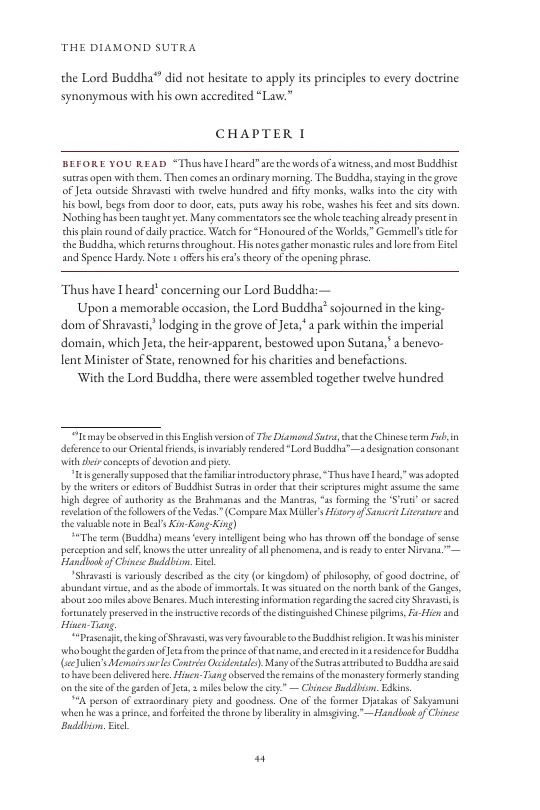
Thus have I heard1 concerning our Lord Buddha:—
Continue reading
Upon a memorable occasion, the Lord Buddha2 sojourned in the kingdom of Shravasti,3 lodging in the grove of Jeta,4 a park within the imperial domain, which Jeta, the heir-apparent, bestowed upon Sutana,5 a benevolent Minister of State, renowned for his charities and benefactions.
With the Lord Buddha, there were assembled together twelve hundred and fifty mendicant disciples,6 all of whom had attained to eminent degrees of spiritual wisdom.
As it approached the hour for the morning meal, Lord Buddha, Honoured of the Worlds,7 attired himself in a mendicant’s robe,8 and bearing an alms-bowl in his hands, walked towards the great city of Shravasti, which he entered to beg for food.9 Within the city he proceeded from door to door,10 and received such donations as the good people severally bestowed.11 Concluding this religious exercise, the Lord Buddha returned to the grove of Jeta, and partook of the frugal meal12 received as alms. Thereafter he divested himself of his mendicant’s robe, laid aside the venerated alms-bowl,13 bathed his sacred feet, and accepted the honoured seat reserved for him by his disciples.
- It is generally supposed that the familiar introductory phrase, “Thus have I heard,” was adopted by the writers or editors of Buddhist Sutras in order that their scriptures might assume the same high degree of authority as the Brahmanas and the Mantras, “as forming the ‘S’ruti’ or sacred revelation of the followers of the Vedas.” (Compare Max Müller’s History of Sanscrit Literature and the valuable note in Beal’s Kin-Kong-King)
- “The term (Buddha) means ‘every intelligent being who has thrown off the bondage of sense perception and self, knows the utter unreality of all phenomena, and is ready to enter Nirvana.’”—Handbook of Chinese Buddhism. Eitel.
- Shravasti is variously described as the city (or kingdom) of philosophy, of good doctrine, of abundant virtue, and as the abode of immortals. It was situated on the north bank of the Ganges, about 200 miles above Benares. Much interesting information regarding the sacred city Shravasti, is fortunately preserved in the instructive records of the distinguished Chinese pilgrims, Fa-Hien and Hiuen-Tsang.
- “Prasenajit, the king of Shravasti, was very favourable to the Buddhist religion. It was his minister who bought the garden of Jeta from the prince of that name, and erected in it a residence for Buddha (see Julien’s Memoirs sur les Contrées Occidentales). Many of the Sutras attributed to Buddha are said to have been delivered here. Hiuen-Tsang observed the remains of the monastery formerly standing on the site of the garden of Jeta, 2 miles below the city.” — Chinese Buddhism. Edkins.
- “A person of extraordinary piety and goodness. One of the former Djatakas of Sakyamuni when he was a prince, and forfeited the throne by liberality in almsgiving.”—Handbook of Chinese Buddhism. Eitel.
- The Chinese text is ta-pi-k’u—greater disciples. Our Chinese editor of The Diamond Sutra suggests that there are different grades of discipleship. The “lesser disciples” are those who have abandoned every form of vice, and are striving after virtue. The “greater disciples” are those to whom virtue has become spontaneous, and who have ceased to strive after its attainment.
- A title conferred by Chinese Buddhists upon the founder of their faith, believing him to be a Teacher and Saviour whose merit is acclaimed in worlds beyond our own.
- Having taken vows of poverty, a robe is one of the following eight articles which Buddhist monks are permitted to possess: three garments of different descriptions, a girdle for the loins, an alms-bowl, a razor, a needle, and a water-strainer.
- Buddha has said, “the wise priest never asks for anything; he disdains to beg; it is a proper thing for which he carries the alms-bowl; and this is his only mode of solicitation. But when he is sick, he is permitted to ask for any medicine that he may require, without being guilty of any transgression.”—Eastern Monachism. Spence Hardy.
- Concerning the manner of begging an alms: “As a bee, injuring not the flower, or its colour, or its scent, flies away, taking the nectar, so let a sage go through the village.”—Questions of King Milinda. T. W. Rhys Davids.
- “By many of the Buddhists it is considered to be an act of great merit to make a vow never to partake of food without giving a portion to the priests.”—Eastern Monachism. Spence Hardy.
- “The fifth of the twelve sacred observances of the Chinese is called in Sanscrit Khaloupas’ Waddhaktinka, and is said to enjoin that the food obtained by the mendicant is to be divided into three portions: one to be given to any person whom he sees to be suffering from hunger, and a second to be carried to some quiet place in the forest, and placed upon a stone for the birds and beasts. If he does not meet with any one who is in want, he is not to eat the whole of the food that he has received, but two-thirds only. By this means his body will be lighter and more active.... He will be able readily to enter upon the practice of all good works. When any one eats too greedily… nothing is more harmful to the development of reason.” (Quotation from Remusat’s Relation des Royaumes Buddhiques, in Spence Hardy’s Eastern Monachism.)
- “The alms-bowl which Sakyamuni used is considered a sacred relic, and to be used by each of the hundred Buddhas of the present kalpa. It was first preserved in Vais’ali, whence its emigrations began to Gandhara, to Persia, to China, to Ceylon, to Madhyades’a, up into the heaven Tuchita, and down to the bottom of the ocean, where it is to await (in the palace of Sagara) the advent of Meitreya Buddha.”—Handbook of Chinese Buddhism. Eitel.
Read the companion to Chapter I
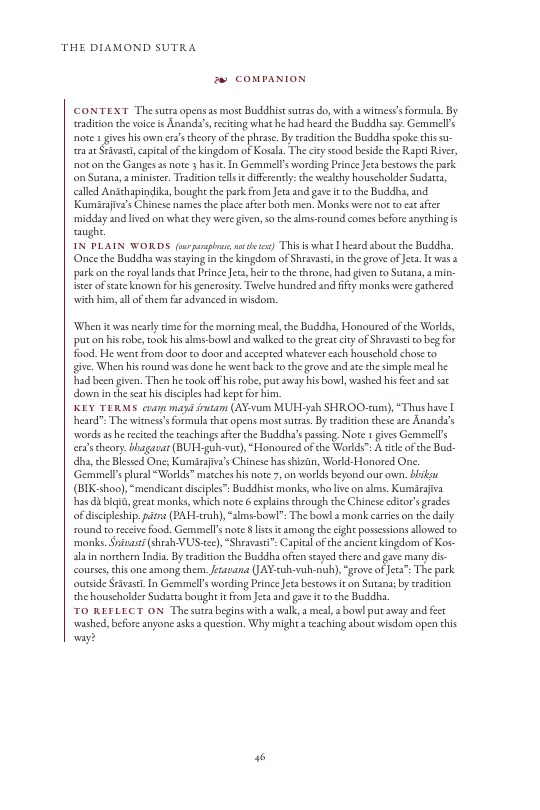
Context The sutra opens as most Buddhist sutras do, with a witness’s formula. By tradition the voice is Ānanda’s, reciting what he had heard the Buddha say. Gemmell’s note 1 gives his own era’s theory of the phrase. By tradition the Buddha spoke this sutra at Śrāvastī, capital of the kingdom of Kosala. The city stood beside the Rapti River, not on the Ganges as note 3 has it. In Gemmell’s wording Prince Jeta bestows the park on Sutana, a minister. Tradition tells it differently: the wealthy householder Sudatta, called Anāthapiṇḍika, bought the park from Jeta and gave it to the Buddha, and Kumārajīva’s Chinese names the place after both men. Monks were not to eat after midday and lived on what they were given, so the alms-round comes before anything is taught.
In plain words (our paraphrase, not the text) This is what I heard about the Buddha. Once the Buddha was staying in the kingdom of Shravasti, in the grove of Jeta. It was a park on the royal lands that Prince Jeta, heir to the throne, had given to Sutana, a minister of state known for his generosity. Twelve hundred and fifty monks were gathered with him, all of them far advanced in wisdom. When it was nearly time for the morning meal, the Buddha, Honoured of the Worlds, put on his robe, took his alms-bowl and walked to the great city of Shravasti to beg for food. He went from door to door and accepted whatever each household chose to give. When his round was done he went back to the grove and ate the simple meal he had been given. Then he took off his robe, put away his bowl, washed his feet and sat down in the seat his disciples had kept for him.
Key terms evaṃ mayā śrutam (AY-vum MUH-yah SHROO-tum), “Thus have I heard”: The witness’s formula that opens most sutras. By tradition these are Ānanda’s words as he recited the teachings after the Buddha’s passing. Note 1 gives Gemmell’s era’s theory. bhagavat (BUH-guh-vut), “Honoured of the Worlds”: A title of the Buddha, the Blessed One; Kumārajīva’s Chinese has shìzūn, World-Honored One. Gemmell’s plural “Worlds” matches his note 7, on worlds beyond our own. bhikṣu (BIK-shoo), “mendicant disciples”: Buddhist monks, who live on alms. Kumārajīva has dà bǐqiū, great monks, which note 6 explains through the Chinese editor’s grades of discipleship. pātra (PAH-truh), “alms-bowl”: The bowl a monk carries on the daily round to receive food. Gemmell’s note 8 lists it among the eight possessions allowed to monks. Śrāvastī (shrah-VUS-tee), “Shravasti”: Capital of the ancient kingdom of Kosala in northern India. By tradition the Buddha often stayed there and gave many discourses, this one among them. Jetavana (JAY-tuh-vuh-nuh), “grove of Jeta”: The park outside Śrāvastī. In Gemmell’s wording Prince Jeta bestows it on Sutana; by tradition the householder Sudatta bought it from Jeta and gave it to the Buddha.
To reflect on The sutra begins with a walk, a meal, a bowl put away and feet washed, before anyone asks a question. Why might a teaching about wisdom open this way?