


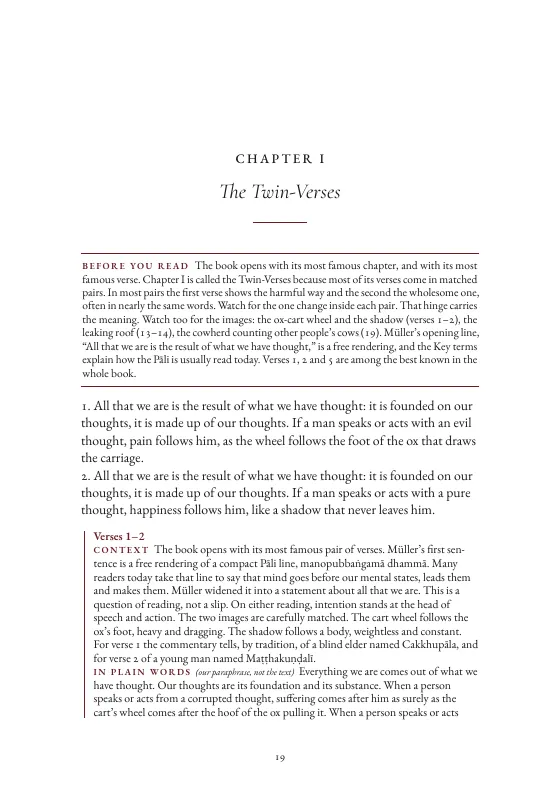
Chapter I
The Twin-Verses
1. All that we are is the result of what we have thought: it is founded on our thoughts, it is made up of our thoughts. If a man speaks or acts with an evil thought, pain follows him, as the wheel follows the foot of the ox that draws the carriage.
2. All that we are is the result of what we have thought: it is founded on our thoughts, it is made up of our thoughts. If a man speaks or acts with a pure thought, happiness follows him, like a shadow that never leaves him.
3. ‘He abused me, he beat me, he defeated me, he robbed me,’—in those who harbour such thoughts hatred will never cease.
4. ‘He abused me, he beat me, he defeated me, he robbed me,’—in those who do not harbour such thoughts hatred will cease.
5. For hatred does not cease by hatred at any time: hatred ceases by love, this is an old rule.
6. The world does not know that we must all come to an end here;—but those who know it, their quarrels cease at once.
7. He who lives looking for pleasures only, his senses uncontrolled, immoderate in his food, idle, and weak, Mâra (the tempter) will certainly overthrow him, as the wind throws down a weak tree.
8. He who lives without looking for pleasures, his senses well controlled, moderate in his food, faithful and strong, him Mâra will certainly not overthrow, any more than the wind throws down a rocky mountain.
9. He who wishes to put on the yellow dress without having cleansed himself from sin, who disregards also temperance and truth, is unworthy of the yellow dress.
10. But he who has cleansed himself from sin, is well grounded in all virtues, and regards also temperance and truth, he is indeed worthy of the yellow dress.
11. They who imagine truth in untruth, and see untruth in truth, never arrive at truth, but follow vain desires.
12. They who know truth in truth, and untruth in untruth, arrive at truth, and follow true desires.
13. As rain breaks through an ill-thatched house, passion will break through an unreflecting mind.
14. As rain does not break through a well-thatched house, passion will not break through a well-reflecting mind.
15. The evil-doer mourns in this world, and he mourns in the next; he mourns in both. He mourns and suffers when he sees the evil of his own work.
16. The virtuous man delights in this world, and he delights in the next; he delights in both. He delights and rejoices, when he sees the purity of his own work.
17. The evil-doer suffers in this world, and he suffers in the next; he suffers in both. He suffers when he thinks of the evil he has done; he suffers more when going on the evil path.
18. The virtuous man is happy in this world, and he is happy in the next; he is happy in both. He is happy when he thinks of the good he has done; he is still more happy when going on the good path.
19. The thoughtless man, even if he can recite a large portion (of the law), but is not a doer of it, has no share in the priesthood, but is like a cowherd counting the cows of others.
20. The follower of the law, even if he can recite only a small portion (of the law), but, having forsaken passion and hatred and foolishness, possesses true knowledge and serenity of mind, he, caring for nothing in this world or that to come, has indeed a share in the priesthood.
Read the companion to Chapter I
Verses 1–2
Context The book opens with its most famous pair of verses. Müller’s first sentence is a free rendering of a compact Pāli line, manopubbaṅgamā dhammā. Many readers today take that line to say that mind goes before our mental states, leads them and makes them. Müller widened it into a statement about all that we are. This is a question of reading, not a slip. On either reading, intention stands at the head of speech and action. The two images are carefully matched. The cart wheel follows the ox’s foot, heavy and dragging. The shadow follows a body, weightless and constant. For verse 1 the commentary tells, by tradition, of a blind elder named Cakkhupāla, and for verse 2 of a young man named Maṭṭhakuṇḍalī.
In plain words (our paraphrase, not the text) Everything we are comes out of what we have thought. Our thoughts are its foundation and its substance. When a person speaks or acts from a corrupted thought, suffering comes after him as surely as the cart’s wheel comes after the hoof of the ox pulling it. When a person speaks or acts from a pure thought, happiness comes after him, like his own shadow that never leaves him.
Key terms mano (MUH-no), “thought”: Mind, the faculty that thinks and intends. The Pāli says mind goes before and leads, and Müller turns this into “what we have thought.” dhamma (DUM-muh), “All that we are”: Here the word is usually read as mental states or experiences, which mind leads and shapes. Müller widens it to everything we are. dukkha (DOOK-kuh), “pain”: Suffering or pain: what follows speech and action that come from a corrupted mind. sukha (SOO-kuh), “happiness”: Happiness, ease, well-being: what follows speech and action that come from a pure mind.
To reflect on Before one conversation today, notice the mood you bring into it. Afterward, notice whether anything of that mood followed you, in what you said or in how it was received.
Verses 3–6
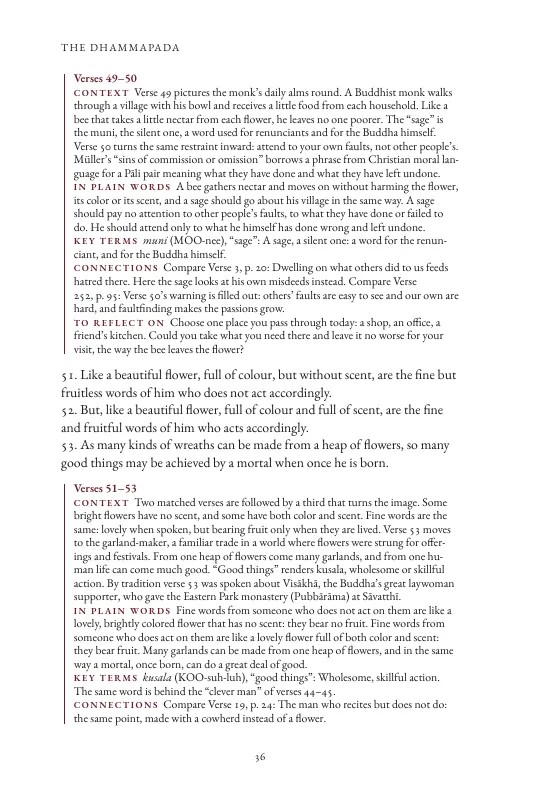
Context Verses 3 and 4 match word for word until the end, where one small change turns the grievance held into the grievance let go. The Pāli verb behind Müller’s “harbour” means to tie or bind, as if the grievance were strapped on and carried around. Verse 5 is among the most often recited lines in the Buddhist world. It says that hatred ends through avera, non-hatred, which Müller renders “love,” and it closes by calling this an ancient or lasting law. By tradition verse 6 was spoken to the monks of Kosambī, whose dispute had split their community. Its key Pāli verb can be read as saying that we perish here, or that we should restrain ourselves here. Müller follows the first reading, which makes mortality the reason to stop quarreling.
In plain words People who keep repeating to themselves that someone insulted them, struck them, got the better of them or robbed them will never be free of hatred. People who stop dwelling on such thoughts will see their hatred come to an end. Hatred has never been ended by more hatred. It is ended by love, and that is a very old rule. Most people forget that all of us here must die. Those who keep it in mind stop quarreling at once.
Key terms vera (VAY-ruh), “hatred”: Enmity or hatred, especially a grudge kept alive by retaliation. avera (uh-VAY-ruh), “love”: Non-hatred. The Pāli frames it as the absence of enmity, and Müller’s “love” names the warmth that takes its place. sanantana dhamma (suh-NUN-tuh-nuh DUM-muh), “an old rule”: An ancient or eternal law: the closing words of verse 5, presenting the principle as something that has always held true.
To reflect on Think of one old grievance you still repeat to yourself. Notice the exact words you use for it, the way verse 3 records them, and notice what happens in you as you say them. You need not do anything else.
Verses 7–8
Context Māra appears here for the first time, and Müller adds his own gloss, “(the tempter).” In Buddhist tradition Māra is a deity of the realm of desire and death who works to keep beings bound. He also stands for death and for the mind’s own defilements. The pair sets two lives side by side. The first looks for pleasures (the Pāli speaks of dwelling on what seems attractive), eats without measure and lacks energy. The second guards the senses and eats in moderation. It also has saddhā, a confident trust in the teaching, which Müller gives as “faithful.” By tradition the commentary tells of two brothers who became monks. One was drawn back to household life, and the other held firm.
In plain words Someone who lives for pleasure, lets the senses run unchecked, eats without limit, and is lazy and feeble will be brought down by Māra, the tempter, as easily as the wind topples a weak tree. Someone who does not live for pleasure, keeps the senses in check, eats in moderation, and is full of trust and energy cannot be brought down by Māra, any more than the wind can topple a mountain of rock.
Key terms Māra (MAH-ruh): In Buddhist tradition the deity of desire and death, and also a figure for death and the defilements. Müller glosses him as “(the tempter).”
Verses 9–10
Context The “yellow dress” is the kāsāva, the dyed robe of a Buddhist monk. Verse 9 holds a pun that English cannot keep. A person not yet free of kasāva, a stain or impurity, is unworthy of the kāsāva, the dyed robe. Müller gives the stain as “sin,” a Christian word for what the Pāli presents as an inner defilement. His “temperance and truth” stand for self-taming and truthfulness. By tradition these verses were spoken when a costly robe was given to Devadatta, the Buddha’s cousin, who later tried to split the Sangha.
In plain words A person who wants to wear the monk’s yellow robe while still stained within, and who cares nothing for self-control and truthfulness, does not deserve it. A person who has washed those stains away, is firmly settled in good conduct, and cares for self-control and truthfulness truly deserves the robe.
Key terms kāsāva (kah-SAH-vuh), “yellow dress”: The dyed robe of a Buddhist monk. It puns on kasāva, stain, which Müller renders “sin.” sīla (SEE-luh), “virtues”: Moral conduct, the restraint of body and speech. Being “well grounded” in it is the first mark of one worthy of the robe.
Verses 11–12
Context Behind Müller’s “truth” and “untruth” stand the Pāli words sāra and asāra: the heartwood of a tree, and what is not heartwood. The picture is of the hard, valuable core a woodsman looks for, as opposed to sapwood and bark. So the pair is about judging what is essential, and not only about true and false statements. The “desires” in these verses render a phrase about the pasture on which one’s intentions feed, wrong in verse 11 and right in verse 12. By tradition the commentary links this pair to the Buddha’s two chief disciples, Sāriputta and Moggallāna, and to their former teacher, who refused to come to the Buddha.
In plain words Those who mistake what is false for what is true, and what is true for what is false, never reach the truth. They feed on empty wishes. Those who recognize the true as true and the false as false do reach the truth, and their wishes are sound.
Key terms sāra (SAH-ruh), “truth”: Heartwood, the solid core of a tree, and so what is essential or real. Its opposite, asāra, is Müller’s “untruth.”
Verses 13–14
Context Thatch was the ordinary roofing of a house in the Buddha’s India, and in the monsoon a badly laid roof let the rain straight in. Müller’s “unreflecting” and “well-reflecting” render words that mean uncultivated and well cultivated. They come from bhāvanā, the cultivation of the mind, which is also the tradition’s everyday word for meditation. “Passion” is rāga, lust or craving. By tradition these verses were spoken about Nanda, the Buddha’s half-brother, who was ordained on the day of his wedding. He could not stop longing for his bride until he trained his mind.
In plain words Rain pours through a badly thatched roof, and passion pours into a mind that has not been trained. Rain cannot get through a well-thatched roof, and passion cannot get into a mind that has been well trained.
Key terms rāga (RAH-guh), “passion”: Lust or craving: the first of the three roots of harmful action named by the tradition. bhāvanā (BAH-vuh-nah), “well-reflecting”: Cultivation of the mind, and the usual word for meditation. Müller’s “unreflecting” and “well-reflecting” mean uncultivated and well cultivated. citta (CHIT-tuh), “mind”: The mind or heart as a whole, which here is either left open to the weather or roofed well.
Verses 15–18
Context Here are two more pairs, built on repetition: “in this world,” “in the next,” “in both.” The Pāli word behind “the next” is pecca, after death. The verses assume the teaching of rebirth according to one’s deeds, as the tradition understands it. The compounds Müller gives as “the evil of his own work” and “the purity of his own work” contain the word kamma, action. In verses 17–18 the “evil path” and “good path” render duggati and sugati, a bad or a happy destination after death. A bad destination means a state of misery, and a happy one means a fortunate human or heavenly birth. By tradition the commentary ties verse 15 to a pig butcher named Cunda and verse 17 to Devadatta.
In plain words The person who does harm grieves here and grieves hereafter. He grieves in both, and he is wretched when he sees how foul his own deeds have been. The person who does good is glad here and glad hereafter, glad in both, and he rejoices when he sees how clean his own deeds have been. The wrongdoer suffers in both worlds. He suffers at the memory of the wrong he has done, and he suffers still more as he goes on along the bad road. The good person is happy in both worlds. He is happy remembering the good he has done, and happier still as he goes on along the good road.
Key terms pecca (PECH-chuh), “the next”: After death: the life that, as the tradition understands it, follows this one according to one’s deeds. kamma (KUM-muh), “work”: Intentional action. Here it appears inside the compounds for defiled and purified action, which the doer later sees for what it was. duggati (DOOG-guh-tee), “evil path”: A bad destination: rebirth, as the tradition understands it, in a state of misery. sugati (SOO-guh-tee), “good path”: A good destination: rebirth, as the tradition understands it, in a happy human or heavenly state.
Verses 19–20
Context A hired cowherd took other people’s cattle out to graze and counted them home in the evening, but the milk and the calves were never his. This pair sets a learned but careless monk beside one who knows little by heart yet lives what he knows. Müller’s “portion (of the law)” renders a word for the recited texts. His “priesthood” renders sāmañña, the life of a renunciant, since Buddhism has no priests in the Christian sense. Memorizing and reciting the teaching is still honored in Theravāda communities, and the verses do not scorn it. By tradition the commentary tells of two friends who became monks. One became a scholar, and the other a meditator who reached the goal.
In plain words A careless man may be able to recite a great deal of the teaching, but if he does not practice it he has no share in the renunciant’s life. He is like a hired cowherd counting cattle that belong to someone else. Another may know only a little of the teaching by heart, yet live by it. He has let go of passion, hatred and delusion, and he has real understanding and a mind at peace. Clinging to nothing in this world or the next, he truly shares in that life.
Key terms sāmañña (sah-MUN-nyuh), “priesthood”: The state and life of a samaṇa, one who has left home for the spiritual life. Müller’s word is Victorian and does not fit Buddhism, which has no priests. rāga (RAH-guh), “passion”: Lust or craving, the first of the three roots of harmful action that the true follower has given up. dosa (DOH-suh), “hatred”: Aversion or ill will, the second of the three roots. moha (MOH-huh), “foolishness”: Delusion, not seeing things as they are: the third of the three roots. huraṃ (HOO-rum), “that to come”: Beyond, the other world. The true follower clings to nothing here or there.
To reflect on Pick one teaching, from any source, that you could recite easily. In the past week, when did you actually act on it, and when did you only know it?