Bookhawk PressRead one section
Cover of Carmilla and The Vampyre, The Reader’s Companion Edition
The Reader’s Companion Edition

Carmilla and The Vampyre

The vampire tale printed as Byron’s. He hadn’t written it.

Both tales complete, plus Byron’s own abandoned Fragment, a note before every chapter and a glossary. Your new favorite stormy-night read.

Hardcover US$39.99 · Paperback US$25.99 · Ebook US$15.99

Get my copy · from US$15.99

Two short tales, a guide at every turn: you’ll never lose your place in the dark.

Hardcover and paperback ship within 14 days · Late? Cancel for a full refund · Damaged or not as described? Refund or replacement, no return needed

The hardcover includes the ebook; with the paperback, add it for US$4.00. Start reading while your book is printed and shipped.

Why this edition

  • Byron’s ghost-story dare, and his own pages

    June 1816, the year without a summer: at the Villa Diodati, Byron challenged his friends to write ghost stories. Mary Godwin’s became Frankenstein. Byron’s stops mid-journey. It’s printed at the end: set it beside the tale it became.

  • Published as Byron’s. Written by his doctor.

    On April 1, 1819, The Vampyre appeared in a London magazine as a tale by Lord Byron, without Polidori’s consent. The introduction tells how it became a sensation: the tale that made the vampire a gentleman.

  • A quarter of a century before Dracula

    Carmilla (1872) is set in Styria, and Bram Stoker’s working notes first put his own vampire there too, before he moved it to Transylvania. The introduction gives you the Dublin thread that links the two writers.

  • Never lost, never told too much

    A short note stands before every chapter and each piece (19 in all): where you are, what to watch for, even the narrator’s two clocks, then and now. It tells you only what has happened so far.

  • Finally see what an equipage is

    An equipage is a grand carriage with its horses and servants; outriders ride as its escort. A glossary of 134 terms decodes words, places and customs, and a who’s who of 39 entries keeps names straight.

  • An evening or two, complete

    The complete 1872 text of Carmilla with its Prologue and the complete 1819 text of The Vampyre, plus Byron’s Fragment: about 38,000 words in all. Light the lamp, pour something warm, and finish before the storm does.

Get my copy · from US$15.99

The words, plus the world behind them

A plain copyThis edition
Byron’s name hangs over The Vampyre, and nobody tells you why.The introduction tells how it was printed as Byron’s in 1819, and what he did about it.
Byron’s Fragment isn’t there, so you can’t see where the tale began.Byron’s Fragment of June 17, 1816 is printed at the end, to read beside The Vampyre.
A carriage arrives with outriders and postillions, and you just keep going.The glossary at the back explains both, so you can picture the whole grand arrival.
You open a chapter cold and wonder what you missed.A short note before every chapter: where you are, what to watch for, only what has happened so far.
A narrator speaks from years later, and the two voices blur.The introduction helps you keep her two clocks apart: what she saw then, what she knows now.

Get my copy · from US$15.99

Two old ghost stories can feel like a locked house: carriages with outriders, a schloss (a castle) in Styria, a narrator who knows more than she’s telling. This edition hands you the keys. A short note before every chapter says where you are and what to watch for, and tells you only what has happened so far. A glossary at the back explains the period words, places and customs, and the introduction tells the wild history behind both tales. Honestly, the most readable Carmilla and The Vampyre you’ll ever hold.

In a lonely castle in Styria, a young Englishwoman and her father take in a beautiful stranger after a carriage accident outside their gates. The guest becomes her closest friend in an intense, consuming friendship, and strange things begin to happen in the house and the villages around. Le Fanu published it in 1872, a quarter of a century before Dracula.

The Vampyre, from 1819, is quick and restless: a young man of fortune travels with a cold, fascinating nobleman and learns too much about him. It grew from a tale Byron began at the Villa Diodati in the stormy summer of 1816 and then put aside. His unfinished Fragment is printed at the end, so you can read the seed beside what grew from it.

The complete texts, an evening or two of reading, and every guide you need close at hand: this is the way to spend a stormy night with them.

What’s inside

  • Carmilla by J. Sheridan Le Fanu, complete, with its Prologue, in the text of 1872
  • The Vampyre by John William Polidori, complete, in the text first published in book form in 1819
  • A Fragment, the unfinished tale Lord Byron began at the Villa Diodati in June 1816, from which The Vampyre grew
  • An introduction for today’s reader: the summer of 1816 at the Villa Diodati, how The Vampyre came to be published under Byron’s name, and Le Fanu’s Carmilla half a century later
  • A short reader’s note before the Prologue, every chapter and each piece (19 in all): where we are, who is there and what to watch for, telling only what has happened so far
  • A guide to the people of the stories, in 39 entries
  • A glossary of 134 terms: period words, places, customs and phrases

Look inside

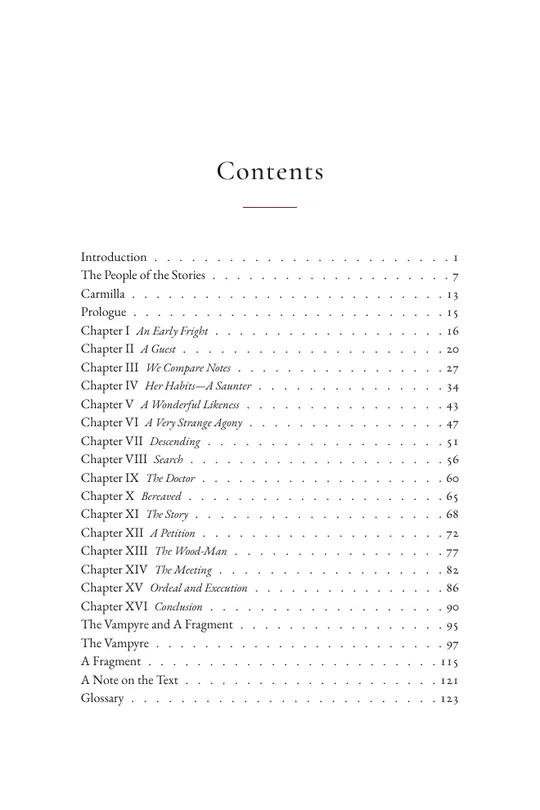
Contents
Contents
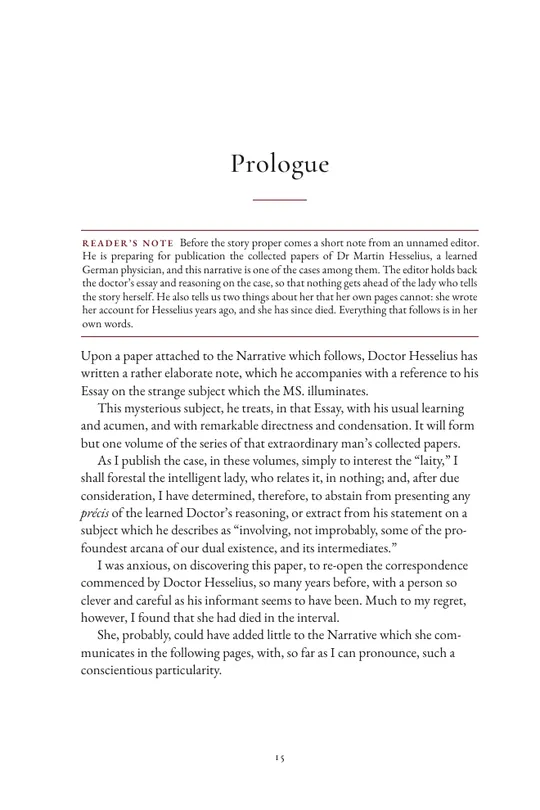
The Prologue of Carmilla, with its reader’s note
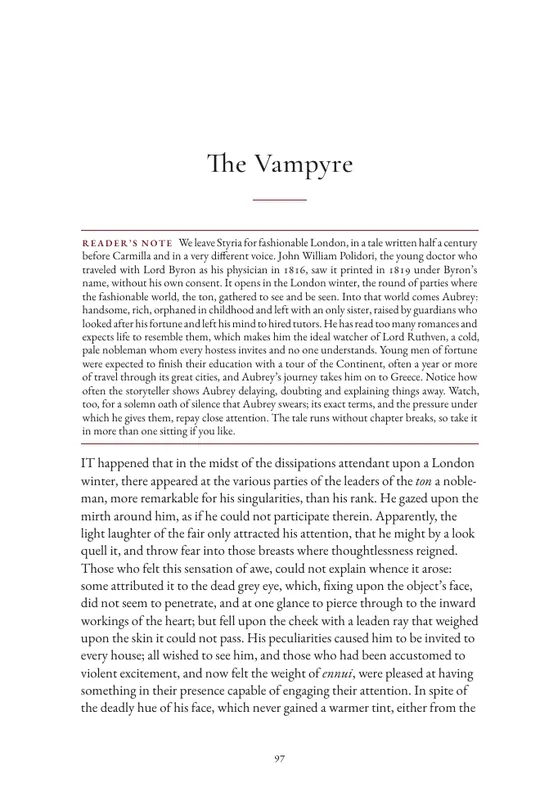
The opening of The Vampyre, with its reader’s note

The people of the stories

  • The narrator (Laura). A young Englishwoman who has never seen England, living with her father in a castle in Styria and writing down her story some eight years after its main events. The Prologue tells us she corresponded with Dr Hesselius and has since died.
  • The narrator’s father. A kind Englishman, growing old, who retired from the Austrian service and bought the schloss and its small estate. Partly from patriotism, he and his daughter speak English together every day, and he lets his only child have pretty nearly her own way.
  • Carmilla. A slender young lady lifted, stunned but alive, from an overturned carriage near the schloss, and left in the household’s care until the lady who calls herself her mother returns in three months. Of herself she will tell only her name, that her family is very ancient and noble, and that her home lies to the west; about everything else, her mother, her history and her plans, she keeps an ever-wakeful reserve.
  • General Spielsdorf. An old gentleman whose schloss, nearly twenty miles away, is the nearest inhabited one of any historic note. A ruined village lies between his home and the narrator’s.
  • Lord Ruthven. A nobleman with a deadly pale face and a dead grey eye who appears one winter at the parties of London’s fashionable world, more remarkable for his oddities than his rank. Everyone invites him, many try to win his notice, and no one can read him.
  • Aubrey. A handsome, frank and wealthy young gentleman, orphaned in childhood with an only sister, whose guardians cared for his fortune but not his mind. Raised on romances, he turns the mysterious Lord Ruthven into the hero of one in his imagination.
  • Augustus Darvell. The name the narrator chooses to give his traveling companion, a few years older, wealthy and of ancient family, reserved and restless, and the subject of many contradictory stories. His health has been failing without any apparent disease.

Choose your format

Every format includes the reader’s notes, the introduction, the who’s who and the glossary.

The hardcover and paperback editions (illustration)
Format
Ship to

Prices in US dollars. Printed books ship for a flat US$5.99 to the US or US$10.99 to Canada. Ebooks have no shipping charge. US sales tax, if any, is shown before you pay. Internationally fulfilled orders may be subject to customs duties or other import charges.

With tracked shipping, printed books usually arrive about 3 weeks after you order in the US and about 4 weeks in Canada.

Our promise

  • Order today and your hardcover or paperback ships within 14 days, or your ebook is emailed within 5 days. Your confirmation email gives the exact date.
  • Running late? We email you before that date, and you can keep waiting or cancel for a full refund.
  • Arrives damaged or misprinted, or not as this page describes? Email us a photo up to 30 days after delivery for a full refund or a replacement. No need to send it back.
  • Secure checkout by Stripe. Your card details go to Stripe, never to us. Your statement will show BOOKHAWK PRESS.

Shipping · Refunds

See how it works: the opening of Carmilla

The book opens with a short prologue, and a note before it tells you whose papers these are and what to watch for. Every section of the book opens this way: the Prologue, each chapter of Carmilla, The Vampyre and A Fragment.

Prologue

Upon a paper attached to the Narrative which follows, Doctor Hesselius has written a rather elaborate note, which he accompanies with a reference to his Essay on the strange subject which the MS. illuminates.

This mysterious subject, he treats, in that Essay, with his usual learning and acumen, and with remarkable directness and condensation. It will form but one volume of the series of that extraordinary man’s collected papers.

As I publish the case, in these volumes, simply to interest the “laity,” I shall forestal the intelligent lady, who relates it, in nothing; and, after due consideration, I have determined, therefore, to abstain from presenting any précis of the learned Doctor’s reasoning, or extract from his statement on a subject which he describes as “involving, not improbably, some of the profoundest arcana of our dual existence, and its intermediates.”

I was anxious, on discovering this paper, to re-open the correspondence commenced by Doctor Hesselius, so many years before, with a person so clever and careful as his informant seems to have been. Much to my regret, however, I found that she had died in the interval.

She, probably, could have added little to the Narrative which she communicates in the following pages, with, so far as I can pronounce, such a conscientious particularity.

Enjoyed Prologue? Get the whole book.

That’s how every section in this edition works: a short note, then the section itself. All 19 of them.

Hardcover US$39.99 · Paperback US$25.99 · Ebook US$15.99

Get my copy · from US$15.99

Not ready yet? Get the General’s story and Byron’s Fragment free by email

A PDF of Chapters XI and XII of Carmilla, where the General tells the story of a masked ball, and Lord Byron’s A Fragment, each with its reader’s note (PDF, 20 pages).

We’ll email the sample whether or not you tick the box. Sent by Bookhawk Press (Space Dog Tech LLC), 411 Walnut St, PMB 22412, Green Cove Springs, FL 32043, USA · support@bookhawkpress.com. Privacy

Questions

Is it hard going for a modern reader?
Not with this edition. Both tales are short: Carmilla runs to about 28,000 words and The Vampyre to about 8,000. A note before every chapter tells you where you are, who is there and what to watch for. Period words, places and customs are explained in a glossary of 134 terms at the back, and a who’s who of 39 entries keeps the names straight.
Which texts are these, and are they complete?
Yes, both tales are complete. Carmilla is complete, with its Prologue, as printed in In a Glass Darkly in 1872. The Vampyre is complete as first printed in book form in 1819. Byron’s A Fragment is given as he printed it with his Mazeppa in 1819. We print The Vampyre alone, without the unsigned letter, introduction and Mitylene account that the 1819 volume carried, since none of them is part of the tale. Spelling and punctuation are kept as first printed, so you’ll meet ‘chesnut’ and ‘langour’. That’s the mark of the real text, and the glossary explains them.
What do the reader’s notes do? Do they give anything away?
They keep you on track without looking ahead. A short note stands before the Prologue, each chapter of Carmilla, The Vampyre and A Fragment, 19 in all. Each one says where we are, who is there and what to watch for, adds a period detail, and tells you only what has happened so far. No note looks ahead of its own section.
Who wrote The Vampyre, and what did Byron have to do with it?
John William Polidori, Byron’s young physician, wrote it. At the Villa Diodati in June 1816 Byron began a tale of two travelers heading for the ruins of Ephesus, then put it aside. Polidori took its outline and made a new, darker tale from it. When the tale appeared in a London magazine on April 1, 1819, it was presented as Byron’s, without Polidori’s consent. Byron wrote to a Paris newspaper to say it wasn’t his and printed his own Fragment so readers could compare the two. That Fragment is at the end of this book.
How long does it take to read?
An evening or two. It runs to about 38,000 words in all: Carmilla about 28,000, The Vampyre about 8,000 and Byron’s Fragment about 2,000.
Does this edition suit a class or a book club?
Yes, very well. The notes keep everyone on the same footing, section by section, and no note looks ahead of its own section, so a group can read at its own pace. The introduction supplies the talking points: the Diodati summer, the tale printed under the wrong name, the intense friendship at the heart of Carmilla, and a narrator writing years after the events.
What are the formats, and when will my order arrive?
Choose hardcover, paperback, ebook, or a printed copy with the ebook. Every printed copy is printed for your order. Hardcover or paperback: “Ships within 14 days.” Ebook: “Emailed within 5 days.” Paperback with ebook: “Ebook emailed within 5 days; paperback ships within 14 days.” Hardcover with ebook: “Ebook emailed within 5 days; hardcover ships within 14 days.” The ebook is an EPUB that works on most e-readers and reading apps, plus a PDF in the print layout. Printed books go by tracked mail for a flat US$5.99 to the US or US$10.99 to Canada and usually arrive in about 3 weeks (US) or about 4 weeks (Canada). We sell and ship to the US and Canada only.
Can I cancel, or get a refund?
Yes, if you cancel before printing. Each printed copy is made for its order, so if you change your mind, cancel before your copy goes to print to get a refund. Once it’s printed, a book that arrives in good condition can’t be returned. If your book arrives damaged, misprinted or not as described, you can tell us up to 30 days after delivery. The full policy is at bookhawkpress.com/refunds.
Who is Bookhawk Press?
We’re an independent publisher in the United States, and this is our Reader’s Companion Edition. Questions are always welcome at support@bookhawkpress.com.
What is the hardcover like?
A hardcover to keep or to give: 6 × 9 inches, 136 pages, cream paper. The cover is printed on rigid boards, matte finish, no dust jacket.

About Bookhawk Press

Bookhawk Press is an independent publisher of carefully edited books in print and ebook. We sell direct from our own site, and each copy is printed for your order and shipped straight to you. Questions before you order? Email support@bookhawkpress.com. We answer every message, usually in two business days.

See all our books

Order Carmilla and The Vampyre