Bookhawk PressRead one chapter
Cover of Bushido, The Reader’s Companion Edition
The Reader’s Companion Edition

Bushido

Nitobe’s 1899 argument, with the history beside it

All 17 chapters as first published in 1900, each with a plain-words paraphrase, key terms you can pronounce, and where historians differ.

Hardcover US$34.99 · Paperback US$21.99 · Ebook US$12.99

Get my copy · from US$12.99Give the hardcover · US$34.99

Gave up on it before? With help beside every chapter, this is the one you’ll finish.

Hardcover and paperback ship within 14 days · Late? Cancel for a full refund · Damaged or not as described? Refund or replacement, no return needed

Sending it as a gift? Enter their name and address at checkout and we ship it straight to them. Your receipt, and any ebook in your order, come to you. Printed books usually arrive about 3 weeks after you order in the US, about 4 weeks in Canada. How gifting works

With the hardcover, add it for US$5.00; with the paperback, add it for US$4.00. Start reading while your book is printed and shipped.

Why this edition

  • See where historians differ from Nitobe

    The word bushidō came into wide use only in the 1890s. Every chapter’s Context ends where historians differ from Nitobe, and the introduction’s Bushido in history tells what they’ve found about how samurai lived.

  • Long 1899 sentences, easy to follow

    After every chapter comes In plain words: our own short paraphrase, marked as ours and printed after the text. Nitobe’s rolling sentences become easy to follow, and his words are never replaced.

  • Japanese words and 1899 allusions, decoded

    Gi (GHEE) is his “Rectitude or Justice”; giri (GHEE-ree) his “Right Reason.” Key terms after each chapter, a glossary with pronunciation, Burke’s eulogy explained, and Iyéyasu shown as Tokugawa Ieyasu.

  • Never lost at a chapter’s first line

    In the 1900 layout, most chapters open mid-sentence. A short Before you read orientation joins each one up and says what to watch for. After the chapter: Connections across the book and a question to reflect on.

  • Know the man and his moment

    An introduction of about five thousand words: the book, Nitobe, Japan in 1899, bushido in history, and how the book has been read. Plus a timeline, A Two-Week Reading Plan, or a path through the book by theme.

  • The 1900 first edition, all 17 chapters

    Bushido as first published in 1900, word for word with five printing slips corrected: the dedication, Nitobe’s preface with Laveleye’s “No religion! How do you impart moral education?”, all 17 chapters and his footnotes.

Get my copy · from US$12.99

The words alone, or the words with their world

A plain copyThis edition
Buké, Gi-ri, Iyéyasu: 1900 spellings with nothing to help you.Key terms with sounds-like pronunciation, and Iyéyasu shown as Tokugawa Ieyasu.
Burke’s eulogy, Tom Brown, Carl Marx: allusions left for you to catch.Context names them: Burke’s 1790 lament that the age of chivalry was gone.
A chapter opens mid-sentence, running on from its title.Before you read joins the sentence up and says what to watch for.
Nitobe’s idealized portrait, with nothing to test it against.Each chapter’s Context ends with where historians see things differently.
Long 1899 sentences, and no help when one loses you.In plain words after every chapter: our short paraphrase, marked as ours.

Get my copy · from US$12.99

You may know Bushido’s reputation before its words. Then the words arrive: long 1899 sentences, allusions to Burke and Carlyle, Japanese terms in Nitobe’s own spellings, and no way to tell his idealized portrait from what historians have found. This edition gives you help with each of those. This is the Bushido you’ll actually finish.

Nitobe wrote it in English, for Western readers, to answer a question the Belgian scholar Émile de Laveleye put to him on a walk: “No religion! How do you impart moral education?” His answer is bushido, which he renders “Military-Knight-Ways.” He traces it to Buddhism, Shinto and the teachings of Confucius and Mencius, then takes the virtues one by one, setting each beside European chivalry, from Burke’s eulogy to Tom Brown’s wish “to leave behind him the name of a fellow who never bullied a little boy or turned his back on a big one.”

Here is the 1900 first edition, word for word, with five printing slips corrected and listed, and a companion around every chapter: a short orientation before it, and after it Context, In plain words, key terms with pronunciation, Connections and a question to reflect on. Nitobe’s claims stay his, historians’ findings stay theirs, and the judgment is yours.

What’s inside

  • Bushido: The Soul of Japan as first published in Philadelphia in 1900, word for word (five printing slips corrected and listed): the dedication, Nitobe’s preface, all 17 chapters and his own footnotes
  • An introduction of about five thousand words: the book, Inazo Nitobe, Japan in 1899, Bushido in history (what historians have found, and where they differ from Nitobe), how the book has been read, and reading it now
  • Before every chapter, a short orientation. After it, the companion: context that ends with where historians see things differently, In plain words (our paraphrase, marked as ours), key terms with pronunciation, connections, and a question to reflect on
  • How to Use This Companion, a two-week reading plan and a themes index
  • A timeline, people and places, a glossary with pronunciation, and further reading
  • Hardcover or paperback, 6 × 9 in on cream paper, each copy printed for its order

Look inside

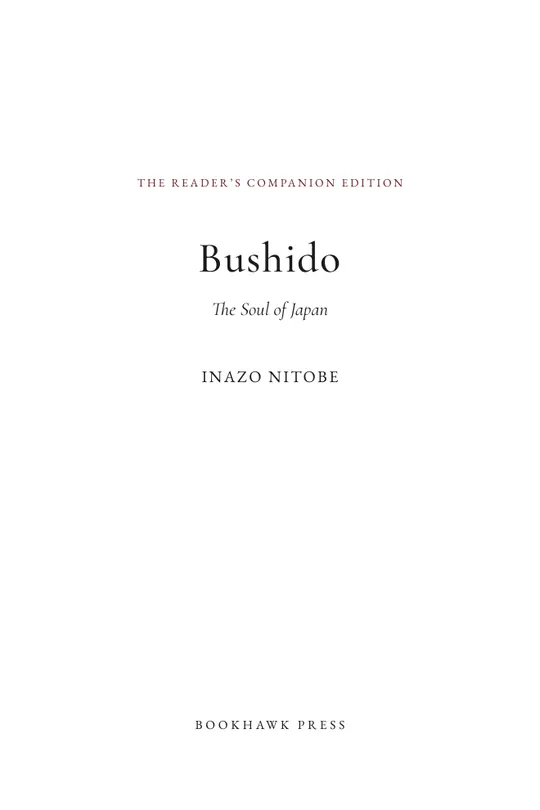
Title page
Title page
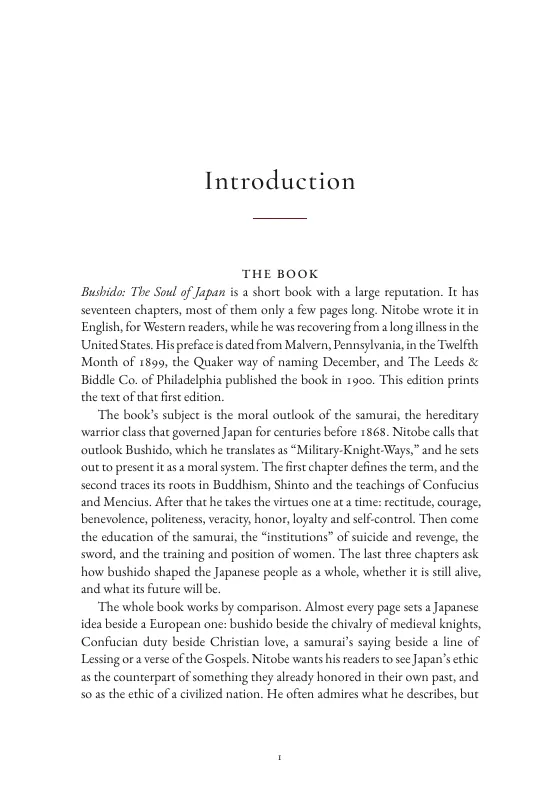
The introduction
The introduction
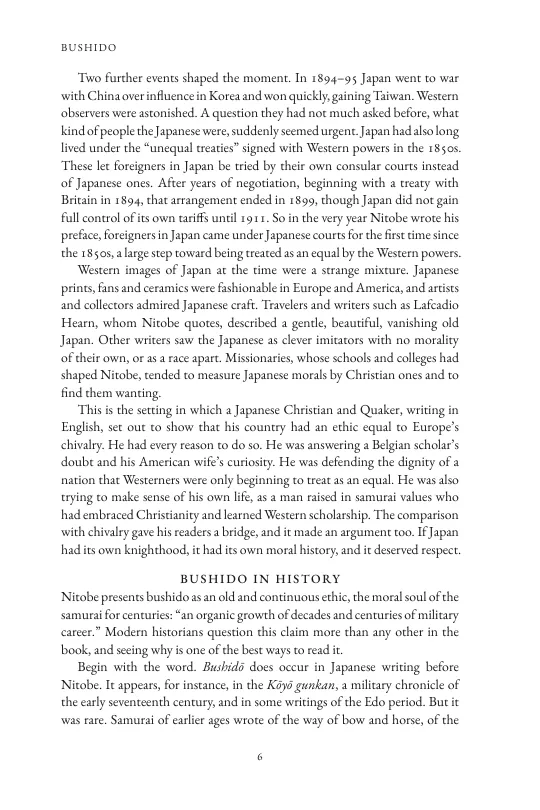
Bushido in history
Bushido in history
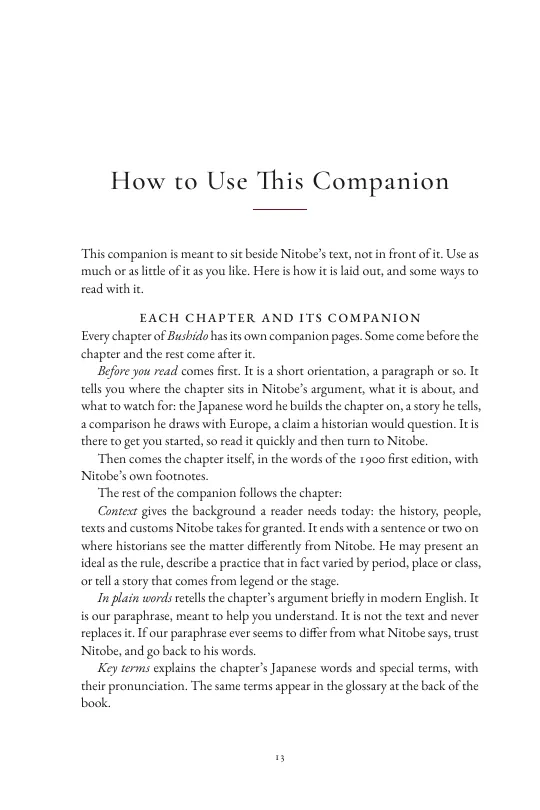
How to Use This Companion
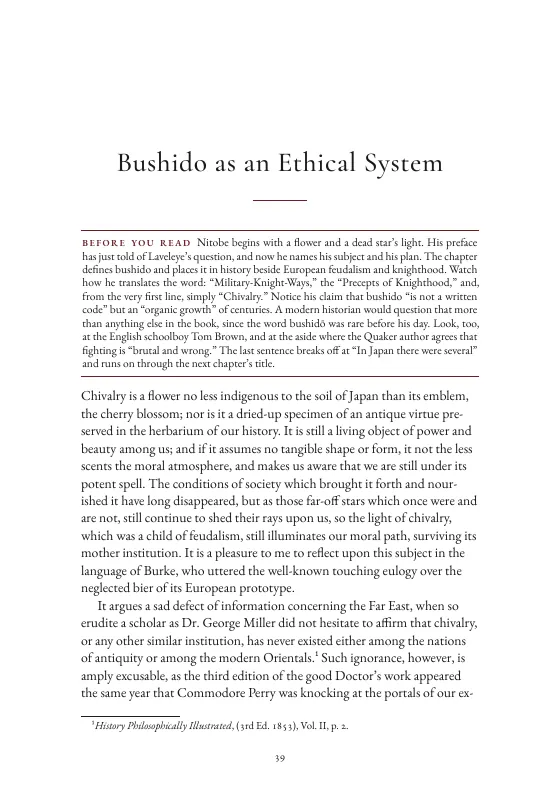
Chapter I, with Before you read
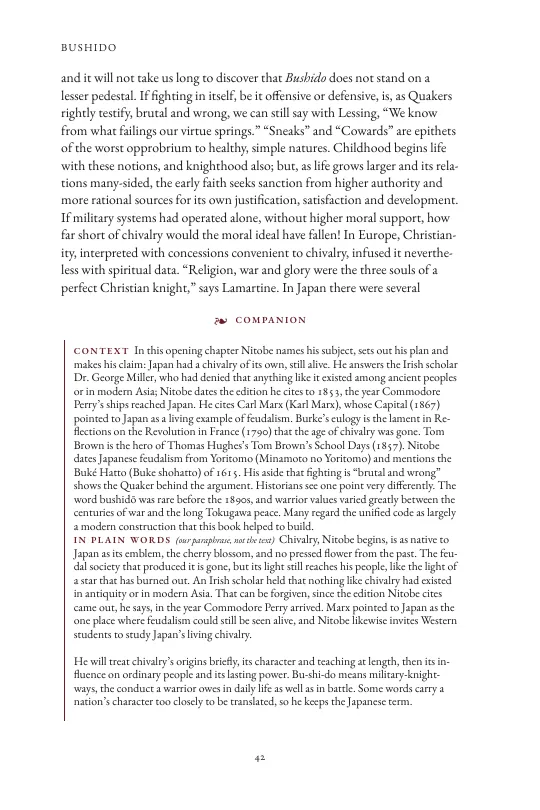
Chapter I’s companion
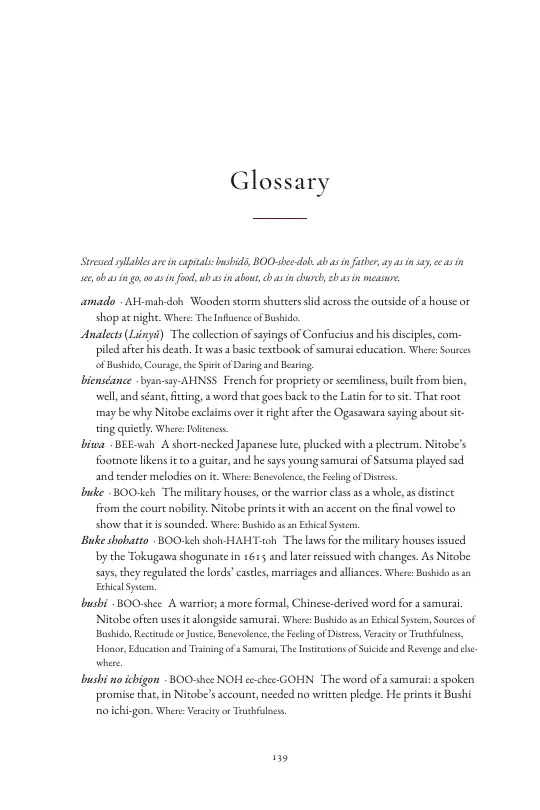
The glossary, with pronunciation

People and places

  • Confucius (Kǒngzǐ). Chinese teacher who by tradition lived from 551 to 479 BCE, whose sayings are collected in the Analects. Nitobe calls his teachings “the most prolific source of Bushido” and quotes his definition of courage.
  • Mencius (Mèngzǐ). Confucian philosopher of about 372–289 BCE who taught that human nature is good and that rulers who oppress the people lose their right to rule. Nitobe notes that his bolder ideas were long thought dangerous in Japan.
  • Wang Yang-Ming (Wang Yangming). Chinese philosopher and official (1472–1529) who taught that knowing and acting are one. Nitobe finds parallels to the New Testament in his teaching and says that some of the noblest samurai were strongly influenced by it.
  • Yoritomo (Minamoto no Yoritomo). Warrior leader (1147–1199) who founded Japan’s first shogunate at Kamakura and was appointed shogun in 1192. Nitobe dates the rise of Japanese feudalism from his ascendancy.
  • The Forty-seven Faithfuls (the Akō rōnin). Retainers of Asano Naganori, lord of Akō, who in 1703 killed the official they held responsible for their lord’s death and were then ordered to take their own lives. Nitobe notes that they are known in common parlance as the Forty-seven Gishi, men of rectitude; the case was debated even in its own day.
  • Miwa Shissai. Japanese Confucian scholar (1669–1744) of the school of Wang Yangming. Nitobe’s footnote names him as the “Japanese disciple” whose words on conscience he quotes.

Choose your format

Every format includes the whole companion: the introduction, an orientation and companion notes for every chapter, the glossary, the who’s who and the themes.

Format
Ship to

Prices in US dollars. Printed books ship for a flat rate to the US or Canada, shown at checkout before you pay. Ebooks have no shipping charge. US sales tax, if any, is shown before you pay. Internationally fulfilled orders may be subject to customs duties or other import charges.

With tracked shipping, printed books usually arrive about 3 weeks after you order in the US and about 4 weeks in Canada.

Our promise

  • Order today and your hardcover or paperback ships within 14 days, or your ebook is emailed within 5 days. Your confirmation email gives the exact date.
  • Running late? We email you before that date, and you can keep waiting or cancel for a full refund.
  • Arrives damaged or misprinted, or not as this page describes? Email us a photo up to 30 days after delivery for a full refund or a replacement. No need to send it back.
  • Secure checkout by Stripe. Your card details go to Stripe, never to us. Your statement will show BOOKHAWK PRESS.

Shipping · Refunds

See how it works: the first chapter, with its companion

Every chapter opens with a short Before you read and ends with its companion. Here is Chapter I, whole, as the 1900 edition prints it; open the companion under it to see what comes after.

Bushido as an Ethical System

Chivalry is a flower no less indigenous to the soil of Japan than its emblem, the cherry blossom; nor is it a dried-up specimen of an antique virtue preserved in the herbarium of our history. It is still a living object of power and beauty among us; and if it assumes no tangible shape or form, it not the less scents the moral atmosphere, and makes us aware that we are still under its potent spell. The conditions of society which brought it forth and nourished it have long disappeared, but as those far-off stars which once were and are not, still continue to shed their rays upon us, so the light of chivalry, which was a child of feudalism, still illuminates our moral path, surviving its mother institution. It is a pleasure to me to reflect upon this subject in the language of Burke, who uttered the well-known touching eulogy over the neglected bier of its European prototype.

It argues a sad defect of information concerning the Far East, when so erudite a scholar as Dr. George Miller did not hesitate to affirm that chivalry, or any other similar institution, has never existed either among the nations of antiquity or among the modern Orientals.1 Such ignorance, however, is amply excusable, as the third edition of the good Doctor’s work appeared the same year that Commodore Perry was knocking at the portals of our exclusivism. More than a decade later, about the time that our feudalism was in the last throes of existence, Carl Marx, writing his “Capital,” called the attention of his readers to the peculiar advantage of studying the social and political institutions of feudalism, as then to be seen in living form only in Japan. I would likewise point the Western historical and ethical student to the study of chivalry in the Japan of the present.

Enticing as is a historical disquisition on the comparison between European and Japanese feudalism and chivalry, it is not the purpose of this paper to enter into it at length. My attempt is rather to relate, firstly, the origin and sources of our chivalry; secondly, its character and teaching; thirdly, its influence among the masses; and, fourthly, the continuity and permanence of its influence. Of these several points, the first will be only brief and cursory, or else I should have to take my readers into the devious paths of our national history; the second will be dwelt upon at greater length, as being most likely to interest students of International Ethics and Comparative Ethology in our ways of thought and action; and the rest will be dealt with as corollaries.

The Japanese word, which I have roughly rendered Chivalry, is, in the original, more expressive than Horsemanship. Bu-shi-do means literally Military-Knight-Ways—the ways which fighting nobles should observe in their daily life as well as in their vocation; in a word, the “Precepts of Knighthood,” the noblesse oblige of the warrior class. Having thus given its literal significance, I may be allowed henceforth to use the word in the original. The use of the original term is also advisable for this reason, that a teaching so circumscribed and unique, engendering a cast of mind and character so peculiar, so local, must wear the badge of its singularity on its face; then, some words have a national timbre so expressive of race characteristics that the best of translators can do them but scant justice, not to say positive injustice and grievance. Who can improve by translation what the German “Gemüth” signifies, or who does not feel the difference between the two words verbally so closely allied as the English gentleman and the French gentilhomme?

Bushido, then, is the code of moral principles which the knights were required or instructed to observe. It is not a written code; at best it consists of a few maxims handed down from mouth to mouth or coming from the pen of some well-known warrior or savant. More frequently it is a code unuttered and unwritten, possessing all the more the powerful sanction of veritable deed, and of a law written on the fleshly tablets of the heart. It was founded not on the creation of one brain, however able, or on the life of a single personage, however renowned. It was an organic growth of decades and centuries of military career. It, perhaps, fills the same position in the history of ethics that the English Constitution does in political history; yet it has had nothing to compare with the Magna Charta or the Habeas Corpus act. True, early in the seventeenth century Military Statutes (Buké Hatto) were promulgated; but their thirteen short articles were taken up mostly with marriages, castles, leagues, etc., and didactic regulations were but meagerly touched upon. We cannot, therefore, point out any definite time and place and say, “Here is its fountain head.” Only as it attains consciousness in the feudal age, its origin, in respect to time, may be identified with feudalism. But feudalism itself is woven of many threads, and Bushido shares its intricate nature. As in England the political institution of feudalism may be said to date from the Norman Conquest, so we may say that in Japan its rise was simultaneous with the ascendancy of Yoritomo, late in the twelfth century. As, however, in England, we find the social elements of feudalism far back in the period previous to William the Conqueror, so, too, the germs of feudalism in Japan had been long existent before the period I have mentioned.

Again, in Japan as in Europe, when feudalism was formally inaugurated, the professional class of warriors naturally came into prominence. These were known as samurai, meaning literally, like the old English cniht (knecht, knight), guards or attendants—resembling in character the soldurii whom Cæsar mentioned as existing in Aquitania. A Sinico-Japanese word Bu-ké or Bu-shi (Fighting Knights) was also adopted in common use. They were a privileged class, and must originally have been a rough breed who made fighting their vocation. Coming to profess great honor and great privileges, and correspondingly great responsibilities, they soon felt the need of a common standard of behavior, especially as they were always on a belligerent footing and belonged to different clans.

Fair play in fight! What fertile germs of morality lie in this primitive sense of savagery and childhood. Is it not the root of all military and civic virtues? We smile (as if we had outgrown it!) at the boyish desire of the small Britisher, Tom Brown, “to leave behind him the name of a fellow who never bullied a little boy or turned his back on a big one.” And yet, who does not know that this desire is the corner-stone on which moral structures of mighty dimensions can be reared? May I not go even so far as to say that the gentlest and most peace-loving of religions endorses this aspiration? This desire of Tom’s is the basis on which the greatness of England is largely built, and it will not take us long to discover that Bushido does not stand on a lesser pedestal. If fighting in itself, be it offensive or defensive, is, as Quakers rightly testify, brutal and wrong, we can still say with Lessing, “We know from what failings our virtue springs.” “Sneaks” and “Cowards” are epithets of the worst opprobrium to healthy, simple natures. Childhood begins life with these notions, and knighthood also; but, as life grows larger and its relations many-sided, the early faith seeks sanction from higher authority and more rational sources for its own justification, satisfaction and development. If military systems had operated alone, without higher moral support, how far short of chivalry would the moral ideal have fallen! In Europe, Christianity, interpreted with concessions convenient to chivalry, infused it nevertheless with spiritual data. “Religion, war and glory were the three souls of a perfect Christian knight,” says Lamartine. In Japan there were several

  1. History Philosophically Illustrated, (3rd Ed. 1853), Vol. II, p. 2.
Read the companion to Bushido as an Ethical System

Context In this opening chapter Nitobe names his subject, sets out his plan and makes his claim: Japan had a chivalry of its own, still alive. He answers the Irish scholar Dr. George Miller, who had denied that anything like it existed among ancient peoples or in modern Asia; Nitobe dates the edition he cites to 1853, the year Commodore Perry’s ships reached Japan. He cites Carl Marx (Karl Marx), whose Capital (1867) pointed to Japan as a living example of feudalism. Burke’s eulogy is the lament in Reflections on the Revolution in France (1790) that the age of chivalry was gone. Tom Brown is the hero of Thomas Hughes’s Tom Brown’s School Days (1857). Nitobe dates Japanese feudalism from Yoritomo (Minamoto no Yoritomo) and mentions the Buké Hatto (Buke shohatto) of 1615. His aside that fighting is “brutal and wrong” shows the Quaker behind the argument. Historians see one point very differently. The word bushidō was rare before the 1890s, and warrior values varied greatly between the centuries of war and the long Tokugawa peace. Many regard the unified code as largely a modern construction that this book helped to build.

In plain words (our paraphrase, not the text) Chivalry, Nitobe begins, is as native to Japan as its emblem, the cherry blossom, and no pressed flower from the past. The feudal society that produced it is gone, but its light still reaches his people, like the light of a star that has burned out. An Irish scholar held that nothing like chivalry had existed in antiquity or in modern Asia. That can be forgiven, since the edition Nitobe cites came out, he says, in the year Commodore Perry arrived. Marx pointed to Japan as the one place where feudalism could still be seen alive, and Nitobe likewise invites Western students to study Japan’s living chivalry. He will treat chivalry’s origins briefly, its character and teaching at length, then its influence on ordinary people and its lasting power. Bu-shi-do means military-knight-ways, the conduct a warrior owes in daily life as well as in battle. Some words carry a nation’s character too closely to be translated, so he keeps the Japanese term. Bushido is not a written code. It lives in a few sayings, and more in deeds and the heart. No single person founded it; it grew over centuries of warfare, like the English Constitution. The seventeenth-century laws for the military houses deal mostly with castles and marriages and touch only lightly on morals. Bushido rose with feudalism, which in Japan dates from Yoritomo in the late twelfth century. The samurai were a privileged class, rough at first, who needed a common standard of behavior. Its seed was fair play: the schoolboy’s wish never to bully the small or run from the big. Fighting is brutal and wrong, as the Quakers rightly say, yet virtue can grow even from failings. Such instincts need higher support: in Europe, Christianity; in Japan, several sources.

Key terms bushidō (BOO-shee-doh): The way of the warrior. Nitobe renders it “Military-Knight-Ways” and “Precepts of Knighthood,” then keeps the Japanese word because no translation does it justice. samurai (SAH-moo-rye): The warrior class. Nitobe notes that the word first meant a guard or attendant, like the Old English cniht, from which “knight” comes. bushi (BOO-shee), “Bu-shi”: A more formal, Chinese-derived word for a warrior, which Nitobe translates as “Fighting Knights.” Buke shohatto (BOO-keh shoh-HAHT-toh), “Buké Hatto”: The “Military Statutes” of the early seventeenth century. Nitobe notes they dealt mostly with marriages and castles, touching moral teaching only meagerly, so bushido has no founding document. noblesse oblige (noh-BLESS oh-BLEEZH): The idea that rank brings duties as well as privileges. Nitobe uses it to sum up what bushido asked of the warrior class. feudalism: A society of lords and sworn vassals. Nitobe calls chivalry its child and dates it in Japan from Yoritomo’s rise in the late twelfth century.

To reflect on Nitobe traces great moral structures back to a schoolboy’s wish never to bully a smaller boy or run from a bigger one. Think of a rule of fairness you learned as a child. Where is it still at work in you, and where has it needed something more to hold it up?

Enjoyed Bushido as an Ethical System? Get the whole book.

That’s how every chapter in this edition works: a short orientation, the chapter itself, then its companion.

Hardcover US$34.99 · Paperback US$21.99 · Ebook US$12.99

Get my copy · from US$12.99

Not ready yet? Get Chapter II free by email

Chapter II, Sources of Bushido: Zen, Shinto and the teachings of Confucius and Mencius, as Nitobe traces them, with its Before you read and its companion (PDF, 10 pages).

We’ll email the sample whether or not you tick the box. Sent by Bookhawk Press (Space Dog Tech LLC), 411 Walnut St, PMB 22412, Green Cove Springs, FL 32043, USA · support@bookhawkpress.com. Privacy

Questions

Is Bushido hard going for a modern reader?
Not with this edition. The book is short, about 28,000 words, but Nitobe writes long 1899 sentences full of allusions. Before every chapter, a short orientation tells you what to watch for. After it, In plain words gives our own short paraphrase, and Context explains the people and books he takes for granted, from Burke to Tom Brown.
What is Bushido really, and will this edition help me read it?
It is Nitobe’s portrait and argument, written in English in 1899 for Western readers. He renders the word “Military-Knight-Ways” and presents it as unwritten “Precepts of Knighthood.” Historians date the idea of one unified code largely to his own era, and the word bushidō came into wide use only in the 1890s. The introduction and every chapter’s Context set his ideal beside the history, so you can read both.
Does the companion say where Nitobe was wrong?
It says where historians see things differently, and leaves the verdict to you. Every chapter’s Context ends on that point. For example, giri, which Nitobe glosses “Right Reason,” is by historians’ and anthropologists’ account the web of obligations people owe one another. The introduction discusses the work of Benesch, Friday, Hurst and Ikegami, and Chamberlain’s 1912 essay The Invention of a New Religion.
Does In plain words change or replace Nitobe’s text?
No. Each chapter is printed first, in Nitobe’s own words. In plain words follows it: a short paraphrase in everyday English, labeled as our paraphrase and not the text, to help you follow the argument. His words are right there to go back to.
Which text is this, and is the whole book included?
Yes, the whole book: the 1900 first edition, published in Philadelphia by The Leeds & Biddle Co., with the dedication, the three epigraphs, Nitobe’s preface, all 17 chapters and his footnotes. It was transcribed from a copy of the 1900 printing and checked word by word against its pages; five slips of the printing are corrected and listed. Nitobe wrote it in English, and his spellings of Japanese words (Buké, Gi-ri, Iyéyasu) appear as he wrote them, with the modern forms in our notes. This is the book as it first appeared, not the 1905 revision.
How do I say the Japanese words, and who are the people Nitobe names?
The key terms after each chapter and the glossary give a sounds-like guide: bushidō is BOO-shee-doh, samurai SAH-moo-rye, Shintō SHIN-toh. Nitobe’s own preface note puts the stress on the first syllable, and our respelling agrees. People and places gives his spelling beside the modern form (Iyéyasu is Tokugawa Ieyasu; Carl Marx is Karl Marx), with dates where confirmed.
How does the two-week reading plan work?
How to Use This Companion offers three ways to read: straight through, A Two-Week Reading Plan that takes you through the book in 14 days, or by theme, using the themes index (Loyalty, Ideal and History, Japan and Europe Compared and more). Pick whichever suits you.
What are the hardcover and the paperback like?
Both are 6 × 9 in on cream paper, and each copy is printed for its order. The hardcover’s cover is printed on rigid boards with a matte finish and no dust jacket, a good copy to give and keep. The paperback has a matte cover. Each format card on this page shows its promise: Ships within 14 days.
Which ebook formats are included, and how does the ebook arrive?
You get both: an EPUB for Kindle (through Send to Kindle), Kobo, Apple Books and most reading apps, plus a PDF in the print layout. They come by email. Emailed within 5 days.
Where do you ship, and how long does it take?
We sell and ship to the US and Canada only. Printed books go by tracked mail and usually arrive in about 3 weeks (US) or about 4 weeks (Canada) after the order. Your confirmation gives the date your order will ship by, and we email you when it ships.
Can I cancel, and what if something goes wrong?
You can cancel for a full refund until your order goes to print. If we might miss the ship-by date in your confirmation, we email you first and you can cancel for a full refund. If a printed book arrives damaged or misprinted, or isn’t what this page describes, email a photo up to 30 days after delivery and we refund in full or send a replacement where we can, without asking for it back. The same applies if tracking shows no movement for 10 business days. Undamaged books can’t be taken back, since each is printed for its order. Details: bookhawkpress.com/refunds.
Who is Bookhawk Press?
An independent publisher based in the United States that sells its books direct from its own site. Questions go to support@bookhawkpress.com.
What is the hardcover like?
A hardcover to keep or to give: 6 × 9 inches, 160 pages, cream paper. The cover is printed on rigid boards, matte finish, no dust jacket.

About Bookhawk Press

Bookhawk Press is an independent publisher of carefully edited books in print and ebook. We sell direct from our own site, and each copy is printed for your order and shipped straight to you. Questions before you order? Email support@bookhawkpress.com. We answer every message, usually in two business days.

See all our books

Order Bushido