Bookhawk PressRead two chapters
Cover of The Art of War, The Reader’s Companion Edition
The Reader’s Companion Edition

The Art of War

All of Giles’s notes, with our plain-words paraphrase

Sun Tzu in Giles’s 1910 translation, word for word, with a companion after every few paragraphs and the key terms made sayable.

Hardcover + ebook US$39.99 · Paperback US$25.99 · Ebook US$15.99

Get my copy · from US$15.99Give the hardcover · US$39.99

Gave up on it before? This edition is built to help you finish.

Hardcover and paperback ship within 14 days · Late? Cancel for a full refund · Damaged or not as described? Refund or replacement, no return needed

Sending it as a gift? Enter their name and address at checkout and we ship it straight to them. Your receipt, and any ebook in your order, come to you. Printed books usually arrive about 3 weeks after you order in the US, about 4 weeks in Canada. How gifting works

The hardcover includes the ebook; with the paperback, add it for US$4.00. Start reading while your book is printed and shipped.

Why this edition

  • Hear the commentators argue over the lines

    On almost every paragraph, Giles weighs Ts‘ao Kung, Tu Mu, Chang Yü and others, argues over the Chinese and brings in Wellington on the eve of Waterloo. All of his 1910 notes, with the Chinese line above each paragraph.

  • Never lost on a dense 1910 page

    After every few paragraphs comes In plain words, our own short paraphrase of Giles’s English. It is labeled as ours and printed after his text. It helps you follow him and never replaces a word he wrote.

  • Names made clear, key terms made sayable

    Key terms in pinyin with a sounds-like pronunciation: dào (DOW) is Giles’s ‘Moral Law’, jiàng (jee-AHNG) the Commander. A who’s who sets Giles’s spelling beside the pinyin: Ts‘ao Kung is Cao Cao. And a glossary with pronunciation.

  • Know what to watch for, then why it matters

    Before you read: a short orientation ahead of each chapter. After it: Context on what the commentators argue about and why, and Connections to the chapters that come back to the same idea.

  • Read it in thirty days, or by theme

    Follow a thirty-day reading plan, or read by theme: the cost of war, winning without fighting, knowing the enemy and yourself, deception, the commander.

  • The story behind the book, told straight

    An introduction of about four thousand words: what is known and debated about Sun Tzu, the bamboo slips found at Yinqueshan in 1972, and who Giles was. Plus a timeline, from King Ho Lü of Wu to the slips.

Get my copy · from US$15.99

The bare words, or the whole argument around them

A plain copyThis edition
“The Moral Law” sits on the page, and you’re left guessing what lies behind it.Key terms: dào, said DOW, literally a way; here, what binds the people to their ruler.
Ts‘ao Kung, Tu Mu, Chang Yü: names with no faces.A who’s who with Giles’s spelling beside the pinyin. Ts‘ao Kung is Cao Cao.
A dense 1910 paragraph, and you lose the thread.In plain words every few paragraphs: our short paraphrase, clearly marked as ours.
Sun Tzu’s short lines alone, with no one to argue over what they mean.All of Giles’s notes: the classical commentators weighed on almost every paragraph.
You finish a chapter unsure what mattered.Before you read says what to watch for; Connections point to where an idea comes back.

Get my copy · from US$15.99

Quoted three lines and stopped? The lines are short, but the world behind them isn’t. Who is Ts‘ao Kung? Why does Giles write “the Moral Law”? What is Wellington doing in a note? This edition answers them, beside Giles’s own words.

It opens in the council room: “Sun Tzŭ said: The art of war is of vital importance to the State.” Before any army moves, ruler and general weigh five factors and compare the two sides. Then comes the turn: “All warfare is based on deception.” Chapter II counts the cost, a thousand ounces of silver a day and farmers ruined by long campaigns. Chapter III holds that “supreme excellence consists in breaking the enemy’s resistance without fighting.” War here is ruinous, best kept short and better avoided.

This is Lionel Giles’s 1910 translation of all thirteen chapters, word for word. Each paragraph sits under its line of Chinese, with all of his notes: the classical commentators weighed on almost every paragraph, and Giles finding Captain Calthrop “decidedly hazy” over one passage. Around it is our companion: an introduction that runs from the traditional account to the bamboo slips of 1972, and a Before you read ahead of each chapter. After each chapter come Context, In plain words, Key terms and Connections. Add a who’s who, a glossary with pronunciation and a thirty-day reading plan. Finally read Sun Tzu instead of just quoting him.

What’s inside

  • Lionel Giles’s 1910 translation of all thirteen chapters, word for word, each numbered paragraph under its line of Chinese
  • All of Giles’s notes, which weigh the classical Chinese commentators from Ts‘ao Kung (Cao Cao) onward, with his preface and his introduction
  • An introduction of about four thousand words: the book, what is known and debated about Sun Tzu, the bamboo slips of 1972, how it has been read, and Giles’s translation
  • Before every chapter, a short orientation; after it, the companion to each group of paragraphs: context, In plain words (our paraphrase, marked as ours), key terms with pronunciation, connections, and a question to think about where a passage invites one
  • How to Use This Companion, with a thirty-day reading plan and a themes index
  • A who’s who, a timeline, a glossary with pronunciation, and further reading

Look inside

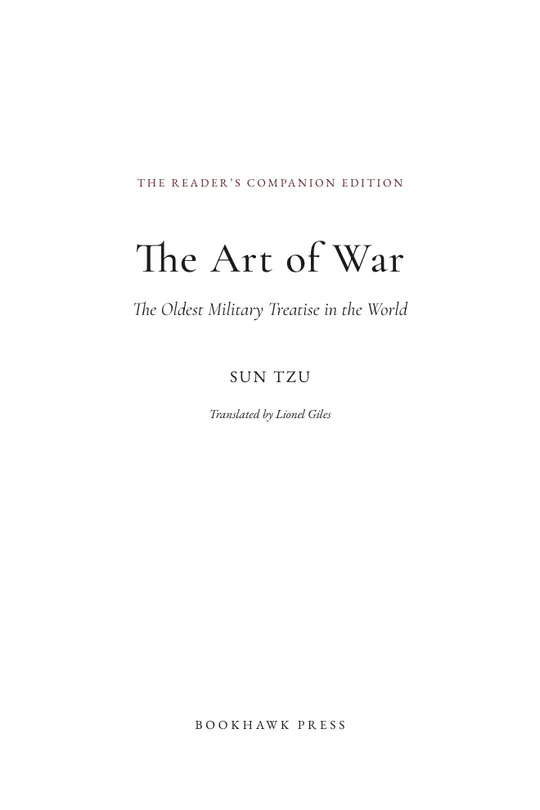
Title page
Title page
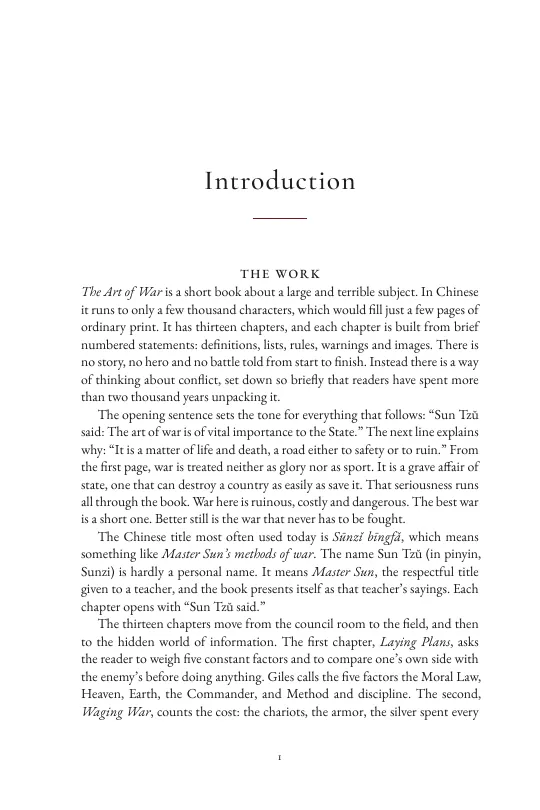
The introduction
The introduction
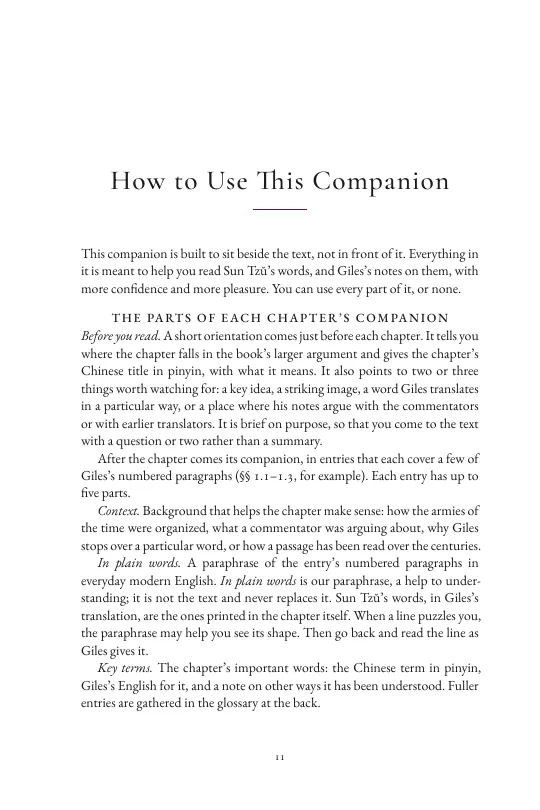
How to Use This Companion
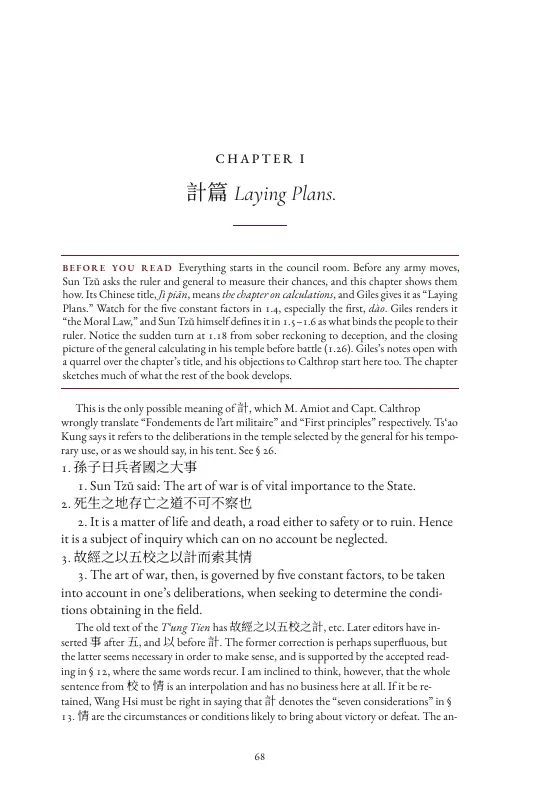
Chapter I, with Before you read
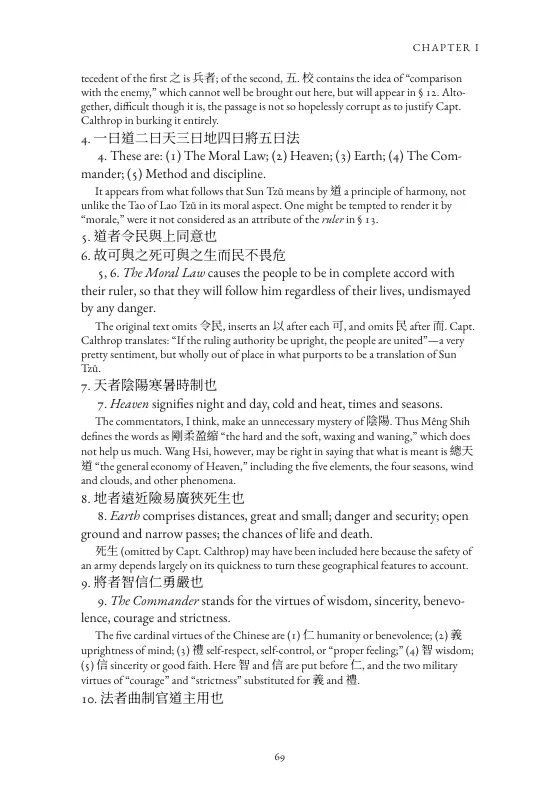
The Chinese, Giles’s translation and his notes
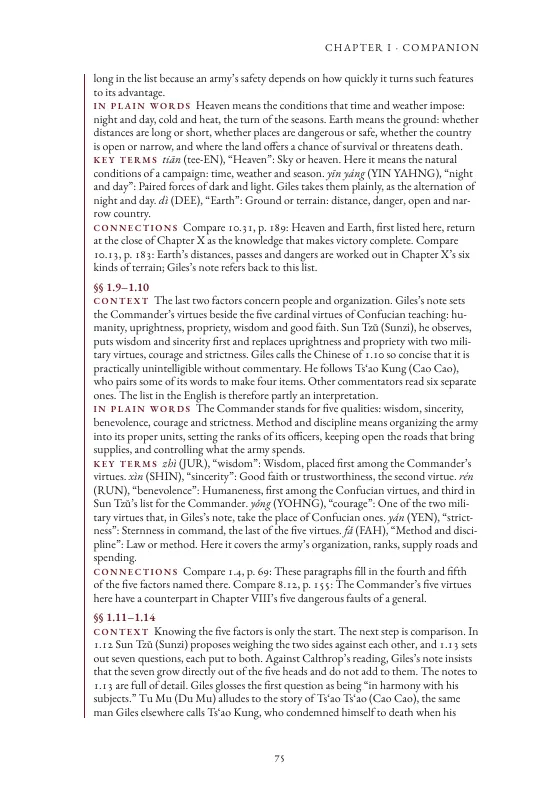
The companion to Chapter I
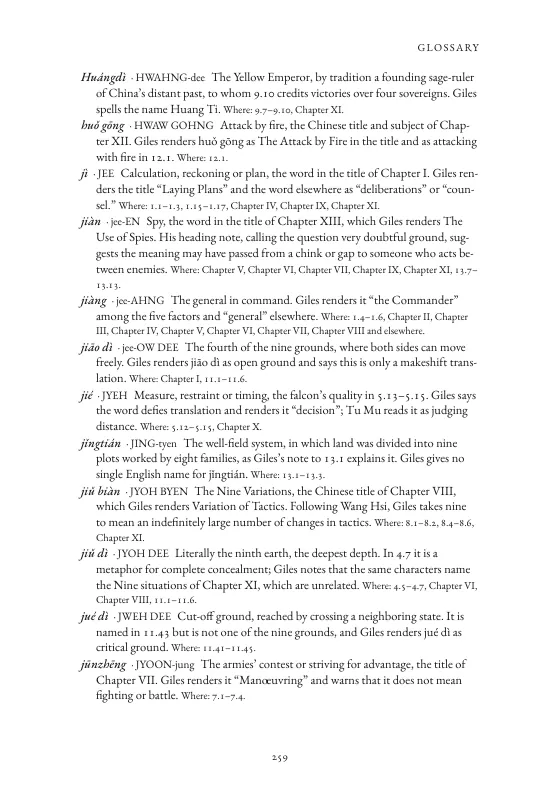
The glossary, with pronunciation

Who’s who

  • Sun Tzŭ. Master Sun (Sunzi), to whom the book is attributed. By tradition he was Sun Wu, a general of King Ho Lü of Wu around 500 BCE, though many scholars think the text took shape later, in the Warring States period. His words are the numbered paragraphs, set in full-size type, not Giles’s notes.
  • Ho Lü. Helü, king of Wu from 514 to 496 BCE, for whom, by tradition, the thirteen chapters were written. Giles’s note to 1.15 mentions him.
  • Ts‘ao Kung. Cao Cao (155–220), general and statesman at the end of the Han dynasty, whose brief notes are the oldest surviving commentary on the book. Giles also calls him Ts‘ao Ts‘ao, and Giles’s note to 1.13 tells, after Tu Mu, the story of Ts‘ao Ts‘ao’s self-imposed punishment.
  • Tu Mu. Du Mu (803–852), Tang poet and commentator. Giles often quotes him and sometimes prefers another reading to his, as in 2.4, where Giles follows Tu Yu instead.
  • Mei Yao-ch‘ên. Mei Yaochen (1002–1060), Song poet and commentator. Giles follows his paraphrase in 2.16 and his reading of 3.15.
  • Chang Yü. Zhang Yu, a Song-dynasty commentator whom Giles quotes often and values highly, as in his notes to 1.17, 3.8 and 3.18.

Choose your format

Every format includes the whole companion: the introduction, an orientation and companion notes for every chapter, the glossary, the who’s who and the themes.

Format
Ship to

Prices in US dollars. Printed books ship for a flat rate to the US or Canada, shown at checkout before you pay. Ebooks have no shipping charge. US sales tax, if any, is shown before you pay. Internationally fulfilled orders may be subject to customs duties or other import charges.

With tracked shipping, printed books usually arrive about 3 weeks after you order in the US and about 4 weeks in Canada.

Our promise

  • Order today and your hardcover or paperback ships within 14 days, or your ebook is emailed within 5 days. Your confirmation email gives the exact date.
  • Running late? We email you before that date, and you can keep waiting or cancel for a full refund.
  • Arrives damaged or misprinted, or not as this page describes? Email us a photo up to 30 days after delivery for a full refund or a replacement. No need to send it back.
  • Secure checkout by Stripe. Your card details go to Stripe, never to us. Your statement will show BOOKHAWK PRESS.

Shipping · Refunds

See how it works: two chapters from the book

Every chapter opens with a short Before you read, sets each of Sun Tzu’s numbered paragraphs under its line of Chinese with Giles’s notes after it, and ends with its companion. Here are Chapter I and Chapter III, whole; open the companion under each to see what comes after.

Chapter I

計篇 Laying Plans.

This is the only possible meaning of 計, which M. Amiot and Capt. Calthrop wrongly translate “Fondements de l’art militaire” and “First principles” respectively. Ts‘ao Kung says it refers to the deliberations in the temple selected by the general for his temporary use, or as we should say, in his tent. See § 26.

1. 孫子曰兵者國之大事

Continue reading

1. Sun Tzŭ said: The art of war is of vital importance to the State.

2. 死生之地存亡之道不可不察也

2. It is a matter of life and death, a road either to safety or to ruin. Hence it is a subject of inquiry which can on no account be neglected.

3. 故經之以五校之以計而索其情

3. The art of war, then, is governed by five constant factors, to be taken into account in one’s deliberations, when seeking to determine the conditions obtaining in the field.

The old text of the T‘ung Tien has 故經之以五校之計, etc. Later editors have inserted 事 after 五, and 以 before 計. The former correction is perhaps superfluous, but the latter seems necessary in order to make sense, and is supported by the accepted reading in § 12, where the same words recur. I am inclined to think, however, that the whole sentence from 校 to 情 is an interpolation and has no business here at all. If it be retained, Wang Hsi must be right in saying that 計 denotes the “seven considerations” in § 13. 情 are the circumstances or conditions likely to bring about victory or defeat. The antecedent of the first 之 is 兵者; of the second, 五. 校 contains the idea of “comparison with the enemy,” which cannot well be brought out here, but will appear in § 12. Altogether, difficult though it is, the passage is not so hopelessly corrupt as to justify Capt. Calthrop in burking it entirely.

4. 一曰道二曰天三曰地四曰將五曰法

4. These are: (1) The Moral Law; (2) Heaven; (3) Earth; (4) The Commander; (5) Method and discipline.

It appears from what follows that Sun Tzŭ means by 道 a principle of harmony, not unlike the Tao of Lao Tzŭ in its moral aspect. One might be tempted to render it by “morale,” were it not considered as an attribute of the ruler in § 13.

5. 道者令民與上同意也

6. 故可與之死可與之生而民不畏危

5, 6. The Moral Law causes the people to be in complete accord with their ruler, so that they will follow him regardless of their lives, undismayed by any danger.

The original text omits 令民, inserts an 以 after each 可, and omits 民 after 而. Capt. Calthrop translates: “If the ruling authority be upright, the people are united”—a very pretty sentiment, but wholly out of place in what purports to be a translation of Sun Tzŭ.

7. 天者陰陽寒暑時制也

7. Heaven signifies night and day, cold and heat, times and seasons.

The commentators, I think, make an unnecessary mystery of 陰陽. Thus Mêng Shih defines the words as 剛柔盈縮 “the hard and the soft, waxing and waning,” which does not help us much. Wang Hsi, however, may be right in saying that what is meant is 總天道 “the general economy of Heaven,” including the five elements, the four seasons, wind and clouds, and other phenomena.

8. 地者遠近險易廣狹死生也

8. Earth comprises distances, great and small; danger and security; open ground and narrow passes; the chances of life and death.

死生 (omitted by Capt. Calthrop) may have been included here because the safety of an army depends largely on its quickness to turn these geographical features to account.

9. 將者智信仁勇嚴也

9. The Commander stands for the virtues of wisdom, sincerity, benevolence, courage and strictness.

The five cardinal virtues of the Chinese are (1) 仁 humanity or benevolence; (2) 義 uprightness of mind; (3) 禮 self-respect, self-control, or “proper feeling;” (4) 智 wisdom; (5) 信 sincerity or good faith. Here 智 and 信 are put before 仁, and the two military virtues of “courage” and “strictness” substituted for 義 and 禮.

10. 法者曲制官道主用也

10. By Method and discipline are to be understood the marshalling of the army in its proper subdivisions, the gradations of rank among the officers, the maintenance of roads by which supplies may reach the army, and the control of military expenditure.

The Chinese of this sentence is so concise as to be practically unintelligible without commentary. I have followed the interpretation of Ts‘ao Kung, who joins 曲制 and again 主用. Others take each of the six predicates separately. 曲 has the somewhat uncommon sense of “cohort” or division of an army. Capt. Calthrop translates: “Partition and ordering of troops,” which only covers 曲制.

11. 凡此五者將莫不聞知之者勝不知者不勝

11. These five heads should be familiar to every general: he who knows them will be victorious; he who knows them not will fail.

12. 故校之以計而索其情

12. Therefore, in your deliberations, when seeking to determine the military conditions, let them be made the basis of a comparison, in this wise:—

The Yü Lan has an interpolated 五 before 計. It is obvious, however, that the 五者 just enumerated cannot be described as 計. Capt. Calthrop, forced to give some rendering of the words which he had omitted in § 3, shows himself decidedly hazy: “Further, with regard to these and the following seven matters, the condition of the enemy must be compared with our own.” He does not appear to see that the seven queries or considerations which follow arise directly out of the Five heads, instead of being supplementary to them.

13. 曰主孰有道將孰有能天地孰得法令孰行兵衆孰强士卒孰練賞罰孰明

13. (1) Which of the two sovereigns is imbued with the Moral law?

I.e., “is in harmony with his subjects.” Cf. § 5.

(2) Which of the two generals has most ability?

(3) With whom lie the advantages derived from Heaven and Earth?

See §§ 7, 8.

(4) On which side is discipline most rigorously enforced?

Tu Mu alludes to the remarkable story of Ts‘ao Ts‘ao (A.D. 155–220), who was such a strict disciplinarian that once, in accordance with his own severe regulations against injury to standing crops, he condemned himself to death for having allowed his horse to shy into a field of corn! However, in lieu of losing his head, he was persuaded to satisfy his sense of justice by cutting off his hair. Ts‘ao Ts‘ao’s own comment on the present passage is characteristically curt: 設而不犯犯而必誅 “when you lay down a law, see that it is not disobeyed; if it is disobeyed, the offender must be put to death.”

(5) Which army is the stronger?

Morally as well as physically. As Mei Yao-ch‘ên puts it, 內和外附, which might be freely rendered “esprit de corps and ‘big battalions.’”

(6) On which side are officers and men more highly trained?

Tu Yu quotes 王子 as saying: “Without constant practice, the officers will be nervous and undecided when mustering for battle; without constant practice, the general will be wavering and irresolute when the crisis is at hand.”

(7) In which army is there the greater constancy both in reward and punishment?

明, literally “clear;” that is, on which side is there the most absolute certainty that merit will be properly rewarded and misdeeds summarily punished?

14. 吾以此知勝負矣

14. By means of these seven considerations I can forecast victory or defeat.

15. 將聽吾計用之必勝留之將不聽吾計用之必敗去之

15. The general that hearkens to my counsel and acts upon it, will conquer:—let such a one be retained in command! The general that hearkens not to my counsel nor acts upon it, will suffer defeat:—let such a one be dismissed!

The form of this paragraph reminds us that Sun Tzŭ’s treatise was composed expressly for the benefit of his patron 闔閭 Ho Lü, king of the Wu State. It is not necessary, however, to understand 我 before 留之 (as some commentators do), or to take 將 as “generals under my command.”

16. 計利以聽乃爲之勢以佐其外

16. While heeding the profit of my counsel, avail yourself also of any helpful circumstances over and beyond the ordinary rules.

Capt. Calthrop blunders amazingly over this sentence: “Wherefore, with regard to the foregoing, considering that with us lies the advantage, and the generals agreeing, we create a situation which promises victory.” Mere logic should have kept him from penning such frothy balderdash.

17. 勢者因利而制權也

17. According as circumstances are favourable, one should modify one’s plans.

Sun Tzŭ, as a practical soldier, will have none of the “bookish theoric.” He cautions us here not to pin our faith to abstract principles; “for,” as Chang Yü puts it, “while the main laws of strategy can be stated clearly enough for the benefit of all and sundry, you must be guided by the actions of the enemy in attempting to secure a favourable position in actual warfare.” On the eve of the battle of Waterloo, Lord Uxbridge, commanding the cavalry, went to the Duke of Wellington in order to learn what his plans and calculations were for the morrow, because, as he explained, he might suddenly find himself Commander-in-chief and would be unable to frame new plans in a critical moment. The Duke listened quietly and then said: “Who will attack the first to-morrow—I or Bonaparte?” “Bonaparte,” replied Lord Uxbridge. “Well,” continued the Duke, “Bonaparte has not given me any idea of his projects; and as my plans will depend upon his, how can you expect me to tell you what mine are?”1

18. 兵者詭道也

18. All warfare is based on deception.

The truth of this pithy and profound saying will be admitted by every soldier. Col. Henderson tells us that Wellington, great in so many military qualities, was especially distinguished by “the extraordinary skill with which he concealed his movements and deceived both friend and foe.”

19. 故能而示之不能用而示之不用近而示之遠遠而示之近

19. Hence, when able to attack, we must seem unable; when using our forces, we must seem inactive; when we are near, we must make the enemy believe we are far away; when far away, we must make him believe we are near.

20. 利而誘之亂而取之

20. Hold out baits to entice the enemy. Feign disorder, and crush him.

取, as often in Sun Tzŭ, is used in the sense of 擊. It is rather remarkable that all the commentators, with the exception of Chang Yü, refer 亂 to the enemy: “when he is in disorder, crush him.” It is more natural to suppose that Sun Tzŭ is still illustrating the uses of deception in war.

21. 實而備之强而避之

21. If he is secure at all points, be prepared for him. If he is in superior strength, evade him.

The meaning of 實 is made clear from chap. VI, where it is opposed to 虛 “weak or vulnerable spots.” 强, according to Tu Yu and other commentators, has reference to the keenness of the men as well as to numerical superiority. Capt. Calthrop evolves an extraordinarily far-fetched translation: “If there are defects, give an appearance of perfection, and awe the enemy. Pretend to be strong, and so cause the enemy to avoid you”!

22. 怒而撓之卑而驕之

22. If your opponent is of choleric temper, seek to irritate him. Pretend to be weak, that he may grow arrogant.

I follow Chang Yü in my interpretation of 怒. 卑 is expanded by Mei Yao-ch‘ên into 示以卑弱. Wang Tzŭ, quoted by Tu Yu, says that the good tactician plays with his adversary as a cat plays with a mouse, first feigning weakness and immobility, and then suddenly pouncing upon him.

23. 佚而勞之親而離之

23. If he is taking his ease, give him no rest.

This is probably the meaning, though Mei Yao-ch‘ên has the note: 以我之佚待彼之勞 “while we are taking our ease, wait for the enemy to tire himself out.” The Yü Lan has 引而勞之 “Lure him on and tire him out.” This would seem also to have been Ts‘ao Kung’s text, judging by his comment 以利勞之.

If his forces are united, separate them.

Less plausible is the interpretation favoured by most of the commentators: “If sovereign and subject are in accord, put division between them.”

24. 攻其無備出其不意

24. Attack him where he is unprepared, appear where you are not expected.

25. 此兵家之勝不可先傳也

25. These military devices, leading to victory, must not be divulged beforehand.

This seems to be the way in which Ts‘ao Kung understood the passage, and is perhaps the best sense to be got out of the text as it stands. Most of the commentators give the following explanation: “It is impossible to lay down rules for warfare before you come into touch with the enemy.” This would be very plausible if it did not ignore 此, which unmistakably refers to the maxims which Sun Tzŭ has been laying down. It is possible, of course, that 此 may be a later interpolation, in which case the sentence would practically mean: “Success in warfare cannot be taught.” As an alternative, however, I would venture to suggest that a second 不 may have fallen out after 可, so that we get: “These maxims for succeeding in war are the first that ought to be imparted.”

26. 夫未戰而廟算勝者得算多也未戰而廟算不勝者得算少也多算勝少算不勝而況於無算乎吾以此觀之勝負見矣

26. Now the general who wins a battle makes many calculations in his temple ere the battle is fought.

Chang Yü tells us that in ancient times it was customary for a temple to be set apart for the use of a general who was about to take the field, in order that he might there elaborate his plan of campaign. Capt. Calthrop misunderstands it as “the shrine of the ancestors,” and gives a loose and inaccurate rendering of the whole passage.

The general who loses a battle makes but few calculations beforehand. Thus do many calculations lead to victory, and few calculations to defeat: how much more no calculation at all! It is by attention to this point that I can foresee who is likely to win or lose.

  1. “Words on Wellington,” by Sir W. Fraser.
Read the companion to Chapter I

1.1–1.3

Context The book opens with Sun Tzŭ (Sunzi) speaking in his own voice: “Sun Tzŭ said.” Before he gives any advice, he sets out what is at stake: war concerns the survival of the state itself. The word Giles renders “The art of war” is bīng, which can mean weapons, soldiers or warfare. The Chinese of 1.3 is difficult. Giles’s note weighs the readings and suspects that part of the sentence was added later. He translates it all the same, and faults Capt. Calthrop for leaving it out entirely. The chapter’s title uses jì, calculation. Giles’s opening note follows Ts‘ao Kung (Cao Cao) in tying it to deliberations held in a temple before a campaign.

In plain words (our paraphrase, not the text) Sun Tzŭ says that war is one of the gravest matters a state can face. It decides whether people live or die and whether the state survives or falls, so it must be studied with the greatest care. Five lasting factors govern it, and anyone who deliberates about how things stand before a campaign should keep them in view.

Key terms bīng (BING), “art of war”: Weapons, soldiers, war. Here it means warfare as a whole, the subject of the book. jì (JEE), “deliberations”: Calculation, the title’s word. If the sentence of 1.3 stands, Giles’s note says, Wang Hsi must be right that it means the seven considerations of 1.13.

1.4–1.6

Context Here Sun Tzŭ (Sunzi) names the five factors and starts defining them. “The Moral Law” is Giles’s own rendering of dào. His note explains that Sun Tzŭ means a principle of harmony, and he compares it to the Tao of Lao Tzŭ (Laozi) in its moral aspect. He considered “morale” but set it aside, because 1.13 treats the dào as something a ruler possesses. Other English renderings include the Way. The overlap with other early Chinese thought is a comparison worth making, but it is not evidence that Sun Tzŭ belonged to any school. Giles translates 1.5 and 1.6 together as one sentence. His note records an older text with slightly different wording and dismisses Calthrop’s rendering as out of place.

In plain words The five factors are the Moral Law, Heaven, Earth, the Commander, and Method and discipline. The first, the Moral Law, brings the people into full agreement with their ruler. They will then follow him even at the cost of their lives, and danger will not frighten them.

Key terms dào (DOW), “Moral Law”: Literally a way. Here it is what unites the people with their ruler. Giles compares it to Lao Tzŭ’s Tao in its moral aspect. jiàng (jee-AHNG), “Commander”: The general, the fourth of the five factors. His qualities are listed in 1.9.

Connections Compare 1.2: War is a matter of life and death, and the Moral Law is what lets a people face death with their ruler.

To think about Giles considered the word morale for dào and set it aside, because 1.13 makes the dào something a ruler possesses. As you read 1.5–1.6, which word seems closer to what Sun Tzŭ describes, and what does each one leave out?

1.7–1.8

Context The second and third factors are the natural setting of a campaign. Heaven here is not a god. Sun Tzŭ (Sunzi) defines it as night and day, cold and heat, times and seasons. The words Giles renders “night and day” are yīn yáng. His note says the commentators make “an unnecessary mystery” of them, though he allows that Wang Hsi (Wang Xi) may be right to read them as the whole working of the heavens: the elements, the seasons, wind and clouds. Earth is the ground itself: distance, danger, open country and narrow passes. Giles suggests that “the chances of life and death” belong in the list because an army’s safety depends on how quickly it turns such features to its advantage.

In plain words Heaven means the conditions that time and weather impose: night and day, cold and heat, the turn of the seasons. Earth means the ground: whether distances are long or short, whether places are dangerous or safe, whether the country is open or narrow, and where the land offers a chance of survival or threatens death.

Key terms tiān (tee-EN), “Heaven”: Sky or heaven. Here it means the natural conditions of a campaign: time, weather and season. yīn yáng (YIN YAHNG), “night and day”: Paired forces of dark and light. Giles takes them plainly, as the alternation of night and day. dì (DEE), “Earth”: Ground or terrain: distance, danger, open and narrow country.

1.9–1.10

Context The last two factors concern people and organization. Giles’s note sets the Commander’s virtues beside the five cardinal virtues of Confucian teaching: humanity, uprightness, propriety, wisdom and good faith. Sun Tzŭ (Sunzi), he observes, puts wisdom and sincerity first and replaces uprightness and propriety with two military virtues, courage and strictness. Giles calls the Chinese of 1.10 so concise that it is practically unintelligible without commentary. He follows Ts‘ao Kung (Cao Cao), who pairs some of its words to make four items. Other commentators read six separate ones. The list in the English is therefore partly an interpretation.

In plain words The Commander stands for five qualities: wisdom, sincerity, benevolence, courage and strictness. Method and discipline means organizing the army into its proper units, setting the ranks of its officers, keeping open the roads that bring supplies, and controlling what the army spends.

Key terms zhì (JUR), “wisdom”: Wisdom, placed first among the Commander’s virtues. xìn (SHIN), “sincerity”: Good faith or trustworthiness, the second virtue. rén (RUN), “benevolence”: Humaneness, first among the Confucian virtues, and third in Sun Tzŭ’s list for the Commander. yǒng (YOHNG), “courage”: One of the two military virtues that, in Giles’s note, take the place of Confucian ones. yán (YEN), “strictness”: Sternness in command, the last of the five virtues. fǎ (FAH), “Method and discipline”: Law or method. Here it covers the army’s organization, ranks, supply roads and spending.

Connections Compare 1.4: These paragraphs fill in the fourth and fifth of the five factors named there.

1.11–1.14

Context Knowing the five factors is only the start. The next step is comparison. In 1.12 Sun Tzŭ (Sunzi) proposes weighing the two sides against each other, and 1.13 sets out seven questions, each put to both. Against Calthrop’s reading, Giles’s note insists that the seven grow directly out of the five heads and do not add to them. The notes to 1.13 are full of detail. Giles glosses the first question as being “in harmony with his subjects.” Tu Mu (Du Mu) alludes to the story of Ts‘ao Ts‘ao (Cao Cao), the same man Giles elsewhere calls Ts‘ao Kung, who condemned himself to death when his horse shied into a field of grain, and cut off his hair instead. For the seventh question, Giles notes that the key word literally means “clear.”

In plain words Every general should know these five heads well. Those who understand them will win, and those who do not will fail. So when you assess the situation, use them to compare the two sides. Which ruler has the Moral Law? Which general is more able? Who has the advantages of Heaven and Earth? Where is discipline more strictly enforced? Which army is stronger? Whose officers and men are better trained? Which side rewards and punishes more consistently? With these seven considerations, Sun Tzŭ says, he can forecast victory or defeat.

Key terms dào (DOW), “Moral law”: The first question asks which ruler has the dào, meaning, in Giles’s gloss, which is in harmony with his subjects.

Connections Compare 1.4: The seven questions grow out of the five factors, as Giles’s note to 1.12 insists.

1.15–1.17

Context The voice shifts. Sun Tzŭ (Sunzi) speaks as an adviser to someone who can keep or dismiss generals. Giles’s note takes the form of the paragraph as a reminder that the treatise was composed for his patron Ho Lü (Helü), king of Wu. That patronage comes from the traditional account of Sun Tzŭ’s life. Then comes a qualification of everything so far. The word Giles renders “circumstances” is shì, the idea he later renders “energy” in the title of Chapter V. Here it means favorable conditions beyond the ordinary rules. Giles’s note to 1.17 cites Chang Yü (Zhang Yu) on letting the enemy’s actions guide you. It also tells how Wellington, asked for his plans on the eve of Waterloo, answered that they depended on Bonaparte’s. Giles attacks Calthrop’s version of 1.16 in unusually harsh terms.

In plain words A general who listens to Sun Tzŭ’s counsel and acts on it will win and should be kept in command. One who ignores it will lose and should be dismissed. While you make use of that counsel, also take advantage of any helpful circumstances beyond the ordinary rules. Plans should change as circumstances turn favorable.

Key terms shì (SHUR), “circumstances”: Position or potential: favorable conditions a general can turn to account beyond fixed rules. jì (JEE), “counsel”: The same word as in the chapter title. Here it means the plans or advice Sun Tzŭ offers. Wú (WOO): The state whose king, Ho Lü, was by tradition Sun Tzŭ’s patron.

Connections Compare 1.11: The counsel to be heeded here is knowledge of the five heads, which 1.11 promised would bring victory.

1.18–1.21

Context A line of five characters turns the chapter from reckoning to deception: guǐdào, a way of deceit, which Giles renders “deception.” The paragraphs that follow list ways to mislead an enemy army about one’s strength, activity and distance. These are measures for the battlefield, in a book that also asks the Commander for sincerity and benevolence, and readers have long asked how the two fit together. Giles’s notes quote Col. Henderson on Wellington’s skill at concealment. In 1.20, Giles remarks, every commentator except Chang Yü (Zhang Yu) takes the disorder to be the enemy’s. Giles, like Chang Yü, reads it as disorder one pretends. In 1.21 he links the word for “secure” to the strong and weak points of Chapter VI.

In plain words All war rests on deception. When you are able to attack, seem unable. When you are active, seem idle. When you are near, make the enemy think you are far away, and when you are far, make him think you are near. Hold out bait to draw him on. Pretend to be in disorder, then strike; most commentators read this instead as striking when the enemy is in disorder. If he is well prepared everywhere, be ready for him. If he is stronger, avoid him.

Key terms guǐdào (GWAY-dow), “deception”: A way of deceit or cunning. In 1.18 Sun Tzŭ says all war rests on it. xūshí (SHYOO-shur): Empty and full, weak points and strong. Giles’s note to 1.21 explains the word for secure by this pairing.

Connections Compare 1.9: The Commander’s sincerity stands beside this counsel of deception, and readers weigh how the two fit together.

To think about Sun Tzŭ’s deceptions are aimed at an enemy army in wartime. In your own dealings, where does keeping your plans to yourself shade into misleading someone who trusts you? Where would you draw that line?

1.22–1.25

Context The list of stratagems goes on, now aimed at the opposing commander’s temper and comfort and at his army’s unity. Giles’s notes show how open these lines are. In 1.23 Mei Yao-ch‘ên (Mei Yaochen) reads the first clause as resting while the enemy tires himself out. The Yü Lan (Taiping yulan) has another reading, “Lure him on and tire him out,” which Ts‘ao Kung (Cao Cao) seems to have known. Most commentators take the next clause as sowing division between a ruler and his subjects, which Giles finds less plausible. Paragraph 1.25 is harder still. Giles and Ts‘ao Kung take it to mean these devices must be kept hidden. Most commentators say no rules can be fixed before meeting the enemy.

In plain words If the opposing general has a hot temper, provoke him. Pretend to be weak so that he grows overconfident. If he is resting, give him no peace. If his forces are united, split them. Strike where he is unprepared, and appear where he does not expect you. These devices that lead to victory must not be revealed in advance; most commentators read this line instead as saying that no rules can be fixed before you meet the enemy.

Connections Compare 1.17: The commentators’ reading of 1.25 echoes 1.17: plans have to wait on what the enemy does.

1.26

Context The chapter ends where Giles’s opening note began, in the temple. Chang Yü (Zhang Yu), as Giles reports him, says that in ancient times a temple was set apart for a general about to take the field, so that he could work out his campaign there. Giles faults Calthrop for taking it as a shrine of the ancestors. The word for these reckonings, miàosuàn, joins “temple” and “calculation.” In 1.26 Sun Tzŭ (Sunzi) presents victory as largely settled before any fighting begins. The idea ties the chapter together. The comparison of 1.12–1.14 seems to be the kind of calculation meant here.

In plain words The general who wins a battle has made many calculations in the temple before it is fought. The general who loses has made few. Many calculations lead to victory and few lead to defeat, and making none at all is worse still. By paying attention to this, Sun Tzŭ says, he can see in advance who is likely to win or lose.

Key terms miàosuàn (MYOW-swahn), “calculations”: Reckonings made in the temple before a campaign, the planning that in Sun Tzŭ’s view decides victory beforehand.

Connections Compare 1.13: The seven considerations show what these temple calculations would weigh. Compare 1.3: The chapter’s opening call for deliberation returns here as its closing image.

To think about Think of something you are about to begin. How many of the questions that matter have you actually worked through, and how many are you leaving to chance?

Chapter III

謀攻篇 Attack by Stratagem.

1. 孫子曰凡用兵之法全國爲上破國次之全軍爲上破軍次之全旅爲上破旅次之全卒爲上破卒次之全伍爲上破伍次之

Continue reading

1. Sun Tzŭ said: In the practical art of war, the best thing of all is to take the enemy’s country whole and intact; to shatter and destroy it is not so good. So, too, it is better to capture an army entire than to destroy it, to capture a regiment, a detachment or a company entire than to destroy them.

A 軍 “army corps,” according to the Ssŭ-ma Fa, consisted nominally of 12500 men; according to Ts‘ao Kung, a 旅 contained 500 men, a 卒 any number between 100 and 500, and a 伍 any number between 5 and 100. For the last two, however, Chang Yü gives the exact figures of 100 and 5 respectively.

2. 是故百戰百勝非善之善者也不戰而屈人之兵善之善者也

2. Hence to fight and conquer in all your battles is not supreme excellence; supreme excellence consists in breaking the enemy’s resistance without fighting.

Here again, no modern strategist but will approve the words of the old Chinese general. Moltke’s greatest triumph, the capitulation of the huge French army at Sedan, was won practically without bloodshed.

3. 故上兵伐謀其次伐交其次伐兵下政攻城

3. Thus the highest form of generalship is to baulk the enemy’s plans;

I.e., as Li Ch‘üan says (伐其始謀也), in their very inception. Perhaps the word “baulk” falls short of expressing the full force of 伐, which implies not an attitude of defence, whereby one might be content to foil the enemy’s stratagems one after another, but an active policy of counter-attack. Ho Shih puts this very clearly in his note: “When the enemy has made a plan of attack against us, we must anticipate him by delivering our own attack first.”

the next best is to prevent the junction of the enemy’s forces;

Isolating him from his allies. We must not forget that Sun Tzŭ, in speaking of hostilities, always has in mind the numerous states or principalities into which the China of his day was split up.

the next in order is to attack the enemy’s army in the field;

When he is already in full strength.

and the worst policy of all is to besiege walled cities.

The use of the word 政 is somewhat unusual, which may account for the reading of the modern text: 其下攻城.

4. 攻城之法爲不得已修櫓轒轀具器械三月而後成距闉又三月而後已

4. The rule is, not to besiege walled cities if it can possibly be avoided.

Another sound piece of military theory. Had the Boers acted upon it in 1899, and refrained from dissipating their strength before Kimberley, Mafeking, or even Ladysmith, it is more than probable that they would have been masters of the situation before the British were ready seriously to oppose them.

The preparation of mantlets, movable shelters, and various implements of war, will take up three whole months;

It is not quite clear what 櫓 were. Ts‘ao Kung simply defines them as 大楯 “large shields,” but we get a better idea of them from Li Ch‘üan, who says they were to protect the heads of those who were assaulting the city walls at close quarters. This seems to suggest a sort of Roman testudo, ready made. Tu Mu says they were “what are now termed 彭排” (wheeled vehicles used in repelling attacks, according to K‘ang Hsi), but this is denied by Ch‘ên Hao. See supra, II. 14. The name is also applied to turrets on city walls. Of 轒轀 (fên yün) we get a fairly clear description from several commentators. They were wooden missile-proof structures on four wheels, propelled from within, covered over with raw hides, and used in sieges to convey parties of men to and from the walls, for the purpose of filling up the encircling moat with earth. Tu Mu adds that they are now called 木驢 “wooden donkeys.” Capt. Calthrop wrongly translates the term, “battering-rams.” I follow Ts‘ao Kung in taking 具 as a verb, co-ordinate and synonymous with 修. Those commentators who regard 修 as an adjective equivalent to 長 “long,” make 具 presumably into a noun.

and the piling up of mounds over against the walls will take three months more.

The 距闉 (or 堙, in the modern text) were great mounds or ramparts of earth heaped up to the level of the enemy’s walls in order to discover the weak points in the defence, and also to destroy the 樓櫓 fortified turrets mentioned in the preceding note. Tu Yu quotes the Tso Chuan: 楚司馬子反乘堙而窺宋城也.

5. 將不勝其忿而蟻附之殺士三分之一而城不拔者此攻之災

5. The general, unable to control his irritation, will launch his men to the assault like swarming ants,

Capt. Calthrop unaccountably omits this vivid simile, which, as Ts‘ao Kung says, is taken from the spectacle of an army of ants climbing a wall. The meaning is that the general, losing patience at the long delay, may make a premature attempt to storm the place before his engines of war are ready.

with the result that one-third of his men are slain, while the town still remains untaken. Such are the disastrous effects of a siege.

We are reminded of the terrible losses of the Japanese before Port Arthur, in the most recent siege which history has to record. The T‘ung Tien reads 不勝心之忿… 則殺士卒… 攻城之災. For 其忿 the Yü Lan has 心怒. Capt. Calthrop does not translate 而城不拔者, and mistranslates 此攻之災.

6. 故善用兵者屈人之兵而非戰也拔人之城而非攻也毁人之國而非久也

6. Therefore the skilful leader subdues the enemy’s troops without any fighting; he captures their cities without laying siege to them; he overthrows their kingdom without lengthy operations in the field.

Chia Lin notes that he only overthrows the 國, that is, the Government, but does no harm to individuals. The classical instance is Wu Wang, who after having put an end to the Yin dynasty was acclaimed “Father and mother of the people.”

7. 必以全爭於天下故兵不頓而利可全此謀攻之法也

7. With his forces intact he will dispute the mastery of the Empire, and thus, without losing a man, his triumph will be complete.

Owing to the double meanings of 兵, 頓 [= 鈍] and 利, the latter part of the sentence is susceptible of quite a different meaning: “And thus, the weapon not being blunted by use, its keenness remains perfect.” Chang Yü says that 利 is “the advantage of a prosperous kingdom and a strong army.”

This is the method of attacking by stratagem.

8. 故用兵之法十則圍之五則攻之倍則分之

8. It is the rule in war, if our forces are ten to the enemy’s one, to surround him; if five to one, to attack him;

Straightaway, without waiting for any further advantage.

if twice as numerous, to divide our army into two.

Note that 之 does not refer to the enemy, as in the two preceding clauses. This sudden change of object is quite common in Chinese. Tu Mu takes exception to the saying; and at first sight, indeed, it appears to violate a fundamental principle of war. Ts‘ao Kung, however, gives a clue to Sun Tzŭ’s meaning: 以二敵一則一術爲正一術爲奇 “Being two to the enemy’s one, we may use one part of our army in the regular way, and the other for some special diversion.” [For explanation of 正 and 奇, see V. 3, note.] Chang Yü thus further elucidates the point: “If our force is twice as numerous as that of the enemy, it should be split up into two divisions, one to meet the enemy in front, and one to fall upon his rear; if he replies to the frontal attack, he may be crushed from behind; if to the rearward attack, he may be crushed in front. This is what is meant by saying that “one part may be used in the regular way, and the other for some special diversion.” Tu Mu does not understand that dividing one’s army is simply an irregular, just as concentrating it is the regular, strategical method, and he is too hasty in calling this a mistake.”

9. 敵則能戰之少則能逃之不若則能避之

9. If equally matched, we can offer battle;

Li Ch‘üan, followed by Ho Shih, gives the following paraphrase: 主客力敵惟善者戰 “If attackers and attacked are equally matched in strength, only the able general will fight.” He thus takes 能 as though it were 能者, which is awkward.

if slightly inferior in numbers, we can avoid the enemy;

The T‘u Shu has 守 instead of 逃, which is hardly distinguishable in sense from 避 in the next clause. The meaning, “we can watch the enemy,” is certainly a great improvement on the above; but unfortunately there appears to be no very good authority for the variant. Chang Yü reminds us that the saying only applies if the other factors are equal; a small difference in numbers is often more than counterbalanced by superior energy and discipline.

if quite unequal in every way, we can flee from him.

10. 故小敵之堅大敵之擒也

10. Hence, though an obstinate fight may be made by a small force, in the end it must be captured by the larger force.

In other words: “C’est magnifique; mais ce n’est pas la guerre.”

11. 夫將者國之輔也輔周則國必强輔隙則國必弱

11. Now the general is the bulwark of the State: if the bulwark is complete at all points, the State will be strong; if the bulwark is defective, the State will be weak.

隙 cannot be restricted to anything so particular as in Capt. Calthrop’s translation, “divided in his allegiance.” It is simply keeping up the metaphor suggested by 周. As Li Ch‘üan tersely puts it: 隙缺也將才不備兵必弱 “Ch‘i, gap, indicates deficiency; if the general’s ability is not perfect (i.e. if he is not thoroughly versed in his profession), his army will lack strength.”

12. 故君之所以患於軍者三

12. There are three ways in which a ruler can bring misfortune upon his army:—

13. 不知軍之不可以進而謂之進不知軍之不可以退而謂之退是謂縻軍

13. (1) By commanding the army to advance or to retreat, being ignorant of the fact that it cannot obey. This is called hobbling the army.

Ts‘ao Kung weakly defines 縻 as 御 “control,” “direct.” Cf. § 17 ad fin. But in reality it is one of those graphic metaphors which from time to time illuminate Sun Tzŭ’s work, and is rightly explained by Li Ch‘üan as = 絆. He adds the comment: 如絆驥足無馳驟也. “It is like tying together the legs of a thoroughbred, so that it is unable to gallop.” One would naturally think of “the ruler” in this passage as being at home, and trying to direct the movements of his army from a distance. But the commentators understand just the reverse, and quote the saying of T‘ai Kung: 國不可以從外治軍不可以從中御 “A kingdom should not be governed from without, an army should not be directed from within.” Of course it is true that, during an engagement, or when in close touch with the enemy, the general should not be in the thick of his own troops, but a little distance apart. Otherwise, he will be liable to misjudge the position as a whole, and give wrong orders.

14. 不知三軍之事而同三軍之政者則軍士惑矣

14. (2) By attempting to govern an army in the same way as he administers a kingdom, being ignorant of the conditions which obtain in an army. This causes restlessness in the soldier’s minds.

Ts‘ao Kung’s note is: 軍容不入國國容不入軍禮不可以治兵也, which may be freely translated: “The military sphere and the civil sphere are wholly distinct; you can’t handle an army in kid gloves.” And Chang Yü says: “Humanity and justice (仁義) are the principles on which to govern a state, but not an army; opportunism and flexibility (權變), on the other hand, are military rather than civic virtues.” 同三軍之政, “to assimilate the governing of an army”—to that of a State, understood. The T‘ung Tien has 欲 inserted before 同, here and in § 15.

15. 不知三軍之權而同三軍之任則軍士疑矣

15. (3) By employing the officers of his army without discrimination,

That is, he is not careful to use the right man in the right place.

through ignorance of the military principle of adaptation to circumstances. This shakes the confidence of the soldiers.

I follow Mei Yao-ch‘ên here. The other commentators make 不知 etc. refer, not to the ruler, as in §§ 13, 14, but to the officers he employs. Thus Tu Yu says: 將若不知權變不可付以勢位 “If a general is ignorant of the principle of adaptability, he must not be entrusted with a position of authority.” Tu Mu quotes 黃石公: “The skilful employer of men will employ the wise man, the brave man, the covetous man, and the stupid man. For the wise man delights in establishing his merit, the brave man likes to show his courage in action, the covetous man is quick at seizing advantages, and the stupid man has no fear of death.” The T‘ung Tien reads 軍覆疑, which Tu Yu explains as 覆敗 “is utterly defeated.” Capt. Calthrop gives a very inaccurate rendering: “Ignorant of the situation of the army, to interfere in its dispositions.”

16. 三軍既惑且疑則諸侯之難至矣是謂亂軍引勝

16. But when the army is restless and distrustful, trouble is sure to come from the other feudal princes. This is simply bringing anarchy into the army, and flinging victory away.

Most of the commentators take 引 in the sense of 奪, which it seems to bear also in the Li Chi, 玉藻, I. 18. [卻 is there given as its equivalent, but Legge tries notwithstanding to retain the more usual sense, translating “draw… back,” which is hardly defensible.] Tu Mu and Wang Hsi, however, think 引勝 means “leading up to the enemy’s victory.”

17. 故知勝有五知可以戰與不可以戰者勝識衆寡之用者勝上下同欲者勝以虞待不虞者勝將能而君不御者勝此五者知勝之道也

17. Thus we may know that there are five essentials for victory: (1) He will win who knows when to fight and when not to fight.

Chang Yü says: “If he can fight, he advances and takes the offensive; if he cannot fight, he retreats and remains on the defensive. He will invariably conquer who knows whether it is right to take the offensive or the defensive.”

(2) He will win who knows how to handle both superior and inferior forces.

This is not merely the general’s ability to estimate numbers correctly, as Li Ch‘üan and others make out. Chang Yü expounds the saying more satisfactorily: “By applying the art of war, it is possible with a lesser force to defeat a greater, and vice versâ. The secret lies in an eye for locality, and in not letting the right moment slip. Thus Wu Tzŭ says: ‘With a superior force, make for easy ground; with an inferior one, make for difficult ground.’”

(3) He will win whose army is animated by the same spirit throughout all its ranks.

Ts‘ao Kung refers 上下 less well to sovereign and subjects.

(4) He will win who, prepared himself, waits to take the enemy unprepared.

(5) He will win who has military capacity and is not interfered with by the sovereign.

Tu Yu quotes 王子 as saying: 指授在君決戰在將也 “It is the sovereign’s function to give broad instructions, but to decide on battle is the function of the general.” It is needless to dilate on the military disasters which have been caused by undue interference with operations in the field on the part of the home government. Napoleon undoubtedly owed much of his extraordinary success to the fact that he was not hampered by any central authority,—that he was, in fact, 將 and 君 in one.

Victory lies in the knowledge of these five points.

Literally, “These five things are knowledge of the principle of victory.”

18. 故曰知彼知己百戰不殆不知彼而知己一勝一負不知彼不知己每戰必殆

18. Hence the saying: If you know the enemy and know yourself, you need not fear the result of a hundred battles. If you know yourself but not the enemy, for every victory gained you will also suffer a defeat.

Li Ch‘üan cites the case of 苻堅 Fu Chien, prince of 秦 Ch‘in, who in 383 A.D. marched with a vast army against the 晉 Chin Emperor. When warned not to despise an enemy who could command the services of such men as 謝安 Hsieh An and 桓沖 Huan Ch‘ung, he boastfully replied: “I have the population of eight provinces at my back, infantry and horsemen to the number of one million; why, they could dam up the Yangtsze River itself by merely throwing their whips into the stream. What danger have I to fear?” Nevertheless, his forces were soon after disastrously routed at the 淝 Fei River, and he was obliged to beat a hasty retreat.

If you know neither the enemy nor yourself, you will succumb in every battle.

The modern text, represented by the 北堂書鈔 and T‘u Shu, has 必敗, which I should be inclined to adopt in preference to 殆 here, though the T‘ung Tien and Yü Lan both have the latter. Chang Yü offers the best commentary on 知彼知己. He says that these words “have reference to attack and defence: knowing the enemy enables you to take the offensive, knowing yourself enables you to stand on the defensive.” He adds: 攻是守之機守是攻之策 “Attack is the secret of defence; defence is the planning of an attack.” It would be hard to find a better epitome of the root-principle of war.

Read the companion to Chapter III

3.1–3.2

Context Chapter III opens with Sun Tzŭ’s (Sunzi’s) best-known ideal. The word Giles renders “whole and intact” is quán, and it applies at every scale, from a whole country to the smallest group of soldiers. Giles’s note gives the sizes of these units as the Ssŭ-ma Fa (Sima fa), Ts‘ao Kung (Cao Cao) and Chang Yü (Zhang Yu) report them, from about 12,500 men down to as few as five. After the cost-counting of Chapter II, the point follows naturally: destruction wastes what could be won. For a modern parallel to 3.2, Giles’s note offers Moltke’s capture of the huge French army at Sedan.

In plain words (our paraphrase, not the text) In war the best course is to take the enemy’s country whole and undamaged. Wrecking it is second best. In the same way it is better to capture an army, a regiment, a detachment or a company intact than to destroy it. Winning every battle you fight is not the height of skill. The height of skill is breaking the enemy’s resistance without fighting at all.

Key terms quán (CHWEN), “whole and intact”: Whole or complete: Sun Tzŭ’s ideal of taking a country or army undamaged. Sīmǎ fǎ (SUH-mah FAH), “Ssŭ-ma Fa”: An early military work, cited here for the nominal size of an army corps.

Connections Compare 2.6: If no country gains from long war, the cheapest victory is the one won without fighting. Compare 2.18: Keeping captured soldiers already hinted at the gain of taking an army whole.

To think about Sun Tzŭ ranks winning without a fight above winning every fight. In a disagreement you are part of now, what would it look like for it to end with both sides still whole?

3.3–3.5

Context Sun Tzŭ (Sunzi) ranks the ways of opposing an enemy from best to worst. Giles thinks his own word “baulk” is too weak for fá, which his note says implies active counter-attack against the enemy’s plans from their very start. Preventing the junction of the enemy’s forces means, he explains, cutting him off from allies among the many states of the time. The siege comes last, and 3.4–3.5 show why: months spent building shelters and earth mounds, then an impatient general who sends his men up the walls “like swarming ants.” Giles’s notes describe the siege engines in detail. They also recall the Boer sieges of 1899 and the terrible Japanese losses before Port Arthur, the most recent siege when he wrote.

In plain words The best generalship defeats the enemy’s plans. The next best keeps his forces from joining together. Next comes attacking his army in the field, and worst of all is besieging walled cities. Avoid sieges if you possibly can. Preparing shields, covered shelters and other equipment takes three full months, and heaping up earth mounds against the walls takes three more. The general then loses his temper and sends his men swarming up the walls like ants. A third of them die, and the town still does not fall. That is the disaster a siege brings.

Key terms fá (FAH), “baulk”: To strike or attack. Giles’s note says it means active counter-attack on the enemy’s plans, not mere defence. lǔ (LOO), “mantlets”: Large protective shields used in sieges. The same word names turrets on city walls. fénwēn (FUN-wun), “movable shelters”: Covered, wheeled wooden structures that carried soldiers to the walls to fill in the moat. Giles spells the word fên yün. Zuǒzhuàn (DZWOH-jwahn), “Tso Chuan”: The early narrative history that Tu Yu quotes for the use of siege mounds.

Connections Compare 2.2: Chapter II already warned that laying siege to a town exhausts an army’s strength. Compare 1.22: The general unable to control his irritation is the kind of opponent 1.22 says to provoke.

3.6–3.7

Context These two paragraphs gather the argument into a portrait of the skilful leader, and they give the chapter its title phrase, “attacking by stratagem.” Chia Lin (Jia Lin), as Giles reports him, says such a leader overthrows only the government and does no harm to individuals. The note then cites the classical instance of Wu Wang, who by tradition overthrew the Yin dynasty, founded the Zhou, and was hailed as father and mother of the people. Giles also shows that 3.7 can be read two ways, because its key words can mean both forces and weapons, both advantage and sharpness. On one reading the triumph is complete without losing a man. On the other the weapon stays keen because it was never blunted.

In plain words So the skilled leader overcomes the enemy’s troops without a battle, takes their cities without a siege, and brings down their state without a long campaign. With his own forces unharmed he contends for mastery of the empire and wins completely without losing a man, or, on another reading of the Chinese, his weapon keeps its edge because it has not been dulled. This is how to attack by stratagem.

Key terms quán (CHWEN), “intact”: Whole or unharmed. Here it applies to one’s own forces as well as the enemy’s country. bīng (BING), “forces”: Troops or weapons. Giles notes that this double meaning allows a second reading of 3.7. Móugōng (MOH-gohng), “attacking by stratagem”: Attack by means of plans, the chapter’s title, named here as the method just described.

Connections Compare 2.4: Dulled weapons and spent strength were the ruin Chapter II feared. Here the weapon stays sharp.

3.8–3.10

Context Here the book turns to numbers. The rules look simple, but Giles’s notes show the commentators arguing over them. Tu Mu (Du Mu) objects to dividing an army that is only twice the enemy’s size. As Giles reports them, Ts‘ao Kung (Cao Cao) and Chang Yü (Zhang Yu) explain it as using one part in the regular way and the other for a special diversion. This is the pairing of zhèng and qí, which Giles’s note points ahead to Chapter V to explain. Chang Yü also reminds readers that the advice to avoid a slightly stronger enemy holds only if other factors are equal, since energy and discipline can outweigh a small difference in numbers. Giles sums up 3.10 with a French saying: it is magnificent, but it is not war.

In plain words If you outnumber the enemy ten to one, surround him. At five to one, attack him. At two to one, divide your army in two. If the sides are equal, you can offer battle. If you are a little weaker, you can avoid him. If you are outmatched in every way, you can flee. A small force may put up a stubborn fight, but in the end the larger force will capture it.

Key terms zhèng qí (JUNG CHEE): The regular and the unexpected. Ts‘ao Kung uses the pair to explain dividing an army two to one.

Connections Compare 1.21: The advice there to evade a stronger enemy is set out here in numbers. Compare 1.13: Which army is the stronger was one of the seven questions.

3.11–3.16

Context Sun Tzŭ (Sunzi) now turns from the enemy to the bond between ruler and general. The general is the state’s bulwark, and a ruler can harm his own army in three ways. Giles’s notes draw out the images. Li Ch‘üan (Li Quan), as Giles reports him, likens the first error to tying a thoroughbred’s legs so that it cannot gallop. Ts‘ao Kung (Cao Cao) says the military and civil spheres are wholly distinct. Chang Yü (Zhang Yu) adds that humanity and justice suit a state, while flexibility suits an army. On the third error, Giles follows Mei Yao-ch‘ên (Mei Yaochen), but reports that the other commentators take the ignorance to be the officers’, not the ruler’s.

In plain words The general is the state’s protective wall. If the wall is sound all around, the state is strong; if it has gaps, the state is weak. A ruler can bring misfortune on his army in three ways. He may order it to advance or retreat without knowing that it cannot; this is called hobbling the army. He may try to run the army as he runs his kingdom, without understanding an army’s conditions, and the soldiers grow uneasy. Or he may use his officers without discrimination, not understanding that war demands adapting to circumstances, and the soldiers lose confidence. Once the army is uneasy and distrustful, the other princes will make trouble. That is bringing disorder into one’s own army and throwing victory away.

Key terms mí (MEE), “hobbling”: To tie up. A ruler’s uninformed orders hobble the army, Li Ch‘üan’s thoroughbred with bound legs. quánbiàn (CHWEN-byen), “opportunism and flexibility”: Adapting to circumstances. Chang Yü calls it a military, not a civic, virtue. rén (RUN), “Humanity”: Humaneness. Chang Yü pairs it with justice as the principles for governing a state, though not an army. zhūhóu (JOO-hoh), “feudal princes”: Rulers of other states, ready to take advantage of an army in disarray.

Connections Compare 1.15: There the ruler keeps or dismisses generals. Here the ruler’s own errors are the danger. Compare 1.17: Changing plans as circumstances change is the principle an ignorant ruler fails to grasp.

To think about Sun Tzŭ’s first error is a ruler giving orders without knowing what his army can do. Where in your own work, whether you give instructions or receive them, do orders made without knowledge of the conditions act as a kind of hobble? What would trust look like instead?

3.17

Context The chapter draws its threads into five marks of the side that will win, and each one looks back. Knowing when to fight echoes the comparisons of Chapter I, and handling large and small forces sums up 3.8–3.10. A spirit shared through all ranks recalls the accord of people and ruler in 1.5. Readiness recalls 1.24, and freedom from the sovereign’s interference answers 3.13–3.16. Chang Yü (Zhang Yu), as Giles reports him, adds that with skill a smaller force can defeat a larger, and he quotes Wu Tzŭ (Wuzi). Ts‘ao Kung (Cao Cao) reads the shared spirit as the accord of sovereign and subjects, which Giles thinks less apt. Giles’s own note points to Napoleon, who was general and ruler in one.

In plain words There are five ways to know who will win. The winner is the side that knows when to fight and when not to, that knows how to handle both larger and smaller forces, and whose army shares one purpose from top to bottom. It is the side that is prepared and waits for an enemy who is not, and whose general is capable and is not interfered with by the ruler. Knowing these five things is knowing the way to victory.

Key terms dào (DOW), “principle”: In Giles’s literal note, these five things are knowledge of the dào, the principle, of victory.

Connections Compare 1.13: The seven considerations of Chapter I are gathered here into five essentials. Compare 1.5: The Moral Law’s accord of people and ruler resembles the shared spirit of the third essential.

3.18

Context The chapter ends with Sun Tzŭ’s (Sunzi’s) most quoted lines, which Giles’s English introduces as a saying. Li Ch‘üan (Li Quan), as Giles reports, tells of Fu Chien (Fu Jian), who in 383 marched on the Chin (Jin) emperor. Fu Chien boasted that his men could dam the Yangtsze River just by throwing their whips into it, and was soon routed at the Fei River. For the last clause, the modern text has a word for defeat where the older sources have one for danger, and Giles says he would be inclined to adopt the modern reading. He praises Chang Yü’s (Zhang Yu’s) reading, which ties knowing the enemy to attack and knowing oneself to defence. Chang Yü’s remark that follows, Giles says, sums up the root principle of war as well as anything could.

In plain words So it is said: if you know the enemy and know yourself, you need not fear the outcome of a hundred battles. If you know yourself but not the enemy, every victory will be matched by a defeat. If you know neither, you will be beaten in every battle.

Key terms zhī bǐ zhī jǐ (JUR BEE JUR JEE), “know the enemy and know yourself”: Know the other, know yourself: the saying that closes Chapter III.

Connections Compare 1.13: The seven questions of Chapter I are a method for knowing both sides. Compare 1.11: There too knowledge decides the outcome: he who knows the five heads will be victorious.

To think about The saying asks for knowledge of both sides. In some situation you face now, how much do you really know of the other side’s aims and limits, and how much of your own? Which is harder to see honestly?

Enjoyed Chapter III? Get the whole book.

That’s how every chapter in this edition works: a short orientation, the chapter itself, then its companion.

Hardcover + ebook US$39.99 · Paperback US$25.99 · Ebook US$15.99

Get my copy · from US$15.99

Not ready yet? Get Chapter II free by email

Chapter II, Waging War: what a campaign costs in silver, chariots and the people’s livelihoods, and why “There is no instance of a country having benefited from prolonged warfare.” With Giles’s notes, its Before you read and its companion (PDF, 14 pages).

We’ll email the sample whether or not you tick the box. Sent by Bookhawk Press (Space Dog Tech LLC), 411 Walnut St, PMB 22412, Green Cove Springs, FL 32043, USA · support@bookhawkpress.com. Privacy

Questions

I’ve tried The Art of War before and found it hard going (or too short to be worth it). Will this edition help?
Yes. That’s what it’s built for. Before you read tells you what to watch for in each chapter. After it, In plain words sums up every few paragraphs, and Context explains what the commentators argue about. If it felt too short, Giles’s notes and the companion show how much is packed into each line. Chapters I and III are printed in full on this page, and Chapter II comes free by email, so you can try it first.
Whose notes are these, and do I have to read them?
They are Lionel Giles’s notes from 1910, not Sun Tzu’s. In them he weighs the classical commentators, argues over the Chinese and brings in examples like Wellington at Waterloo. You don’t have to read them. On a first reading you can follow the numbered paragraphs alone and come back to the notes later. Our companion comes after each chapter.
Does In plain words replace Giles’s text?
No. Giles’s text is printed unchanged. In plain words is our own short paraphrase of his English. It is labeled as ours and printed after the paragraphs it covers, to help you follow him, never in place of his words.
Which translation is this, and is the whole book included?
It’s Lionel Giles’s 1910 translation of all thirteen chapters, word for word as first printed and checked against a copy of the 1910 printing. It includes his preface, his introduction, his list of corrigenda and all of his notes. His spellings are kept as printed (Tzŭ, ‘befel’, ‘waggons’). A few of his notes use the dated language of 1910, and our introduction discusses it plainly. His Chinese Concordance and his index are not reproduced.
Why is there Chinese on the page, and do I need to read it?
Giles wrote for students of Chinese as well as general readers, so each numbered paragraph is printed under its line of Chinese from his 1910 setting. You don’t need to read it. The English is right below, and our key terms give the important words in pinyin.
How do I say the Chinese names and terms, and who is Ts‘ao Kung?
Key terms and the glossary give a sounds-like pronunciation: dào is DOW, jiàng is jee-AHNG, and the book’s Chinese title, Sūnzǐ bīngfǎ, is SWUN-dzuh BING-fah. These are rough guides, not exact. Ts‘ao Kung is Giles’s name for Cao Cao, the general and statesman who wrote the oldest surviving commentary. The who’s who puts Giles’s spellings beside the modern pinyin.
How does the thirty-day reading plan work?
How to Use This Companion sets out a thirty-day reading plan that takes you through the book a portion a day. You can also read straight through, or by theme, such as the cost of war, winning without fighting, or knowing the enemy and yourself.
What are the hardcover and the paperback like?
Both are 6 × 9 in, 280 pages, on cream paper. The hardcover’s cover is printed on rigid boards with a matte finish and has no dust jacket. The paperback has a matte cover. Each copy is printed for its order. Ships within 14 days.
Which ebook formats are included, and how does the ebook arrive?
You get an EPUB for Kindle (through Send to Kindle), Kobo, Apple Books and most reading apps, plus a PDF in the print layout. Both are sent by email. Emailed within 5 days.
Where do you ship, and how long does it take?
We sell and ship to the US and Canada only. Printed books ship by tracked mail. They usually arrive in about 3 weeks (US) or about 4 weeks (Canada) after the order. Ships within 14 days. Your confirmation gives the date your order will ship by, and we email you when it ships.
Can I cancel, and what if something goes wrong?
You can cancel for a full refund until your order goes to print. If we might miss the ship-by date in your confirmation, we email you before it and you can cancel for a full refund. If a printed book arrives damaged or misprinted, or isn’t what this page describes, email a photo up to 30 days after delivery. We’ll refund you in full or send a replacement where we can, and we won’t ask for the book back. The same applies if tracking shows no movement for 10 business days. Undamaged books can’t be returned, because each is printed for its order. Details: bookhawkpress.com/refunds.
Who is Bookhawk Press?
Bookhawk Press is an independent publisher based in the United States. It sells its books direct from its own site. Questions go to support@bookhawkpress.com.

About Bookhawk Press

Bookhawk Press is an independent publisher of carefully edited books in print and ebook. We sell direct from our own site, and each copy is printed for your order and shipped straight to you. Questions before you order? Email support@bookhawkpress.com. We answer every message, usually in two business days.

See all our books

Order The Art of War